Flattening yield curve projects higher rates on horizon

Did you miss me?  The company I work for has gone through a transition (more to come on that at a later date) and there were some regulatory hurdles I had to cross before I could send this update again.  I am still open for business.

Interest Rates

Since Patrick Reed won the Masters home loan rates have worsened.  In fact, mortgage rates are presently at the highest levels in over four years.  

A look at the chart for the US 10-year treasury yield shows that we have to go back to January of 2014 to find a time when interest rates were as high as they currently are.

Yield Curve Flattening

Longer term interest rates are not the only section of the yield curve that are rising.  If you have a Home Equity Line of Credit or balance outstanding on a credit card then you also know rates have been rising on the short-end of the yield curve.  In fact, the short-end of the yield curve is rising faster which is why the yield curve is flattening.
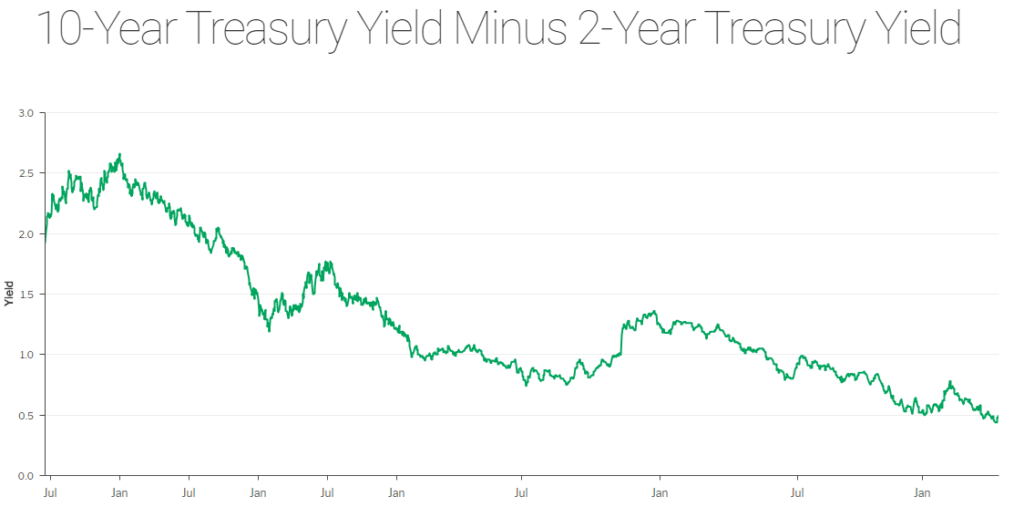
Dating back to 1975 everytime the yield curve has completely flattened a recession has occurred.  Given the economy seems to be chugging along nicely I don’t believe we’ll see a recession in the near-term.  Therefore, I think the longer end of the yield curve will rise. Translation: I believe mortgage rates are poised to increase as the year goes on.

The Week Ahead

There are a lot of significant economic reports due out this week that can influence the direction of mortgage rates.  

Earlier today the National Association of Realtors reported that existing home sales were stronger than expected.  A lack of inventory continues to be a challenge in the housing market and therefore median home prices continue to rise.  

We will learn more about home prices rising on Tuesday when the latest Case-Shiller home price index is reported.  Also on Tuesday is consumer confidence and new home sales.

At the tail end of the week we’ll get readings on durable goods, gross domestic product, and the employment cost index.

Current Outlook: locking bias
Rates end Q1 on a positive note but higher rates likely later in the year

At the end of her life my wife has already decided to be buried at the golf course so that I visit her multiple times per week.  It’s’ Masters week which means my productivity at work will decline significantly starting Thursday.

Quarterly Report

Interest rates had a tough start to the year increasing by approximately .50% during the first seven weeks.  Peaking on February 21st mortgage rates have since flattened and even improved modestly.

For the quarter mortgage rates increased by about .375%.

Yield Curve

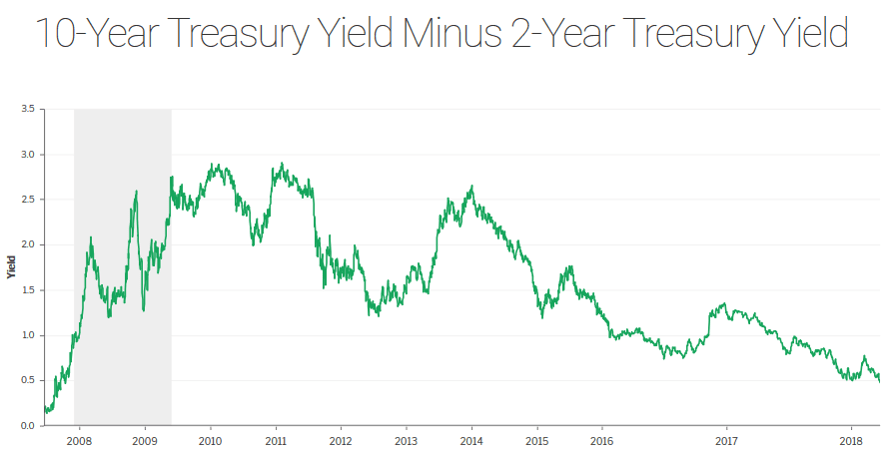
The yield curve is at the flattest point since 2007.  The yield curve measures interest rates over a variety of durations.  The chart below depicts the difference between the yield on the 2-year and 10-year treasury notes.  As the difference declines the yield curve gets flatter.

A flat yield curve is thought to forecast either an economic slowdown or higher long-term interest rates in the future.  Given that the economy appears to be stable I think we are in for higher mortgage rates later in the year.

US Stocks

Home loan rates are currently benefiting from volatility in the US stock market.  Equities are off ~2% again today as investors fret over the possibility of trade wars with China and regulatory backlash on tech companies.  When stocks do poorly interest rates tend to benefit.

The Week Ahead

It’s the first week of a new month so we’ll get the all-important jobs report this Friday.  Analysts are most interested in average hourly earnings which has remained sluggish despite low unemployment.  A higher reading for hourly earnings would be unfriendly to mortgage rates. The remainder of the economic calendar is light.

Mortgage rates are presently at the lower end of their recent range so I will recommend locking.

Current Outlook: locking

A busy week for housing, for home loan rates 2.91% is key

One of my favorite days of the year took place on Saturday when Berkshire-Hathaway released its annual shareholder letter.  If you have never partaken in Warren Buffett’s simple, humorous, and sage advice I encourage you to dive in HERE.  Have kids?  This is all the financial education you need to give them.

Mortgage Rates

Mortgage rates held steady last week and even improved modestly for 30-year fixed rate amortizations.  I had written about the significance of the US 10-year treasury note yielding 2.91%.  Fortunately that technical level did hold and today it is trading at 2.86%.  As long as it trades below 2.91% I expect mortgage rates to hold steady (and possibly improve?).

Housing Data

This week’s economic calendar will tell us a lot about housing.  Earlier today new home sales were reported below economists’ expectations.  However, they are coming off record highs reported in November of 2017.

On Tuesday we’ll see the most current home price index reports from Case-Shiller and the FHFA.  On Wednesday the National Association of Realtors will release the latest pending home sale report.

The Fed

New Fed Chairman Jerome Powell will address lawmakers on Capitol Hill for the first time on Tuesday and Thursday.  Larger projected government spending deficits have increased speculation that inflation pressures will rise.  Inflation is the primary driver of home loan rates so we will be listening closely to his comments.

The Outlook

As long as the yield on the US 10-year treasury note remains at or below 2.91% I feel comfortable floating.  However, longer-term trends are still concerning so my advice is use caution this week.

Current Outlook: cautiously floating

What, when, why mortgage insurance?

Video Transcription:

Hi! Evan Swanson here to talk to you today about mortgage insurance. What is mortgage insurance, when is it required, and why do banks require it?

First, what is mortgage insurance? Mortgage insurance is insurance that homeowners pay for, and the bank is the beneficiary to the insurance coverage. It protects the bank against losses they would incur in the event of default or foreclosure on the mortgage they make.

When is mortgage insurance required? On conventional loans, mortgage companies typically require mortgage insurance whenever there’s less than 20% down. On FHA loans mortgage insurance is required regardless of down payment.

Why do banks require mortgage insurance? To answer that question we have to go back and look at what banks required prior to mortgage insurance. Banks required that everybody have 20% down and the idea was in the event of a foreclosure the bank would have incurred losses and that means they would have missed out on mortgage payments for somewhere between six and 18 months, meaning missed interest income.

If a person can’t afford to make their mortgage payments chances are they can’t afford to maintain the property so once they get the house back via the foreclosure process there’s deferred maintenance the bank has to pay for. The bank would have had to hire an attorney to execute the foreclosure process and then hire a realtor and pay a commission in order to sell the house. The banks require 20% down as their cushion to ensure that if they had to go through that foreclosure process they can still get their loan proceeds back.

Now there are a variety of ways to pay for mortgage insurance but without 20% down banks are going to require it.

If you’re curious about the different mortgage insurance options available to you and want to learn about them I’d love to be your resource for you. Please contact me today. Thank you.

Can a cosigner help me qualify for a mortgage?

I often get asked if a cosigner can help a person qualify for a mortgage.  As is often the case in the home loan industry my answer is “it depends”.

Cosigners and poor credit

Can a person use a cosigner to overcome low credit scores?  Unfortunately, the answer is no. That’s because a mortgage underwriter will default to the lower of the two credit scores in a joint mortgage application.

For example, let’s assume we receive an application from a homebuyer who has a credit score of 550 which is too low to qualify for a conventional loan.  If their parents, who happen to have excellent credit scores, submit an application as a cosigner it does not change the credit decision because the underwriter will still use the 550 credit score in evaluating the application.

When cosigners can help

Typically, cosigners are included with a loan application when a person does not have enough qualifying income to be approved for a loan.

Let’s assume we have a homebuyer who is in a new career and does not have sufficient history of earning their income according to underwriting guidelines.  In that instance they may ask a parent or sibling to cosign.  We can then measure the cosigner’s income and existing obligations and use additional cash-flow to help the homebuyer qualify.

Cosigners and down payment help

Regarding down payments, theoretically a cosigner can help with a down payment for a homebuyer.  However, most loan programs allow for gift funds from family so there’s really no reason to go through the trouble of having the family member cosign if they’re not required to.

Primary residence only

Cosigners can typically only be used on a loan that is connected to a primary residence, not for buying rental property.  Furthermore, most jumbo mortgage loan programs have restrictions against using cosigners even if the loan is being made on a primary residence.

Cosigners be aware

Cosigners need to know that they are going to be obligated on that mortgage and that the account will show on their credit record.  Regardless of any agreements between the homebuyer and cosigner if any party fails to make payments on the home loan and causes a default that negative credit information will appear on both party’s credit reports.

If you have questions about qualifying for a mortgage or using a cosigner for your own situation, I would love to be a resource. Contact me today for a no obligation conversation.

Despite stock market losses home loan rates rose last week

The winter Olympics are fully underway in South Korea and I find it inspiring to watch all the athletes who have trained tirelessly for the past four years to compete for gold.  My idea of training?  I named my dog six miles so I could tell people that ‘I walked six miles today’.

Typically when stocks perform poorly interest rates benefit.  Last week the US stock market lost ~5% of its value yet interest rates continued to march higher.  Why?

S & D

I wrote about the topic last week and I am going to harp on it again.  One of the primary factors pressuring interest rates higher is supply and demand.

The supply of US Treasury notes is expected to increase following passage of the tax reform bill and the latest two-year federal budget.  Both create substantial deficit spending which will have to be financed with a greater supply of US debt.

Meanwhile, demand for US Treasury securities is expected to decline as central banks around the world cut back on quantitative easing measures which are a legacy of the great recession.

An increase in supply met with a decrease in demand drives prices lower which in turn pressures yields higher.

Four-year highs

The average rate for a conventional 30-year fixed rate mortgage is now at the highest level since 2014.  15-year fixed rate loans are at the highest level in over five years.

Since September mortgage rates have increased by over .50%.  A .50% increase to interest rates has the same impact on mortgage payments as home appreciation of 6%.  In other words, even without appreciation homes “feel” more expensive for buyers.

Interestingly, according to a recent survey only 6% of respondents said they would cancel their plans to buy a home if mortgage rates surpassed 5%.

The week ahead

The meat of this week’s economic calendar kicks off Wednesday with retail sales and the Consumer Price Index.  On Thursday we’ll get industrial production and the homebuilders’ index.  On Friday we’ll see housing starts and consumer sentiment.

The technical outlook is mixed.  Interest rates are currently trading at important technical levels that could help them reverse and move lower.  However, recent momentum is too much for me to ignore so I will maintain the locking position we;ve held for the past month.

Current Outlook: locking

How home affordability is impacted by higher mortgage rates


As you may be aware mortgage rates are on the rise which is negatively impacting home affordability.

Over the past five weeks average fixed rate home loan rates have increased by ~.50%.  Many analysts think that rates will continue to rise for the remainder of the year.

How much does higher interest rates impact home affordability?  Take a moment to watch the video below for an explanation.

A .50% increase to mortgage rates effectively translates to a +6.3% increase to home prices.

In other words, a +.50% increase to interest rates for a conventional 30-year fixed rate mortgage has the same impact on monthly payments as if interest rates were unchanged and homes were 6.3% more expensive.

If rates should increase by an additional .50% over the remainder of the year this would make homes ~12% more expensive even homes don’t appreciate as a result of the basic tenets of supply and demand.

Given that many analysts think both mortgage rates and home prices are expected to increase for the remainder of 2018 it may be significantly less affordable to buy a home in the future than it is today.

Are you curious to learn about the options you have to purchase a home today?  Contact us for a no obligation review.

Decreasing demand and increasing supply causes mortgage rates to rise

Congratulations to the Philadelphia Eagles who won their very first Super Bowl Championship yesterday.  As for the Patriots, do you know the difference between a New England fan and a carp?  Answer: One is a bottom-feeding, scum sucker, and the other is a fish.

Mortgage rates continue to march higher.  I know this may seem repetitive but it’s not like we didn’t see this coming (see HERE, HERE, and HERE).

Supply & Demand

The basic concept of supply and demand can explain why we’re witnessing home loan rates rising.  Rates are effectively determined by the price of mortgage-backed bonds (MBS’s).  When the price of bonds fall then mortgage rates rise and vice versa.

The Federal Reserve

Starting in 2017 the Fed began to unwind the balance sheet which they accrued during the aftermath of the housing crash.  The Fed had been investing billions of dollars per month into the fixed income market including MBS’s.  In the absence of the Fed’s investment demand for MBS’s has declined pushing prices down and yields up.

European Central Bank

The US central bank was not the only entity dumping money into quantitative easing (QE) measures following the recession.  The European Central Bank followed the US’s lead and became a major investor in the European fixed income market.  They recently discontinued their QE and that has also drawn demand away from the US further pressuring prices down and yields up.

Higher deficits

Not only is demand for fixed income securities declining but the US government will be increasing the supply of US Treasury notes and bonds in the coming years in order to fund the recently passed tax cuts.  Should congress and the president also sign an infrastructure bill into law we could expect to see higher deficits and a greater supply of fixed income securities competing with MBS’s.

The bottom line is that we are in an environment where the demand for MBS’s has declined and the supply of competing debt securities is increasing.  As a result yields are rising.

I expect this trend to continue in the immediate term.  I think mortgage rates will worsen by another .125%-.25% before stabilizing.

Current Outlook: locking

State of the Union speech may pressure mortgage rates higher

On Tuesday President Trump will deliver the annual State of the Union Address to Congress.  Some people think that Congress should work towards increasing the Federal minimum wage.  If anyone knows about doing the minimum for their wage it seems like a great place to start.

What legislative priorities will the President focus on in his speech? Any emphasis on infrastructure spending could add fuel to the fire in terms of mortgage rates increasing.

The tax reform law which passed in December has already added $1.5 trillion in deficit spending over the next decade.  Additional infrastructure investment without means to pay for it would put further pressure on interest rates to move higher (CLICK HERE to learn how).

Interest rates are currently at the highest levels since April of 2014.  There are a variety of factors contributing to higher home loan rates.

Notably the Fed has been hiking short-term interest rates for the past couple years and the longer end of the yield curve has remained flat.  It appears longer durations are following suit.

In addition, although inflation measures remain tepid the economy is growing and unemployment is near historic lows.  Speaking of employment we’ll get a new all-important jobs report this Friday.  The markets are currently expecting ~190,000 new jobs.

On Tuesday the latest S&P Corelogic Case-Shiller Home Price Index will be released as well as Consumer Confidence.

This column has been recommending a locking position ever since the US 10-year treasury note eclipsed 2.50% back on January 10th.  Since then mortgage rates have increased by .25%-.375%.  I continue to recommend a locking stance.

Current Outlook: locking

How much can I afford for a mortgage?


Transcript of Video:

Hi. I’m Evan Swanson, mortgage professional and certified financial planner based in Portland, Oregon.

Today I’m going to help answer a question we get frequently, which is how much house or how much mortgage can I afford?

What I’ve done is prepared a hypothetical scenario that we’re going to use to help answer that question. What you can see on the screen here is what we call a Debt-to-Income Calculation for our hypothetical couple; Mary and Joe. The Debt-to-Income Calculation, also referred to as Debt-to-Income Ratio, is a calculation that we make for all loan applications that come through the pre-approval process. What this calculation measures is cash flow on a monthly basis.

In the denominator I’ve listed Mary has a base salary of $5,000 per month gross, or $60,000 per year. Joe as well also has a job that pays him $5,000 a month gross, equaling $60,000 per year. Combined, they make $120,000 per year, which equates to $10,000 per month in qualifying income.

In the numerator, we list their existing obligations. You can see here that Mary has a student loan with monthly payments of $350. Joe has an auto loan with monthly payments of $350. Then there’s some credit card debt here with a small balance and payments of right around $100 per month. In terms of their existing obligations, they pay about $800 per month in existing payments.

In terms of measuring that cash flow, from an approval standpoint most banks are going to allow for 50% of the applicant’s qualifying income, less their existing obligations, to go towards a mortgage payment. So what this calculation does for us over here is calculates that their maximum monthly PITI or mortgage payment would be $4,199.

I think we can all agree here that that level of payment for a couple making $120,000 per year is probably a little bit too expensive. It’s not a prudent decision, it wouldn’t allow them to accomplish other financial goals. In the financial planning community, we typically like to see a couple spending no more than 28% of their gross income on a housing payment. Simple calculation, that works out to be $2,800 per month. In terms of what we call a back end ratio, which takes into account the monthly mortgage payment and their existing obligations, we like to see no more than 36%.

Now in this example, it’s the same number. In other words, 36% of their income less the existing obligations, leaves $2,800 per mortgage payment.

From a financial planning perspective, we would like to see this couple keep their payments at $2,800 or less, the idea being that roughly one third is allocated to housing, a third goes to taxes, and a third can go to savings, consumption, and other needs.

Hopefully that helps you understand your situation. Feel free to email or contact me. Let me be a resource for you. Have a great day.