The stock market rally is not helping home loan rates

On this day in 1803 President Thomas Jefferson requested funding from Congress for the Lewis and Clark expedition.  The funding package was for $2,500 in 1803 dollars which equates to $52,252 in today’s dollars.  Any guesses as to whether or not our current government could accomplish the same feat as cheaply?

Government expeditions aren’t the only thing that have become more expensive.  Just take a look at the stock market.  Earlier today the Dow Jones Industrial Average (DJIA) eclipsed 26,000 for the first time.

Only seven trading sessions have passed from when the DJIA eclipsed 25,0000.  Should it close above 26,000 later today it would be the first time in the market’s 120-year history that it has increased by 1,000 points this quickly.

Typically, when stocks rally it hurts mortgage rates because it encourages money to flow out of the bond market and into equities.  As we know mortgage rates have increased by ~.25% over the past few weeks and the stock market has had an influence.

Momentum in the stock market suggests that home loan rates will have a difficult time moving lower in the near-term.  I think the best we can hope for this week is for them to remain constant and I won’t be surprised to see them edge higher.

In my personal opinion US stocks are currently overvalued as compared to long-run valuation comparisons (see HERE) but that doesn’t mean we’ll see a near-term correction.

For now I recommend locking.

Current Outlook: locking
US 10-year treasury breaks 2.50%, mortgage rates at risk of moving higher

I warned in yesterday’s post (see HERE) that, “if the yield on the US 10-year treasury note breaks through 2.50% then watch out. I would expect mortgage rates to worsen by another .125%-.25%.

This morning yields have broken above 2.50% which is not a favorable sign for home loan rates.

There are a variety of factors contributing to the move higher in rates including an expectation for less monetary stimulus in Japan and Europe, growing inflationary pressure, and economic optimism.

It is possible that yields reverse and move back below 2.50% but if that does not happen today and the market closes above this threshold then it will be more difficult for that take place in the near-term.

At this point I would recommend loan applicants lock their rates (if they are able) if they haven’t already.

US 10-year treasury note holds key to mortgage rates this week

On this day in 1947 a mother walked into a hardware store in Tupelo, Mississippi and purchased a guitar for her 11-year old son’s birthday.  It was his first guitar and the $6.95 investment turned out to be a pretty good one.

In 2004, the son’s estate sold for ~$100 million which equates to a 33.5% annualized return.  The power of compound interest brought to you by Elvis Presley.

Mortgage banks only wish they could earn a return of 33.5% on their loans.  Rates did tick up last week (modestly) but at today’s 30-year fixed rates it would take 401 years for a $6.95 investment to turn into $100 million.  Who’s got time for that?

This week’s economic calendar is relatively light.  The highlights include a 10-year treasury note auction on Wednesday, jobless claims on Thursday, and the Consumer Price Index (CPI) on Friday.

Inflation is the primary driver of mortgage rates so any signal that price pressure is increasing in the CPI would not be favorable.

From a technical perspective I am keeping a close eye on the US 10-year treasury note (which home loan rates tend to track).  It is currently yielding 2.48%.  It has not traded above 2.50% in nearly a year. Recent attempts to break through 2.50% have resulted in lower interest rates.

If the yield on the US 10-year treasury note breaks through 2.50% then watch out.  I would expect mortgage rates to worsen by another .125%-.25%.

However, if they can hit 2.50% and bounce lower then we may see mortgage rates improve by .125% or better.

Current Outlook: floating as long as the US 10-year treasury note yields less than 2.50%.  

Advancement of tax plan expected to pressure mortgage rates higher

If you’re looking for something to celebrate this week look no further.  On December 5, 1933 the 21st Amendment to the US Constitution was ratified effectively ending prohibition.  Fast forward to 2017, Oregon’s brewing industry contributes $4.49 billion to the state economy and directly/ indirectly employs over 30,000 people.  I can toast to that.

Republicans are toasting their advancement of tax overhaul legislation.  The Senate narrowly passed their version of the tax bill which will now be reconciled with the House version.

The Tax Plan:

The new tax plan is bad for mortgage rates on a couple levels.

First, passage of the new tax laws is expected to add ~$1.4 trillion to the Federal debt over the next ten years.  In order to fund the deficit the US Treasury will have to issue an equal amount of debt which will crowd out other borrowers and push yields higher.

Second, the new tax cuts are expected to promote economic growth which is good news for stocks.  The Dow Jones Industrial Average has increased by over 1,000 points in the past week and is trading at all time highs.  When stocks rally it tends to push interest rates up.

Jobs Week:

It’s the first week of a new month which means we’ll get a fresh all-important jobs report this Friday.  The markets are currently expecting ~+190,000 new jobs created during the month of November.  A figure significantly better than that would put upward pressure on mortgage rates and vice versa.

The Fed:

The next monetary policy meeting is scheduled for next week with an announcement set for December 8th.  There is currently a 90% probability that the Fed will hike short-term interest rates by +.25%.

In other words, the home loan rates you see today already assume a rate hike.  Please help consumers understand that mortgage rates will not automatically increase next week on account of this action (they could move higher for other reasons).  The Fed does not directly set home loan rates but their comments and actions can cause volatility.

Given the momentum of the tax plan I recommend locking in.

Current Outlook: locking

A busy economic calendar and potential vote to drive mortgage rates

Happy Birthday to John Burr Williams who would have turned 117 years old today!

In case you’re not familiar with that name (see HERE) he wrote a book called The Theory of Investment Value in 1938 which is widely regarded as the foundation of “Fundamental Analysis”.  His theories are critical to evaluating investments in real estate (and other assets).

Mortgage rates are essentially sideways from last week which is good news given the fact that US stocks traded at all-time highs.

Following a relatively quiet economic holiday week the calendar is jam packed for the next few days.

Housing in the news

Earlier today new home sales were reported and were much stronger than expected (+6%).  The pace of new home sales is currently at the highest level in 10 years!

Tomorrow we’ll get the latest S&P Case-Shiller Home Price Index and on Wednesday we’ll see pending home sales from the National Association of Realtors.

Inflation and the Fed

On Thursday the Personal Consumption Expenditure price index will be released which is the Fed’s favorite gauge of inflation.  Analysts do not expect a large uptick in inflation but if prices rose at a faster clip than is expected it would likely hurt home loan rates.

The Fed is widely expected to raise rates when they meet in a couple weeks.  Since the markets are already expecting this action that move will not impact mortgage rates (despite what the media coverage says).

Tax reform?

The big question is whether or not the Senate will vote on the tax overhaul bill.  Should legislation pass it is assumed that the stock market will benefit which would likely hurt mortgage rates.

From a technical perspective interest rates appear to be in a sideways pattern.  Unless it appears that tax legislation will be voted on and pass I will maintain a floating bias.

Current Outlook: cautiously floating

I want to buy a rental, how much down payment is needed?

With real estate prices and rents booming across the Portland, Oregon metro region over the past few years, it is no wonder that so many people have become interested in purchasing investment property.  However, it seems that many would-be investors are not aware of the down payment requirements for buying a home that they intend to rent.

This post was written in November of 2017 and the facts below can change so it’s always best to check in with me to see if these requirements are still accurate.

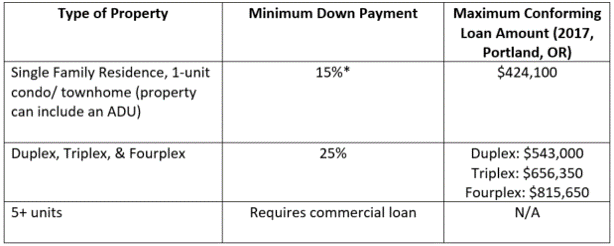
This post is focused on conventional conforming loans for home purchases (excludes refinances) where the buyer intends on renting out the property.  The minimum down payment required depends on the type of property an investor is purchasing:

table illustrating minimum down payment for investment property purchase

*Although one-unit investment property purchases only require a 15% down payment, a homebuyer will have to obtain private mortgage insurance with less than 20% down which can prove costly and upset the feasibility of the investment.

Also, it’s worth noting that an investment property purchaser who puts 25% down or more will obtain a fixed interest rate that is ~.375% better than if they put less than 25% down.  Therefore, stretching to 25% down can greatly improve the financial performance of the investment.

This post is written from the perspective of explaining the minimum down payment required to qualify for a loan.  Just because a lender says you qualify doesn’t mean the loan or investment is prudent.  Additional analysis should be completed to determine if the investment is suitable given your level of down payment (I can help with that but won’t take up that topic in this post).

Next, let’s outline what sources are acceptable forms of down payment capital.  The most common forms of down payment we see are personal checking/savings accounts, investments, mutual funds, inheritances, retirement account loans, and loans against equity in homes already owned.  Again, just because a source of capital is acceptable does not mean it is “suitable” and every applicant should consider the trade-offs associated with their transaction.  Gift funds are not an acceptable source of down payment when purchasing an investment property.

Underwriting requirements will also require that the applicant have left over capital “in reserve” when purchasing an investment property.  Those requirements will change applicant-to-applicant so it’s best to talk to us about the particulars of your situation.

There is no question that owning investment real estate can help families generate wealth in the long-term.  I’d love to help you determine if owning a rental property is right for you.  Please contact me if you’d like to learn more.

Mortgage Rate Update October 30, 2017

My father-in-law once told me, “there is nothing more permanent than a temporary tax.”  Speaking of…. property tax statements for homes in the tri-county area are arriving in mailboxes as I type and most are increasing by greater than 3% this tax year.  I recommend reading THIS PIECE for an explanation.  If your customers have not pinged you yet on this topic I suspect some will soon.

As I wrote about last week mortgage rates have been on a brutal ride higher ever since the beginning of September.  Might we get a reversal this week?  So far so good.  Rates have stabilized this morning and pricing has improved since last Thursday.

It is an extremely busy week on the economic calendar.  Earlier today we got the latest reading of the Personal Consumption Expenditure price index.  It showed that core prices (“core” strips out volatile food & energy items) increased by only 1.3% from last year.  This is well below the Fed’s target of 2% and a friendly number for interest rates.

On Tuesday we’ll get the latest reading of consumer confidence and the Fed’s monetary policy meeting begins.  On Wednesday we’ll get the Fed’s statement (not expected to hike rates) and the ADP private payroll report.  On Thursday we get initial jobless claims and on Friday the all-important jobs report.

From a technical trading perspective mortgage rates are trading at important layers of support/ resistance.  They could break out either direction.

Current Outlook: cautiously floating

Mortgage Rate Update October 10, 2017

The bond markets were closed yesterday in observance of Columbus Day.  According to historians Christopher Columbus was not the first European to sail across the Atlantic Ocean.  Norse Viking Leif Eriksson allegedly reached present day New Foundland, Canada  in 1000 AD.

If you are an observer of the stock market then you know that this is not the first time that the S&P 500 has reached 30 as measured by its cyclically adjusted price earnings ratio (CAPE).  The concern is the last two times it sailed to these heights was 1929 and 1999 and we all know how that ended.

The Economist Magazine ran a great piece over the weekend (see HERE) addressing asset prices.  It provides explanations for why the CAPE is at lofty levels and why it may not translate into a crash.  However, in the same article they provide reasons for why interest rates may rise.  The main culprit?  As I have written repeatedly on this blog it is expected to be the Fed unwinding its balance sheet.

Speaking of the Fed the financial markets are currently pricing in a 90% probability that they will hike short-term interest rates in December.

Last week’s jobs report was a stinker.  The US economy shaved 33,000 jobs during the month of September but investors are ignoring the results because of the hurricanes.

The highlights for the economic calendar this week include the producer price index on Wednesday and retail sales/ consumer price index on Thursday.  Momentum is not on our side so I will maintain a locking bias.

Current Outlook: locking

Mortgage Rate Update October 2, 2017

It is with a heavy heart that we acknowledge the horrible shootings in Las Vegas this morning.  It is my hope that our leaders can act in a meaningful manner to prevent these events in the future.  That is the greatest honor we can pay the victims.

Mortgage rates were mostly steady last week.  Mortgage note rates are unchanged but the underlying pricing worsened meaning consumers are having to pay modestly higher closing costs at these rates.

Given the shootings in Las Vegas investors are feeling understandably cautious.  Also fueling this sentiment is a non-legally binding vote in Spain.  Voters in the Catalonia region have voted overwhelming to secede from Spain.  The Spanish Federal Government is not required to accept the results.  Uncertainty tends to help US interest rates remain low.

Working in the opposite direction is the GOP tax plan.  As the tax legislation currently stands over $1 trillion would be added to the US deficit in the next decade.  Higher US deficits “crowd-out” non-governmental borrowers (including homebuyers) and causes rates to move higher.

It is the first week of a new month which means the all-important jobs report is due out on Friday.  Market expectations are only for 95,000 new jobs as the recent hurricanes are expected to have taken a toll on new hiring.

I think mortgage rates have a greater likelihood of increasing from current levels than decreasing so recommend a locking bias.

Current Outlook: locking

Mortgage Rate Update September 25, 2017

We are officially in Autumn as of Friday when the Earth’s equator passed through the center of the Sun’s disk.  On an equinox the duration of the day and night are approximately equal all over the globe.  Although the season will be turning to fall I don’t anticipate mortgage rates to fall drastically anytime soon.

Although this leaf is soon to fall I don’t expect mortgage rates to follow suit.

In case you missed it the Fed did follow through last week and announce plans to unwind their ~$4.5 trillion balance sheet.  According to the announcement the Fed is expected to reduce the size of their balance sheet on a monthly basis at a pace which will take approximately 7 years to completely liquidate (although they are not likely take the program that far).  This pace is mostly in line with expectations and therefore mortgage rates did not react in a significant manner to the speech.

As I have written repeatedly I believe mortgage rates are far more likely to increase from these levels than they are to decrease given the aforementioned information.

Presently, geopolitical events are preventing US mortgage rates from increasing.  Preliminary German election results show established parties, including Chancellor Angela Merkel’s, receiving the lowest share of the overall vote in the post-World War II era.  Not surprisingly extreme-right populist parties are faring better than expected.

US-North Korean tensions continue to encourage a “flight-to-safety” trade which US interest rates benefit from.

This week the economic calendar is full of fresh housing data.  I will shift to a neutral position in the near-term but favor a locking bias long-term.

Current Outlook: neutral