Follow Up: Housing Affordability In Portland

Last week I posted an article which highlighted the (welcome) perspective from the state of Oregon’s Office of Economic Analysis that housing affordability will reach an inflection point this year.

It turns out that the chief economist for the aforementioned office delivered a talk to the City Club of Portland a couple weeks ago. His talk can be seen in the you tube video below. 

His comments on housing start at the 9:00 mark and last for approximately 10 minutes.

Do you agree with Mark’s comments on the housing market? What is your perspective? Please feel free to add your thoughts in the comment section.

Mortgage Rate Update January 23, 2017

Mortgage rates are mostly unchanged from last Thursday’s ‘rate update’.

Will President Trump’s policies help or hurt our economy?  This is one of the primary questions the financial markets are dealing with right now.

On one hand a large infrastructure investment would provide fiscal stimulus that would certainly create growth and possibly pressure mortgage rates higher.

What economic policies will the new administration draft up?

However, on the other hand an anti-free trade platform is likely to hurt economic growth which could help mortgage rates.  I expect the markets will continue to see-saw until additional details are presented.

The economic calendar is fairly light this week.  The highlights include existing home sales (Tuesday), new home sales (Thursday), and Gross Domestic Product (Friday).

From a technical perspective mortgage rates are improving gradually compared to Friday so I will recommend floating.

Current Outlook: floating

Mortgage Rate Update January 19, 2017

Well, after a nice 5-week run mortgage rates ticked higher yesterday giving away half the improvements they gained on the way down.

The culprit?  Fed Chairwoman Janet Yellen delivered a speech yesterday in which she stated that Fed officials expect to raise short-term interest rates “a few times a year” through 2019.  This was more aggressive than her previous public comments and leads the markets to believe that inflation expectations may be higher than anticipated.

Speaking of inflation expectations, the Wall Street Journal ran THIS STORY yesterday which confirms just that.  The spread between US treasuries and inflation protected treasuries has been widening signaling that investors believe inflation will be higher in the future than it presently is.  Inflation is the primary driver of mortgage rates.

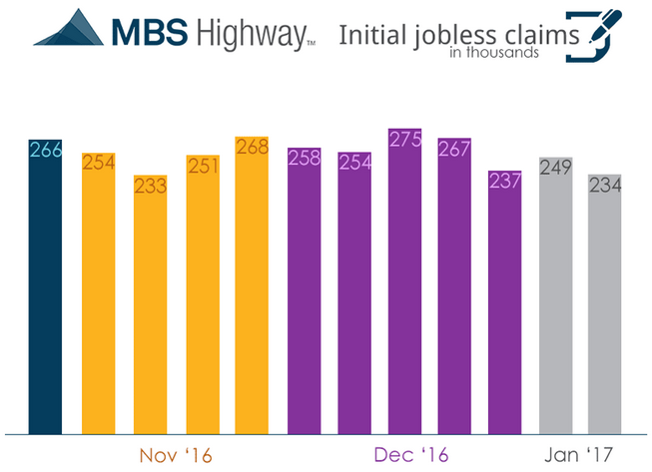
The jobs picture continues to be strong both nationally and locally.  This is bad news for mortgage rates but good news for housing demand.  The number of Americans filing for initial jobless claims fell last week to one of the lowest levels on record.

Furthermore, it was reported that Oregon’s unemployment rate fell to 4.6% which is down nearly 1% from last summer.

All in all the momentum has shifted against us.  Fortunately we remain within a technical range of trading so we could see rates improve off these levels.  For now though I will shift to a locking bias.

Current Outlook: locking bias

Mortgage Rate Update January 17, 2017

Mortgage rates remain at the best levels following the election and about .25% improved from recent highs.

Inflation expectations is the primary driver of mortgage rates.  This is because inflation erodes the purchasing power of future interest payments.  Therefore, when lenders think inflation will rise in the future they charge higher rates of interest to compensate and vice versa.

Inflation is the primary driver of mortgage rates.

Following Donald Trump’s election investors expected higher inflation because of his campaign promises to increase government spending (infrastructure) while cutting taxes.  However, the financial markets are now tapering inflation expectations.

Inflation adjusted treasury yields (nominal yield minus current inflation) have declined to the lowest levels since the election and mortgage rates have also improved off recent highs.

Speaking of inflation the release of the latest Consumer Price Index is scheduled for tomorrow.  It has been trending higher as of late and if this trend continues then of course we’d expect upward pressure on mortgage rates.  Aside from the CPI the remainder of the week looks to be fairly quiet.

From a technical perspective the gradual improvement of interest rates over the past month may be running out of steam but for now we’ll try to remain on track.  I will continue to float but with a more cautious outlook.

Current Outlook: floating

Mortgage Rate Update January 12, 2017

Although mortgage note rates are unchanged today the accompanying closing costs are modestly lower so in fact the rate environment has improved slightly this week.

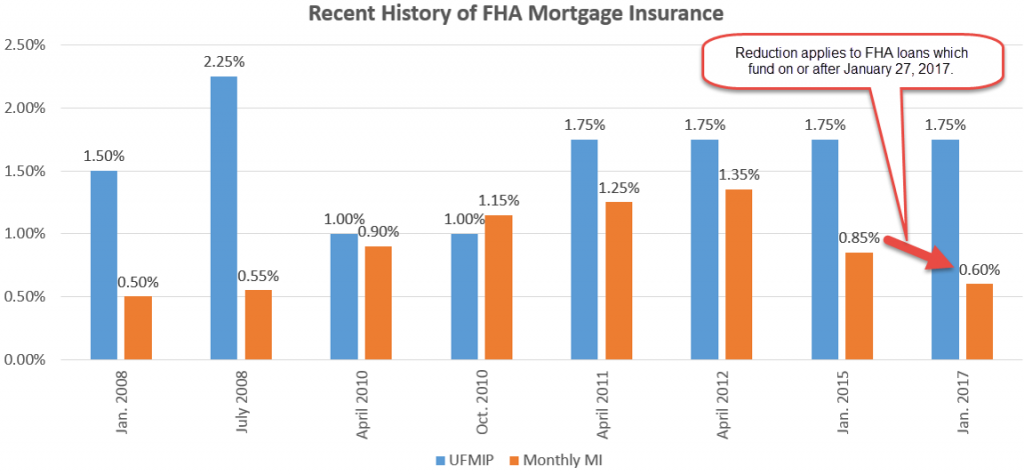
In case you missed it FHA announced Monday that FHA mortgage insurance premiums will be reduced beginning January 27, 2017.  If you ever work with FHA buyers then I would encourage you to read the details HERE.

Improved mortgage rates and lower FHA mortgage insurance premiums should help improve affordability but as we know affordability has eroded significantly in recent years.  Has housing reached an inflection point?  Read about and share your thoughts on the topic HERE.

Beginning in late November and again in mid-December I wrote that I thought the financial markets had overreacted to the results of the election.  It took longer than I hoped but it finally looks like the markets are reversing course.  I do not expect mortgage rates to drop to levels seen prior to the election but they have improved by .125%-.25% over the past couple weeks.  Let’s be thankful for that.

From a technical perspective momentum is on our side so I will maintain a floating position.  That said, if you have been floating for the past couple weeks it may not be a bad plan to lock in and take your profits off the table.

Current Outlook: floating

Will Housing Affordability In Portland Continue To Worsen?

There is no question that housing affordability has been one of the most talked about topics in the Portland area since the Great Recession. Rising rents and rising home prices have been a strain on many households across our region. 

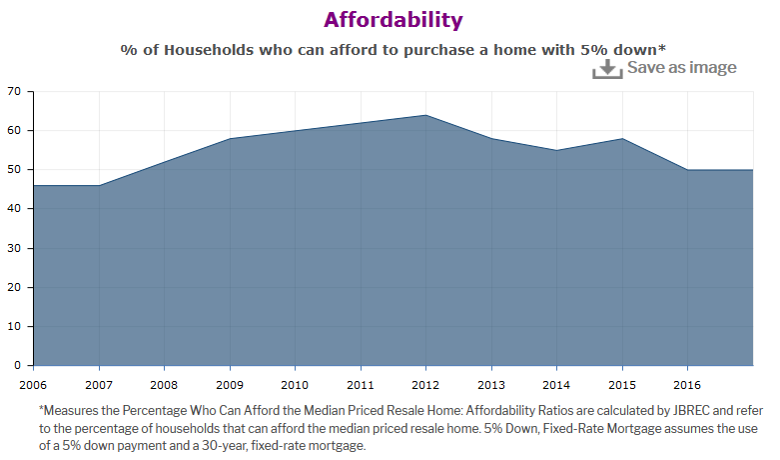
According to John Burns Real Estate Consulting, only 50% of Portlanders can afford a median priced home with a 5% down payment. This is down from ~63% in 2012 and is likely to go lower since the graph below does not take into account mortgage rate increases following the election.

Graph illustrating housing affordability in Portland from 2006 to 2017.

That said, nothing lasts for ever. Josh Lehner of the Oregon Office of Economic Analysis (@OR_EconAnalysis) wrote an article recently entitled The Housing Inflection Point, in which he argues that affordability has reached an “inflection point”

He is not saying that home prices will decline or that affordability will return to previous levels. He is simply stating that he believes that affordability will not continue to worsen.

“What I really mean is that affordability will stop getting worse. This goes for both ownership and rentals. Now, it may not improve considerably for some or even most households. And I do not expect affordability to suddenly return to previous levels, but it does mark a step in the right direction. A necessary but insufficient condition, if you will.” – Josh Lehner, Oregon Office of Economic Analysis

Lehner presents some very good data points, including the additional supply of apartments either already on or soon to be on the market (which should stabilize rents), additional housing inventory in Cooper Mountain/South Hillsboro/Clark County (which should slow home price appreciation) and rising household incomes. It’s definitely worth a read.

What do you think? Do you believe housing affordability in Portland will continue to worsen at a pace seen over the last five years? Will it improve? Please share your thoughts in the comment section.

Mortgage Rate Update January 9, 2017

Mortgage rates are effectively unchanged from last week.

As I’ve written countless times on this feed there is a common misunderstanding about the relationship between the Federal Reserve and mortgage rates.  The Fed does not directly control mortgage rates.

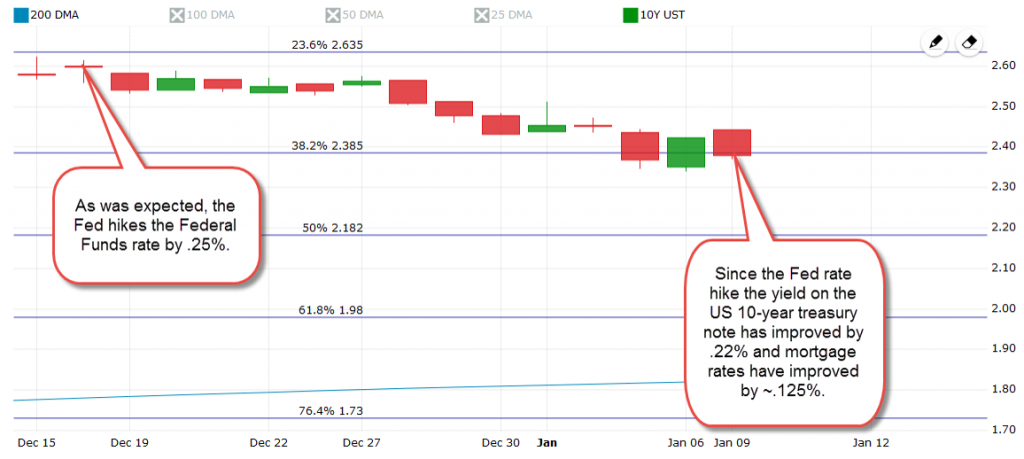
The most recent Fed hike, which took place on December 16th, is yet another example.  Since December 16th the yield on the US 10-year treasury note has improved as have mortgage rates (feel free to knock on wood as you read this).

Why?  It’s important to remember that when the Fed hikes short-term interest rates it is with the intention of curbing inflationary pressure.  Since inflation eats away at the profits for lenders Fed rate hikes can actually encourage improvements in longer-term interest rates.

The all-important jobs report that was released on Friday showed disappointing results for the number of new jobs created in December.  Normally this would be positive news for mortgage rates since bad news for the economy tends to be good news for interest rates.

However, the report also showed higher than expected wage growth.  Since last year average wages increased by nearly 3% which was above expectations.  Wage pressure can lead to inflation which we know is not a positive factor for mortgage rates.

This week’s economic calendar is fairly light until Friday.  On Friday we’ll get the latest readings for retail sales, the Producer Price Index, and the Consumer Price Index.

Current Outlook: floating

Mortgage Rate Update January 5, 2017

Happy New Year!  I hope you had a safe and joyous holiday season and that 2017 is off to a great start!

Mortgage rates are off to a good start.  As we know mortgage rates increased by .50%-1.00% following the election on expectations that the new administration would engage in aggressive fiscal expansion (increased spending and reduced tax revenue).

A larger government budget deficit requires that the US Treasury issue more debt.  The greater supply of debt drives prices lower on existing bonds which consequently drives yields higher.  Hence, mortgage rates rise as well.

However, mortgage rates have improved modestly this week for a couple reasons.

First, the financial markets are finally scaling down expectations for the new president’s fiscal expansion.  There are too many fiscal conservatives in Congress to allow for such a large increase in the deficit.

Second, tomorrow we get the all-important jobs report and expectations are that the results will be weaker than expected.  Bad news for the economy is often good news for interest rates.

From a technical perspective mortgage rates have momentum heading in a positive direction.  That said, we have to cautious because the longer-term trend is working against us.  I am going to recommend that we take our gains off the table and lock in ahead of tomorrow’s jobs report.

Current Outlook: locking

The impact of rising mortgage rates on purchasing power

As many prospective homebuyers are painfully aware mortgage rates have taken an acute shift higher since the election back in November.  Mortgage rates have increased by .50%-1.00% depending the loan program and down payment.  Depending on a prospective homebuyers approach this will impact people in different ways.

Lets look at an example of a homebuyer who is committed to a specific monthly payment of $1,600 per month for principal & interest or approximately $2,000 including property taxes and homeowner’s insurance (not an uncommon budget for the Portland-metro area).

The chart below shows the maximum purchase price that buyer would need to look within assuming a 20% down payment.
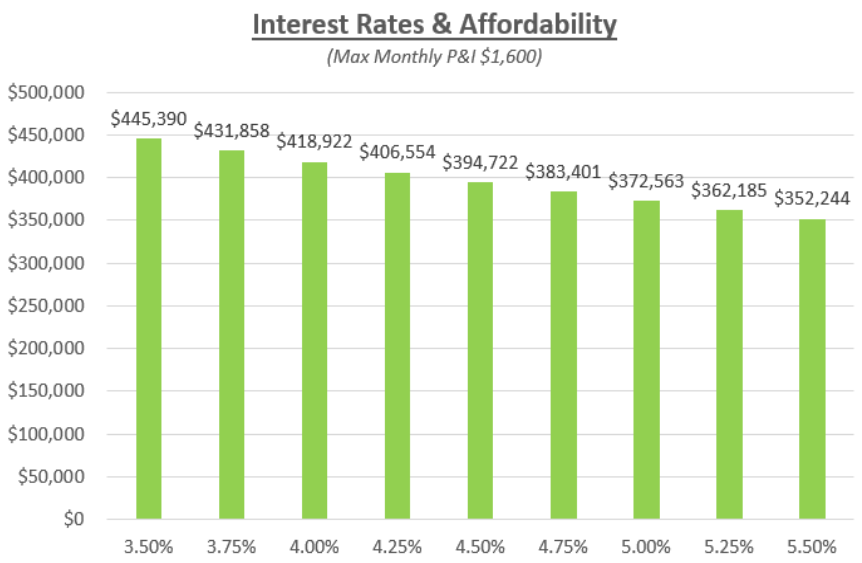
As you can see throughout the summer of 2016, when mortgage rates were in the 3.50% range, a homebuyer with this budget could look for a home in the ~$445,390 price range and maintain payments within their target budget.

However, as mortgage rates have increased closer to 4.50% today their maximum purchase price has declined by ~$50,000 to ~$394,722.  Effectively, a 1% increase in interest rates for a 30-year fixed rate mortgage reduces a homebuyers purchasing power by ~11%.

We do not know what the future holds for mortgage rates.  As I have written repeatedly as of late in my ‘rate update‘ category I happen to believe interest rates have overreacted to the results of the election.  If I am right then rates will reverse modestly lower and purchasing power will increase.

However, if I am wrong rates may continue to trend higher and homebuyers will need to either be willing to spend more per month or settle for less house.

Are you a prospective homebuyer?  If so, I would love to be a resource for you.  Please contact me for an initial phone conversation.

Mortgage Rate Update December 19, 2016

Housekeeping: This will be the last ‘rate update’ of 2016.  The next update will take place the first week of January.  Thank you for your interest in the content.  Have a happy and joyous holiday season!

Mortgage rates got stung following the Fed’s rate hike decision last week.

As expected the Fed hiked short-term interest rates by .25% on Wednesday.  As a reminder the Fed does not directly set mortgage rates but as we witnessed their comments can influence the financial markets.

In the Fed’s monetary policy statement they said they expect to hike short-term interest rates three more times in 2017.  This was more than the markets had been expecting and as a result long-term interest rates, including mortgages, moved higher.

Mortgage rates remained historically low throughout 2016 but ended on a sour note.

Both mortgage rates and the yield on the US 10-year treasury note have increased by ~.80% since election day.  I know I have been overly optimistic about a reversal for the past two weeks so I am hesitant to call one this morning but the markets are trading in our favor.

Strictly looking at technical trading signals the US stock market appears overcooked and interest rates appear ripe for a modest reversal.  Technical trading signals are often accurate but the timing of reversals can take longer than anticipated.  I recommend floating.

Current Outlook: floating