Mortgage Rate Update February 27, 2017

Shifting to a ‘floating bias’ on Thursday of last week has proved timely as yields have improved.  Speaking of floating today is National Polar Bear Day.  Apparently you can bake “cubcakes” if you really want celebrate.

As far as mortgage rates are concerned we are no longer floating.

Mortgage rates had a great ride last week but momentum appears to be shifting.  As the French presidential election draws nearer (scheduled to complete May 7, 2017) I expect that polling will be more and more significant for US interest rates.  Why?

Anti-European Union candidate Marine Le Pen is considered to be an anti-status quo candidate.  The financial markets like certainty.  Therefore, when Le Pen’s polling appears stronger US mortgage rates will improve on perceived uncertainty and vice versa.  Polling released over the weekend showed her down which is bad news for mortgage rates.

President Trump is scheduled to speak in front of a joint session of congress tomorrow afternoon.  Analysts are expecting that he will roll out a major policy initiative.  Depending on what that policy is it could impact mortgage rates.  Specifically, if he announces a major infrastructure package I would expect mortgage rates to worsen in reaction.

This week’s economic calendar is fairly busy with highlights on Tuesday (GPD) and Wednesday (Personal income & inflation).  Given that the technical trading picture has shifted I am going to recommend locking in now.

Current Outlook: locking

Mortgage Rate Update February 23, 2017

Despite there being a lot of noise mortgage rates are unchanged from earlier in the week.

There has been much speculation that the Trump administration will push Fannie Mae & Freddie Mac out of government conservatorship and return the companies to private shareholders.

But will they?  As industry expert Rob Chrisman laid out, imagine your son or daughter returned to your house during the recession and cut a deal with you that they would not be able to pay any rent to live under your roof in the near-term but once their financial conditions improved they would pass along their income to you and you could kick them out whenever you wish.  How quickly would you push them out if they were paying you ~$3 billion per month (not be confused with 3 brazilliion)?  Fannie & Freddie have now delivered profits to the US Treasury for 27 consecutive quarters.  The latest sum is a combined $10 billion.

Given the amount of money Fannie & Freddie are paying the US Treasury its hard to imagine a return to private shareholders.

The Dow Jones Industrial Average closed at a record high for the 9th consecutive day yesterday.  That has only happened five times since 1897 according to stock market legend Art Cashin.  Generally speaking when stocks rally it is bad news for mortgage rates.

Looking back at those five rallies though investors should be cautious.  Four out of the five aforementioned stretches led to stock market crashes (1929 & 1987) or prolonged bear markets (late 1960’s).  Should the stock market enter a down market now it would likely help mortgage rates remain low.

Lastly, minutes from the last Fed meeting were released yesterday.  The notes indicated that the Fed may act to raise short-term interest rates quicker than previously expected.  Their next meeting is March 14-15.  However, I’m not too worried because the Fed does not directly control mortgage rates and the Fed has a history of talking a big game but then not following through.

What was more substantial for me was the fact that they did not specifically mention any plans to curtail the reinvestment of principal prepayments back into the mortgage-backed bond market.  This will come at some point and when it does will likely cause mortgage rates to shift higher (see HERE to learn more).

Current Outlook: floating

Mortgage Rate Update February 21, 2017

The bond market was closed yesterday in recognition of Presidents Day.  Speaking of the nation’s top office, I read over the weekend that during the President’s daily briefing he was told that three Brazilian soldiers were killed overnight.  In reaction the president was stunned and showed an uncommon display of grief and emotion.  After collecting himself the president asked, “how many is a brazillion?”  (may or may not be true).

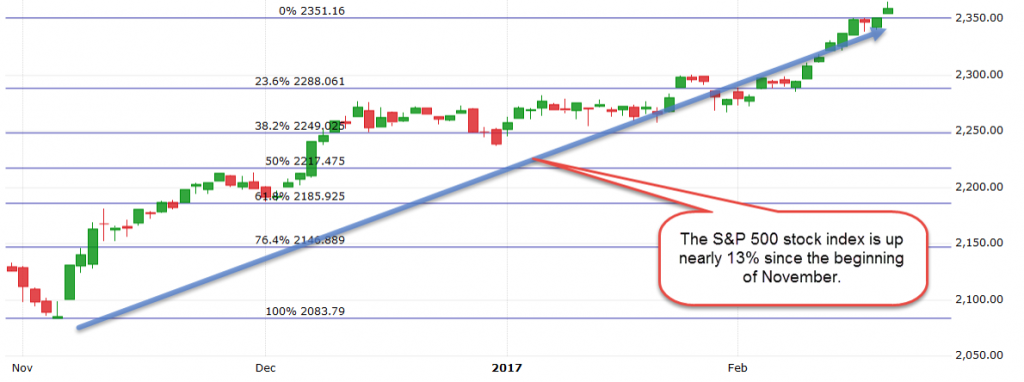
The ‘Trump Bump’ continues to roll on which is not favorable for mortgage rates (CLICK HERE to learn why).  Since early November the S&P 500 has gained nearly 13%.  During that time mortgage rates have increased by ~.50%.

Why have stocks been rallying?  First, investors anticipate legislation which will cut taxes and boost federal spending.  Second, higher anticipated inflation levels make holding bonds less attractive therefore some investors have cut fixed income holdings in favor of stocks.  Neither of these outcomes are certain.

Has the stock market become overheated?  According to data from FactSet the 12-month forward price-to-earnings ratio for the S&P 500 is at its highest level since 2004.  Furthermore, there is growing concern that France’s upcoming presidential election could rattle the global financial markets.  We’ll be keeping an eye on polls there.

The technical picture in the interest rate markets are a little muddled to start the week.  I am going to maintain a floating bias but have grown cautious.

Current Outlook: cautiously floating

Mortgage Rate Update February 16, 2017

Given that today is National “Do a Grouch a Favor Day” (seriously see HERE) I find it appropriate that mortgage rates are improving modestly this morning.  Mortgage rates are essentially unchanged from Monday which is a win given that pricing worsened Monday-Wednesday.

In case you missed it Fed Chairwoman Janet Yellen told congressional lawmakers that the Fed would likely hike short-term interest rates again at one of their upcoming meetings (prepare yourself for annoying mortgage radio commercials in the next few weeks which falsely claim that this will certainly lead to higher mortgage rates).

According to CME Group there is currently a 22% chance the Fed hikes at their March meeting and a 74% chance they hike by their June meeting.  The Fed does not directly control mortgage rates but their comments can influence them.

Why does the Fed hike rates?  The Fed has a dual mandate to “foster economic conditions that achieve both stable prices and maximum sustainable employment.”  Inflation data released yesterday showed that retail prices in the US jumped at the highest annual pace in nearly five years.  Fed rate hikes curb inflationary pressure.

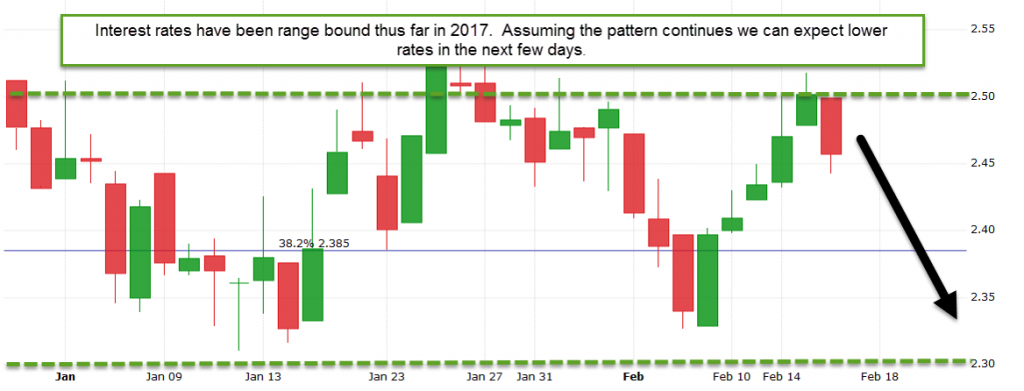
Mortgage rates have been range bound so far in 2017.  The chart below shows that the yield on the US 10-year treasury note, which mortgage rates tend to track, has ranged from 2.30% to 2.50%.

During this time conventional 30-year rate home loans have been offered at 4.125%-4.375%.  Assuming mortgage rates remain range bound the technical outlook looks good headed into next week.  I recommend floating to see if this pattern continues.

Current Outlook: floating

Mortgage Rate Update February 13, 2017

Mortgage rates worsened during the latter half of last week.

Mortgage rates will be looking for love tomorrow from Fed Chairwoman Janet Yellen.  She is scheduled to provide testimony to congressional lawmakers tomorrow and Wednesday.  Much like the origins of St. Valentine’s Day are not well understood neither is the relationship between the Fed and mortgage rates.

Mortgage rates are looking for some love from the Fed this week.

I am particularly interested to hear if Yellen will comment on when they might discontinue the practice of reinvesting principal repayments back into the mortgage-backed bond (MBS) market.

You might remember the term “quantitative easing” (“QE”) which was thrown around exhaustively from 2009-2012.  During this time the Federal Reserve essentially printed money and purchased, amongst other things, mortgage-backed bonds with the intent of driving interest rates lower.  Although the Fed is no longer actively engaging in “QE” they are using the principal repayments from refinances and home sales to repurchase/ replace MBS holdings which in effect helps to keep rates down.  If and when they discontinue this practice we could expect mortgage rates to worsen.

Looking at the rest of the economic calendar for the week we’ll get some fresh inflation data Tuesday and Wednesday, retail sales on Wednesday, and new housing starts on Thursday.

Unfortunately momentum is working against us so I will maintain a locking bias.

Current Outlook: locking

Mortgage Rate Update February 9, 2017

Mortgage rates continued to improve modestly this week and are currently at multi-week lows.  That said pricing is modestly worse this morning so momentum may be shifting.

With heavy snow covering much of the northeastern seaboard we have to be prepared for some volatility in the financial markets.  Its likely that fewer traders are able to make it into their offices and therefore we can assume there are fewer buyers and sellers which can lead to wider swings.

As I stated on Monday the economic calendar has been light this week.  In the absence of significant data mortgage rates tend to react to technical trading patterns and the stock market.

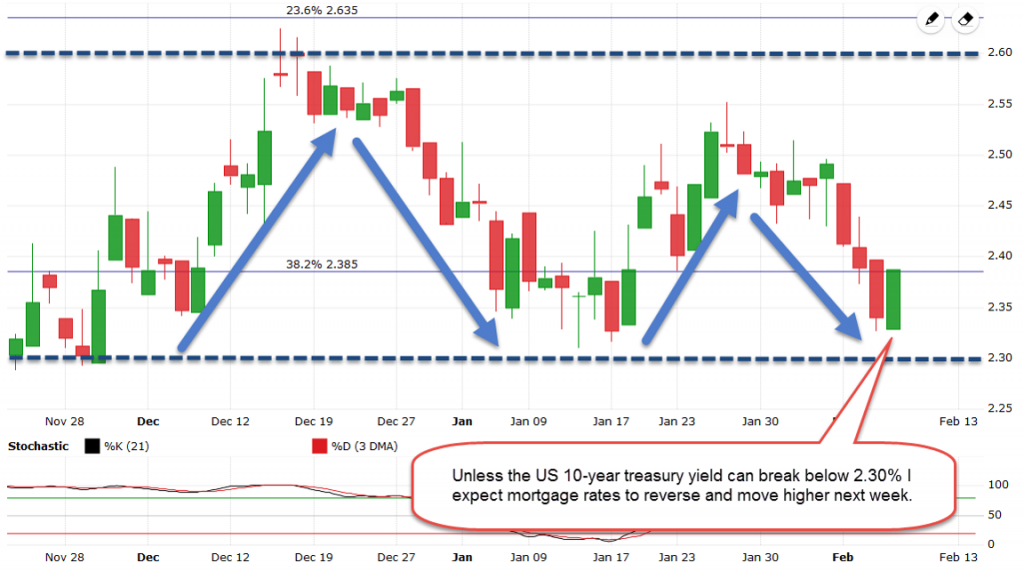
The technical outlook is not favorable.  The yield on the US 10-year treasury, which mortgage rates tend to track, has traded between 2.30%-2.60% since the end of November.  It got down to 2.34% yesterday and has bounced to 2.38% this morning.  Unless the yield can dip below 2.30% it looks as if rates may reverse trend higher.

Stocks are also rallying this morning on news that the Trump administration intends on accelerating tax cuts.  When stocks rally it tends to hurt mortgage rates.

I will maintain a locking recommendation.

Current Outlook: locking

Mortgage Rate Update February 6, 2017

Mortgage rates are unchanged from last week but accompanying closing costs are modestly lower.

In case you missed it Friday’s all-important jobs report showed stronger than expected hiring (+227,000 jobs) which would normally be a bad signal for mortgage rates.  However, average hourly earnings increased by less than expected which tempered inflationary fears.  Therefore, mortgage rates had a muted response.

This week’s economic calendar is relatively light.  The highlights will come on Friday with import/ export prices and consumer sentiment.

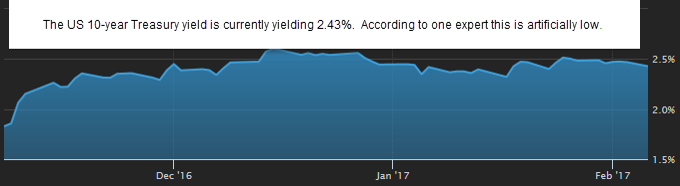
The US 10-year treasury note, which mortgage rates tend to follow,  is currently yielding ~2.43%.  According to a prominent bond money manager this is artificially low and the markets should expect higher yields in the future.  Since the Bank of Japan and European Central Bank are still enacting quantitative easing measures it is placing artificial barriers that are preventing higher rates.  Once those programs stall rates will rise.  When will that happen?  That is up for debate.

Source: Wall Street Journal

Last week President Trump signed an executive order which requires that the Treasury Department take a detailed look at the Dodd-Frank financial regulation law and make recommendations for revisions.  It is generally assumed that the president will push to roll back regulations that affect the mortgage industry.  It is not clear which rules he is targeting and the Senate will have to approve the changes with a 60 vote super majority (Republicans only hold 52 seats).  This is a topic I will be keeping an eye on.

Current Outlook: locking bias

Mortgage Rate Update February 2, 2017

Mortgage rates are effectively unchanged from the beginning of the week.

As expected the Fed left short-term interest rates unchanged yesterday following their 2-day monetary policy meeting.  The Fed DOES NOT directly control mortgage rates but their decisions and comments can certainly influence them.  The Fed did not clarify when the next rate hike may come but did state they remain on track to lift short-term interest rates in 2017.  Fed Chairwoman Janet Yellen is scheduled to testify in front of Congress February 14th-15th so we’ll see if she drops any clues then.

Tomorrow we’ll get the all important monthly jobs report.  The markets are currently expecting ~175,000 new jobs created.  A number north of that would likely pressure mortgage rates higher and vice versa.  In addition to the number of new jobs created analysts will be looking at average hourly wage growth.  Are wages growing at an accelerating pace?  If so, it would also be a bad sign for mortgage rates.

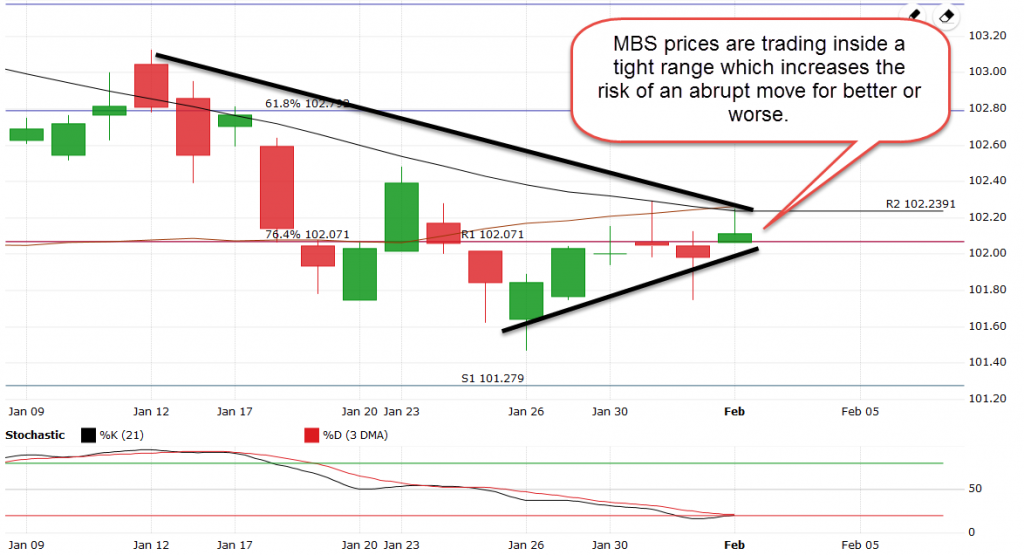
From a technical perspective mortgage-backed bond (MBS) prices are trading within a very tight range.  The risk is that when MBS prices “break-out” of the range they have a greater likelihood of moving abruptly for better or worse.

The jobs report is very hard to handicap.  Given that it is human nature to value loss more than a potential gain I am going to recommend locking in today.

Current Outlook: locking

Mortgage Rate Update January 30, 2017

Mortgage rates are moderately improved from Thursday.

On Friday the Commerce Department released Gross Domestic Product figures for the final quarter of 2016.  It showed that the economy expanded by a 1.9% annual pace for the final three months of the year which is lower than the markets were hoping for.

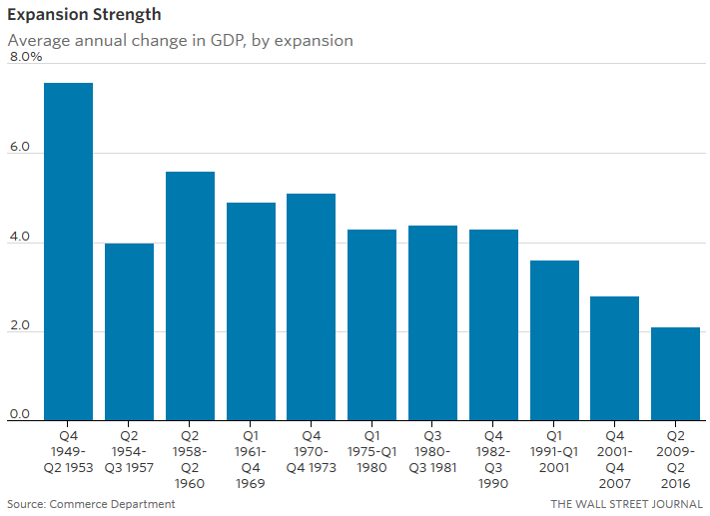
The current cycle of economic expansion began back in 2009 making it one of the longest on record.  However, since then the overall economy has only grown by 15.5% making it one of the shallowest as well.

Source: Wall Street Journal

This week’s economic calendar is a busy one.  Earlier today we got the latest reading on the Personal Consumption Expenditure Price Index which is the Fed’s favorite gauge of inflation.  Excluding volatile food and energy prices the index rose by 1.7% from last year which is still below the Fed’s target of 2% but trending higher.  Inflation is the primary driver of long-term interest rates.

On Wednesday the Fed will release its latest monetary policy decision.  It is widely expected that the Fed will leave short-term interest rates unchanged after hiking in December.  However, as we know their comments can also impact the financial markets.

Lastly, on Friday we’ll get the latest all-important jobs report.  I will focus on that in my Thursday ‘rate update’.

Mortgage rates are attempting to improve but face strong technical resistance.  I recommend a locking bias.

Current Outlook: locking

Mortgage Rate Update January 26, 2017

Mortgage rates are not having a great week.

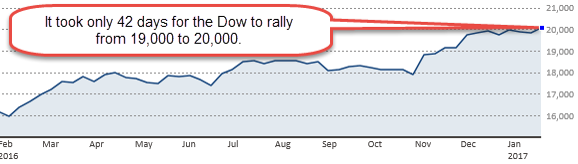
As I’m sure you’ve heard the Dow Jones Industrial Average topped 20,000 yesterday and managed to close above this psychological level.  The Dow is extending those gains today.  When stocks rally it attracts new capital which is often sourced from the bond market.  Weakness in the bond market is what pressures interest rates higher.

Source: CNBC.com

It took only 42 days from the Dow to reach 20,000 from 19,000.  This was the second fastest 1,000 rally in Dow history.

Unfortunately the technical trading patterns have eroded and the outlook for mortgage rates is not extremely optimistic.  Rates have risen this week and they may get worse in the near future.

Current Outlook: locking