Government Intervention in the Housing Market

This article was just published on WSJ.com and provides an excellent summary of all the ways the government has intervened in the housing market over the past year to help stabilize things.  It also asks the question of what will happen as the government pales back it’s involvement.  Leave your comments below.

Extension of the first-time homebuyer credit?

There is no question that the popular first-time homebuyer credit has had a positive impact on the housing market.  Currently my team is working on 11 purchase transactions and 7 of them are first-time homebuyers.  How many of these people would not be buying if it weren’t for the $8,000 incentive?

Data out this morning from the S & P Case Shiller home price index showed that home prices rose modestly in 18 of the top 20 housing markets in the US.  Surely the tax incentives and low interest rates have helped to stabilize the housing market.

Since the first-time homebuyer credit has been such a catalyst in the housing market many people are concerned about what will happen after 12/1/2009 when the program is set to expire.

This morning I came across this article which is reporting that there is currently a bill in front of the House Ways & Means Committee in Washington D.C. which would extend the credit into 2010.

I’m not sure of the political feasibility of such a bill. especially since budget deficits are a growing concern amongst Americans (click this link to see the US national debt clock).

What do you think?  Do you think we should extend the program?  Or, should we let the free market takes its course?

Is more regulation the answer?

The WSJ journal published this article today in their real estate section about Vermont’s tough mortgage regulations.  The article suggests that tougher mortgage regulations in Vermont has helped the state avoid the boom and bust cycle of the housing industry that is prevalent in the rest of the country.

However, I’m not necessarily convinced that government regulation should be credited with helping the state avoid significant problems in their housing/ finance industries.

I am a proponent of increasing financial education to our population as a fix to the long-term sustainability of our economy.

When I went looking on the internet for the “most educated state” I was not surprised to see Vermont be #1 for 2005 & 2006 (click this link to see the results) and Nevada, Arizona, and California to comprise 3 of the bottom 4 “smartest” states.

So, what do you think?  Is regulation the answer?  Or should we focus on educating our population on matters of personal finance?  Please leave your comments below.

FHA Amendatory Clause / Real Estate Certification

Depending on the estimate, FHA loans currently make up approximately 25% of total mortgage originations. Recent experience has led me to realize that although most real estate professionals know what they’re doing, there are still many who need a little coaching on the main disclosure; the FHA Amendatory Clause/ Real Estate Certification.

Download the One-Page FHA Disclosures Amendatory Clause / Real Estate Certification >>

Here are three essential things professionals and consumers need to know:

  • This disclosure MUST be signed by the homebuyer(s), homeseller(s), and real estate professionals (both selling and listing agent) involved in the transaction.
  • What also needs to be filled out? At the top of the form the homebuyer(s), homeseller(s), property address, and date of agreement should be filled in. In addition, the blank space following the “$” symbol in the Amendatory Clause section should be filled with the original purchase price of the offer.
  • The signatures on the FHA Amendatory Clause MUST be dated on the SAME DATE THAT THE RESPECTIVE PARTY ORIGINALLY SIGNED THE EARNEST MONEY AGREEMENT. The signature and dates for the Real Estate Certification are not date sensitive.

Example

If John & Jody Homebuyer write an offer with their real estate agent Shelly Sellalot to purchase a home on September 1st, then John & Jody must sign and date the Amendatory Clause on September 1st.

If the sellers, Jay & Judy Homeseller, along with their listing agent Bob Bigbucks, respond to the offer on September 2nd, then Jay & Judy must sign the Amendatory Clause on September 2nd irregardless of their response (unless they simply reject the offer all together). 

With regard to the Real Estate Certification John, Jody, Shelly, Jay, Judy, and Bob all need to sign this section but the date is not critical.

What are the parties signing? In so many words the Amendatory Clause gives the homebuyer(s) permission to back out of the transaction and receive their earnest money back if the property does not appraise for the amount they are buying the house for. 

The Real Estate Certification states that the entirety of the sales agreement is disclosed in the earnest money agreement and accompanying addendums which are ALL provided to the lender.

New mortgage rules could delay closings

Beginning July 30, 2009 all mortgage applications must comply with the Mortgage Disclosure Improvement Act (MDIA) which was passed into law as a part of the Housing and Economic Recovery Act of 2008.

The objective of MDIA is to protect consumers & improve the consistency of the Truth-in-Lending disclosures (TIL) that applicants get from lenders at the outset of a new loan application.

However, there are provisions embedded within this law that real estate professionals & consumers should be aware of because they may end up delaying scheduled closings if the lender is not adhering to the requirements.

Here are the highlights of this new law along with a brief explanation of the potential impacts and recommended solutions so that they don’t impact your transactions:

1) Cannot order appraisal until TIL has been signed: Under the new law lenders must receive back a signed initial TIL before they can order an appraisal.

Potential Impacts:  Even if the lender sends the initial TIL within the required 3-day time frame, they may not be able to proceed with the processing of the loan if the applicant does not return the signed disclosure promptly. This coupled with the impact of the HVCC appraisal rules create an even longer turn time for receiving appraisals back.  Furthermore, this requirement will prevent applicants from switching lenders once they’ve begun the process of applying for a mortgage because if the applicant tries to switch lenders the clock restarts.

Recommended solution: If the applicant meets with the lender at the outset of the application in a face-to-face meeting and signs the initial TIL then the lender may order the appraisal immediately.

2) 7-Day Waiting Period Before Closing: Under the new rule, the loan cannot close earlier than the 7th business day after the initial TIL is delivered or placed in the mail to the borrowers.

Potential Impacts: This prohibits from lenders conducting “quick closes”.  Currently, in some instances a mortgage broker may transfer a loan application from one lender to another at the last minute to achieve a better interest rate for the applicant OR because the new lender has an underwriting flexibility that the applicant needs in order to be approved for the loan.  Anymore, the applicant will have to wait at least 7 business days from the moment that the new lender sends out their initial TIL to close on their loan.

Recommended solution: It is now even more important that borrowers work with true mortgage professionals who are knowledgeable and thorough so that any potential “red flags” are identified and resolved at the outset of the application.  Otherwise, the mortgage is almost certain to be delayed.

3) APR Change Outside Tolerance/Corrected Disclosures: If the APR disclosed on the initial TIL later increases or decreases by more than .125%, a corrected TIL must be RECEIVED by the borrower no later than 3 business days before the date of the closing. If the corrected TIL is mailed the lender must allow 6 business days to pass for the borrower to review, before closing.

Potential Impacts: From the moment the initial application is taken to the closing table there can be variables that change which can also impact the APR (i.e. closing date, locked interest rate, percentage of down payment).  Should any of these variables change and the lender neglect to send out a new TIL, the transaction will be delayed by at least 3 business days for the new TIL to be reviewed by the applicant.

Recommended solution: Work with reputable lenders who are upfront, honest, and knowledgeable about the industryNow more than ever honest upfront disclosures will literally make the escrow process go smoother.

Click this link to watch a 7:00 minute movie summarizing the new rules.

HVCC gets Jack’d up

For professionals in the housing industry (mortgage, appraisal, & real estate) the new appraisal rules known as the Home Valuation Code of Conduct (HVCC) is a hot topic these days.  These rules which became effective May 1st were designed to improve the accuracy and integrity of appraisals.  However, as many professionals is the housing industry will testify there are many problems with the execution of these rules.  Syndicated columnist Jack Guttentag wrote a good summary of these problems which was featured in the Sunday Oregonian.

Jack Guttentag

Here are some talking points from the article:

*Jack’s definition of an appraisal: “Appraisals are informed judgments regarding the value of specific properties.” – I like this definition because it is a reminder that appraisals ARE subjective.

*Objective of HVCC: “The objective of the code was to insulate the appraisal process from influence by any of the parties with an interest in the outcome.”

*Problems with the rule: “The problem with this well-intentioned rule is that it was issued….squarely in the middle of the worst housing market since the 1930s….Many deals are not getting done because appraisals are coming in too low, and HVCC is seriously aggravating the problem.

*Why the bad appraisals?: “…more appraisals are being done by appraisers who are not familiar with the local market.

*Many appraisers under HVCC “are also paid less per appraisal than (before), which may induce them to invest less time.

*The article goes onto explain that under HVCC the turn around time on appraisals has increased by approximately one week which has put closing dates and buyer’s interest rate locks in jeopardy.

*HVCC prevents loan officers from keeping “clients informed about the status of an appraisal.

*HVCC also limits “access to to informal value opinions from the appraisers…Such opinions allowed them to abort house purchases and refinances that clearly would not fly because of inadequate property value.

*”HVCC has also pretty much eliminated the ability of a borrower to use the same appraisal with multiple loan providers.”  If a deal falls through with one lender “borrowers often have to pay for more than one appraisal.

Housing & GDP

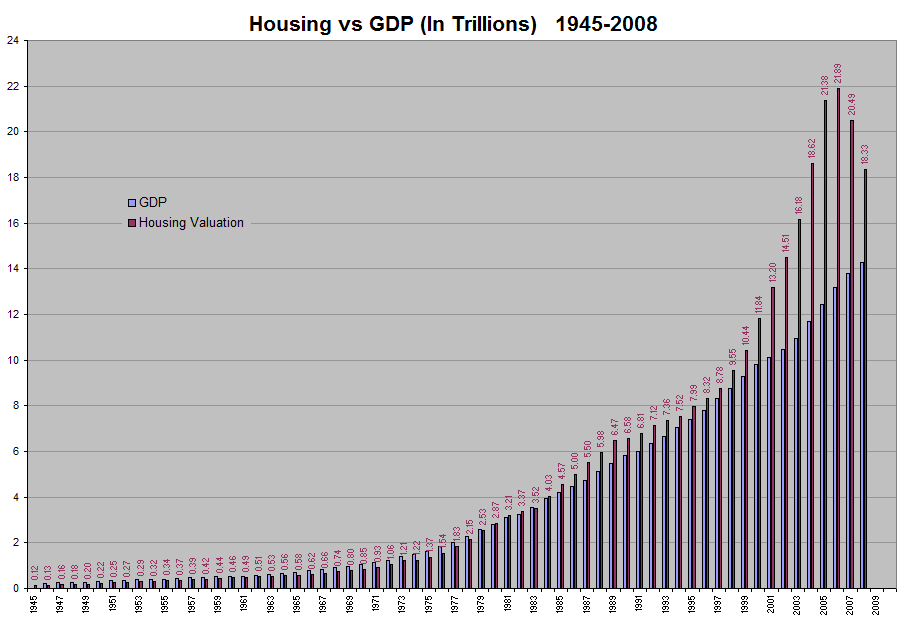
The Big Picture” posted this chart today showing housing prices & GDP growth in the US from 1945-2009.  In the late 1990s housing began to pull away from GDP.  Retrospectively this was the first clue that the levels of house price appreciation were unsustainable.

$8,000 Tax Credit not to be used for Down Payment

I posted some information last week on the blog regarding talks about the possibility of using the Government’s $8,000 tax credit as a down payment.  Unfortunately those talks were quickly extinguished.  Please see articel below that was posted early this week.

Federal officials on Monday reversed an earlier decision to allow first-time home buyers to use an $8,000 tax credit to borrow the down payment on a home.  A week earlier, U.S. Department of Housing and Urban Development Secretary Shaun Donovan had told the National Association of Home Builders that HUD would let banks and local governments offer short-term “bridge loans” to cover the down payment for first-time buyers eligible for the tax credit. The loans would have been available to applicants for federally insured mortgages such as Federal Housing Administration loans.

Lenders, home builders and real- estate agents had reacted favorably to the bridge-loan proposal, saying it would open up the housing market to more first-time buyers.

However, not everyone was in favor of using the tax credit as collateral on a down-payment loan.

“That tax credit should be savings, not debt,” said Patricia Garcia-Duarte, executive director (of Neighborhood Housing Services in Phoenix)

http://www.azcentral.com/arizonarepublic/business/articles/2009/05/18/20090518biz-downpayment0519.html#). Garcia-Duarte said the proposal too closely resembled a now-illegal practice known as seller-funded down-payment assistance, which allowed a home’s seller to “gift” the down payment to a specific buyer through a non-profit organization (

http://www.azcentral.com/arizonarepublic/business/articles/2009/05/18/20090518biz-downpayment0519.html# Phoenix loan originator Dean Wegner was among the housing-industry professionals who had expressed enthusiasm about the bridge-loan plan. Wegner said the program would have boosted local home sales, but he added that the bridge loans likely would have come with a high interest rate

http://www.azcentral.com/arizonarepublic/business/articles/2009/05/18/20090518biz-downpayment0519.html#

Wise Commentary from the Oracle of Omaha

For anyone involved in business or investing Berkshire-Hathaway’s annual report should be required reading.  Not so much the entire report but at least the letter which is carefully crafted by one of my favorite people, Warren Buffett.  You can read this year’s letter along with past years at this link.

I try to read it every year and was pleased that Buffett provided some commentary on the credit/ housing crisis in this year’s letter.  Here is an excerpt from the letter:

Finance and Financial Products

I will write here at some length about the mortgage operation of Clayton Homes and skip any financial commentary, which is summarized in the table at the end of this section. I do this because Clayton’s recent experience may be useful in the public-policy debate about housing and mortgages. But first a little background.

Clayton is the largest company in the manufactured home industry, delivering 27,499 units last year.  This came to about 34% of the industry’s 81,889 total. Our share will likely grow in 2009, partly because much of the rest of the industry is in acute distress.  Industrywide, units sold have steadily declined since they hit a peak of 372,843 in 1998.

At that time, much of the industry employed sales practices that were atrocious. Writing about the period somewhat later, I described it as involving “borrowers who shouldn’t have borrowed being financed by lenders who shouldn’t have lent.”
To begin with, the need for meaningful down payments was frequently ignored. Sometimes fakery was involved. (“That certainly looks like a $2,000 cat to me” says the salesman who will receive a $3,000 commission if the loan goes through.) Moreover, impossible-to-meet monthly payments were being agreed to by borrowers who signed up because they had nothing to lose. The resulting mortgages were usually packaged (“securitized”) and sold by Wall Street firms to unsuspecting investors. This chain of folly had to end badly, and it did.

Clayton, it should be emphasized, followed far more sensible practices in its own lending throughout that time. Indeed, no purchaser of the mortgages it originated and then securitized has ever lost a dime of principal or interest. But Clayton was the exception; industry losses were staggering. And the hangover continues to this day.

This 1997-2000 fiasco should have served as a canary-in-the-coal-mine warning for the far-larger conventional housing market. But investors, government and rating agencies learned exactly nothing from the manufactured-home debacle. Instead, in an eerie rerun of that disaster, the same mistakes were repeated with conventional homes in the 2004-07 period: Lenders happily made loans that borrowers couldn’t repay out of their incomes, and borrowers just as happily signed up to meet those payments. Both parties counted on “house-price appreciation” to make this otherwise impossible arrangement work. It was Scarlett O’Hara all over again: “I’ll think about it tomorrow.” The consequences of this behavior are now reverberating through every corner of our economy.

Clayton’s 198,888 borrowers, however, have continued to pay normally throughout the housing crash, handing us no unexpected losses. This is not because these borrowers are unusually creditworthy, a point proved by FICO scores (a standard measure of credit risk). Their median FICO score is 644, compared to a national median of 723, and about 35% are below 620, the segment usually designated “sub-prime.” Many disastrous pools of mortgages on conventional homes are populated by borrowers with far better credit, as measured by FICO scores.

Yet at yearend, our delinquency rate on loans we have originated was 3.6%, up only modestly from 2.9% in 2006 and 2.9% in 2004. (In addition to our originated loans, we’ve also bought bulk portfolios of various types from other financial institutions.) Clayton’s foreclosures during 2008 were 3.0% of originated loans compared to 3.8% in 2006 and 5.3% in 2004.

Why are our borrowers – characteristically people with modest incomes and far-from-great credit scores – performing so well? The answer is elementary, going right back to Lending 101. Our borrowers simply looked at how full-bore mortgage payments would compare with their actual – not hoped-for – income and then decided whether they could live with that commitment. Simply put, they took out a mortgage with the intention of paying it off, whatever the course of home prices.

Just as important is what our borrowers did not do. They did not count on making their loan payments by means of refinancing. They did not sign up for “teaser” rates that upon reset were outsized relative to their income. And they did not assume that they could always sell their home at a profit if their mortgage payments became onerous. Jimmy Stewart would have loved these folks.

Of course, a number of our borrowers will run into trouble. They generally have no more than minor savings to tide them over if adversity hits. The major cause of delinquency or foreclosure is the loss of a job, but death, divorce and medical expenses all cause problems. If unemployment rates rise – as they surely will in 2009 – more of Clayton’s borrowers will have troubles, and we will have larger, though still manageable, losses.  But our problems will not be driven to any extent by the trend of home prices.

Commentary about the current housing crisis often ignores the crucial fact that most foreclosures do not occur because a house is worth less than its mortgage (so-called “upside-down” loans). Rather, foreclosures take place because borrowers can’t pay the monthly payment that they agreed to pay. Homeowners who have made a meaningful down-payment – derived from savings and not from other borrowing – seldom walk away from a primary residence simply because its value today is less than the mortgage. Instead, they walk when they can’t make the monthly payments.

Home ownership is a wonderful thing. My family and I have enjoyed my present home for 50 years, with more to come. But enjoyment and utility should be the primary motives for purchase, not profit or refi possibilities. And the home purchased ought to fit the income of the purchaser.

The present housing debacle should teach home buyers, lenders, brokers and government some simple lessons that will ensure stability in the future. Home purchases should involve an honest-to-God down payment of at least 10% and monthly payments that can be comfortably handled by the borrower’s income. That income should be carefully verified.

Putting people into homes, though a desirable goal, shouldn’t be our country’s primary objective.  Keeping them in their homes should be the ambition.

By the way, I’m currently reading “The Snowball” which is a great biography of his life.  I should have the review done in the next few weeks.

What we know about the new stimulus package thus far: How it will affect the housing market

The following artical is from a website that I follow for recent updates on Mortgage Related issues and also track daily trading patterns of Mortgage Backed Bonds.  I am sure that there will be more news coming in the following weeks, but this is what we know thus far.


Tax Credit for Homebuyers

First-time homebuyers who purchase homes from the start of the year until the end of November 2009 may be eligible for the lower of an $8,000 or 10% of the value of the home tax credit.  Remember a tax credit is very different than a tax deduction – a tax credit is equivalent to money in your hand, as opposed to a tax deduction which only reduces your taxable income.

The tax credit starts phasing out for couples with incomes above $150,000 and single filers with incomes above $75,000.  Buyers will have to repay the credit if they sell their homes within three years.


Additional Housing-Related Provisions

Tax Incentives to Spur Energy Savings and Green Jobs — This provision is designed to help promote energy-efficient investments in homes by extending and expanding tax credits through 2010 for purchases such as new furnaces, energy-efficient windows and doors, or insulation.

Landmark Energy Savings — This provision provides $5 Billion for energy efficient improvements for more than one million modest-income homes through weatherization.  According to some estimates, this can help modest-income families save an average of $350 a year on heating and air conditioning bills.

Repairing Public Housing and Making Key Energy Efficiency Retrofits To HUD-Assisted Housing—This provision provides a total of $6.3 Billion for increasing energy efficiency in federally supported housing programs.Specifically, it establishes a new program to upgrade HUD-sponsored low-income housing (for elderly, disabled, and Section 8) to increase energy efficiency, including new insulation, windows, and frames.

Expanding Housing Assistance—This provision increases support for several critical housing programs. It includes $2 Billion for the Neighborhood Stabilization Program to help communities purchase and rehabilitate foreclosed, vacant properties.


More Help for Homeowners in the Future

Another thing to keep an eye on in the coming weeks is President Obama’s plan to help struggling borrowers before they are faced with a default on their mortgage.

According to reports, the Obama administration is discussing plans to help borrowers who are struggling to stay afloat, but who have not yet fallen behind on their payments. At this point, details are scarce; however, reports indicate that President Obama is looking to spend approximately $50 Billion to directly help homeowners before they face foreclosure and financial disaster.

While this is good news for individual homeowners, it will likely be good for the housing industry as a whole. That’s because, assisting struggling borrowers before they default should help stop the wave of foreclosures, which are estimated to top two million this year. That, in turn, will help stabilize home prices.