Danish realtors change pricing model

While reading the Copenhagen Post on Monday morning I came across this article which explains how Danish real estate agents are changing their pricing models to reflect the current state of the market.

Like the US housing market Denmark has also entered a period of slower sales.  As a result, some real estate professionals are abandoning the traditional model of commission-only compensation where they are paid only when the home sells.  Instead, they are implementing a fee structure where they pass along marketing expenses to home-owners while the home is on the market.

Kind of interesting.

Do loan modifications work?

The NY Times reported in this article that over half of borrowers who had their loans modified in the first 3 months of 2008 are again at least 30 days delinquent on their mortgage.  This raises questions as to the effectiveness of loan modifications.

Or, it may also lead to questions about how loans are being modified.  It may be that the loan modifications that took place in the first 3 months of the year primarily focused on cutting the principal balance of the loan without addressing the amount of the monthly payment.  If this is the case the homeowner may appreciate the lesser amount owed but if they’re having trouble making ends meet it won’t do anything do address that problem.

Or, it ma be that the downturn in the housing market is making it so many of these homeowners have lost their jobs making it impossible to pay their mortgage.

No matter what the cause it is clear that underwriting got a little too aggressive over the past couple years.

RESPA presentation

I am providing a presentation to a group of real estate professionals about upcoming changes to RESPA rules.  Here are the presentation slides.

WSJ.com article on the future of home prices

The Wall Street Journal published this article today about the future of home prices.  The article in interesting in that it surveys various housing economists for their opinion on the future of housing prices.  Many long-standing themes are highlighted.  Here are some notes:

*Over the next 10 to 20 years, housing economists expect prices will rise again — but, on average, probably not nearly as much as they’ve averaged over the past decade. (most economists predicted average appraciation rates to be 2.5%-4% or 1% above inflation)

*Some experts say it’s a bad idea to count on your home rising in value at all. People should think of their own homes mainly as places to live, not as investments, advises Kenneth Rosen, chairman of the Fisher Center for Real Estate at the University of California, Berkeley.

*In the long term, house prices are driven by fundamentals that are hard to predict: immigration, birth rates, the size and nature of households, and incomes. The trick is to figure out where job and income growth will be strongest and where immigrants and others will want to live. (BTW, Rosen notes that Portland, OR would be a relatively viable housing market because of the “urban vitality” the city offers)

*…applying demographic trends to house-price forecasts can be hazardous. Economists N. Gregory Mankiw and David Weil predicted in a paper in 1989 that demographic trends would lead to a “substantial” fall in real, or inflation-adjusted, home prices over the next two decades “if the historical relation between housing demand and housing prices continues.”

We told you so!

Aaron was recently looking in a folder on his computer and came across this mailer which we sent out in October 2006 warning our past clients about option ARM solicitations.  Option ARMs are mortgage programs that have negative amortization implications when the borrower makes the minimum payment.  Not to say that ALL applications of the option ARM programs are bad.

But unfortunately the option ARM program made it into the mainstream mortgage market and consumers who didn’t understand the program were being solicited to use them.  This is one of the factors why we find ourselves in the position we are in today.

Here is the copy from our warning mailer:

It has come to our attention that many mortgage lenders are currently soliciting many of our past clients to refinance their existing loans with Option ARM Loan Programs.

· What is an Option ARM? These are complicated loan programs with low “teaser” rates and low initial monthly payments.  Many of these programs start out with interest rates as low as 1.00% for 1 month and then increase significantly.  As the interest rate increases the mortgage payments actually remain the same which then causes the homeowner’s loan balances to increase through negative amortization.

· Why are they popular? With higher real estate prices and higher interest rates, many mortgage lenders are pushing these products on homeowner’s because of the low initial monthly payment.

· Why are they risky? What is not often disclosed by lenders who push these products is that payments will increase with time as will the loan balance if the minimum monthly payment is made.   As a result, consumers are not aware that their mortgage balance is actually increasing with time.  Furthermore, lenders are paid greater commissions for pushing these loans with lengthy prepayment penalties which lock in borrowers to these products.

· If you have been solicited by one of these offers and would like more information as to whether or not this loan is good product for you please contact us.  Also, visit http://www.businessweek.com/magazine/content/06_37/b4000001.htm for a good article on the subject.

What is title insurance?

In Oregon, “owner’s title insurance” is required and is paid for by the seller when you buy a home.  The “lender’s title insurance” is also required and is purchased by the buyer when they take out a mortgage.  I was made aware this evening that not all states are like Oregon.

I have been assisting my cousin’s in their purchase of a home back in New Hampshire.  In that state, “owner’s title insurance” is optional and is purchased by the buyer (not the seller).  They called me to ask whether or not they should buy it.  As an optional cost I had to think back on what title insurance is and what it covers.  Here is a good summary I found on line:

Title insurance insures against loss sustained by an insured due to the condition of title being other than as insured. The beneficiaries of title insurance policies generally are real estate buyers and mortgage lenders. A title insurance policy protects the named insured against title defects, liens and encumbrances existing as of the date of the policy and not excepted from coverage. For a one-time premium paid by the seller or borrower, the policy remains in effect until the property is sold or refinanced.

A title insurance policy provides you with peace of mind. It takes the risk out of acquiring property whose legal history is unknown to you. While there should be no risks in transferring property, they do exist. Through the years, your new property may have changed hands many times through sale, inheritance, foreclosure, or bankruptcy. Each transfer was an opportunity for an error in title to arise. If an error occurred, and has never come to light, it puts your title in jeopardy. You could lose your property and the money you paid for it. And, even if you successfully defend your rights of ownership, the cost in time and legal fees could be prohibitive. Among the many risks against which title insurance protects you are:

  • Confusion from similarity of names
  • Forged documents
  • Signatures of minors or mentally incompetent persons
  • Mistakes in recording legal documents
  • Undisclosed or missing heirs
  • Fraud
  • Invalid divorces
  • Misrepresentation of marital status
  • Unpaid taxes
  • Clerical armors in public records
  • Wills not probated

Possible long-term solutions to fix mortgage woes

The Economist published this article in their weekly “Economics Focus” section back in October and I’m just getting around to blogging about it.  This section of the magazine deals with theoretical economics so it’s always interesting to see what the best minds in the field are proposing to help fix our current economic problems.

In this edition the subject matter is mortgages.  Specifically, various economists suggest fixes for the problem of foreclosures.

Let’s first define the problem:

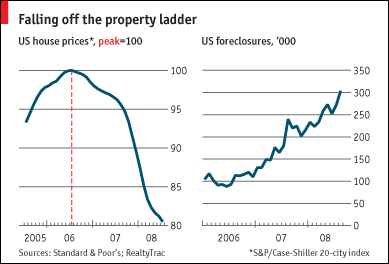
The problem is that as foreclosures increase, the stock of housing inventory rises, pushing home values lower.  As home values go down, it prompts more homeowner’s to enter foreclosure because their is no economic incentive for them to keep current on their home.  It becomes a vicious cycle that is illustrated in the chart below.  As foreclosures increase, property values decrease, causing foreclosures to increase even more……

The proposed solutions:

*Make mortgage a “recourse” loan.  Currently mortgages are “non-recourse” which means when a bank forecloses on a home and is only able to recover a fraction of the original loan the borrower DOES NOT have to pay back the difference.  Under a “recourse” arrangement the borrower would still be personally liable for the difference between the loan amount.  This would increase the incentive for borrowers to avoid foreclosure.

*Another economist suggests adding a clause to future mortgage agreements that would automatically trigger a principal reduction on the loan amount when the value of the home decreases by a certain amount.  For example, under this clause if your home decreases in value by 20%, your loan principal would also decrease by 20%.  This arrangement would protect the homeowner’s equity position and therefore create an incentive for them to remain in their home.  The trade off is that the homeowner would need to share in the equuity appreciation in the future so that the lender is paid back.

Both of these theories are interesting.  We’ll have to wait and see if any take shape in the future.

New RESPA rules enacted

HUD made a huge announcement today regarding new RESPA rules surrounding the Good Faith Estimate and HUD-1 final settlement statement.  I am amazed that this rule has not gotten more attention in the real estate community.

I blogged about these proposed changes back on November 2nd and pointed out the pro’s and con’s of the changes.  Now that the rule has been finalized here are a few thoughts I’d like to share:

*The new GFE is now 3 pages and is standardized.  This means that every lender, mortgage broker, or bank will offer consumers the same GFE format.  This should prevent lenders from “hiding” fees/ changes.  Here is a link to view the new 3 page GFE.

*The one issue I have with this new GFE is that there is no section where a consumer can view their estimated cash to close.  This appears to be a huge oversight on the part of HUD.

*There is no section for the loan originator to include the company name or lender.

*There is no section on the 3 page GFE where a borrower’s total principal, interest, taxes, and insurance payment is shown (PITI) together.

*There are plenty of positive aspects of the new GFE including the requirement to offer consumers other options with higher closing costs and lower interest rates as well as lower closing costs and higher interest rates.  This is a very important concept and one that often gets over looked by loan originators.

*Fortunately, the final rule did away with any sort of escrow officer script reading which would have made signings painful.

*Here is a link the new HUD-1 settlement statement.  There are some confusing aspects of this new document as well.

*These new procedures will have a 12-month transition period.  Lenders may start using the new GFE’s on January 1, 2009.  They will be required to no later than January 1, 2010.

I am in the process of putting together a class for real estate professionals which I plan to offer for continuing education (assuming the principal broker will approve the content).  Please shoot me an email if you’d like to attend.

Further tightening of credit guidelines

For those of us who have been hoping for the credit markets to show signs of stabilization we can keep on waiting.

Freddie Mac announced last week that they would no longer issue or accept underwriting approvals knows as “accept plus” approvals.  These approvals, which were mostly earned by borrowers with high credit scores and large down payments, featured little to no income documentation requirements.  In essence, these were almost like “stated income” loans because the borrower would not have to provide any income documents to confirm the income they listed on their application.

For example, we would expect that an applicant buying a primary residence with a credit score> 740 and >30% down would likely receive an “accept plus” approval.

Freddie Mac’s move to eliminate “accept plus” approvals is another sign that lenders are acting with extreme caution.  Unfortunately this move will also negatively impact many more applicants ability to buy.  However, I would expect that this will also create a niche for a private institution to

You can read the announcement at this link.

New GFE, Hud-1, & closing procedures around the corner

RESPA reform has been in the works for sometime now.  I sat through an excellent continuing education class last week put on by the one and only Ken Perry of Broker Knowledge Group.

In the class he briefed us on the proposed changes to the good faith estimate (GFE), HUD-1 final settlement statement (click link to see example), and closing script procedures (click link to see example) that are likely to become a final rule sometime next week.  According to Ken the new rule will take effect next year.  Participants will have 12 months to transition their business to be in compliance.

These are BIG changes and I plan to put together a class for real estate professionals on the subject.  Here are some notes I took regarding the new GFE (click this link to view a copy of the new GFE).  You’ll find that most of these are criticisms:

*No where on the GFE does it show total payments including principal, interest, real estate taxes, & home insurance.

*On page 1 there is a box to check whether or not the loan has an escrow feature for real estate taxes or home insurance BUT it DOES NOT have a space to indicate the amount of the monthly escrow collection.

*HUD is essentially making yield spread premium pricing more transparent.  On page 2 section A, mortgage brokers will now have to charge the borrower their origination fee AND yield spread premium pricing and explain to them that the lender will credit them the yield spread premium.

*On page 2 section B HUD gives the lender room to itemize only 3 charges in the #3 & #5 sections (these sections are used to disclose estimated costs of third party providers).  The problem with this is that typically there are more than three charges to disclose.

*At the bottom of page 3 the lender will need to provide each borrower two options beside the main option which is being disclosed.  The first option will need to show a loan with lower costs but a higher interest rate.  The second option will need to show a lower interest rate but higher costs.

*At the top of the fourth page the lender is to disclose the ANNUAL costs of the borrower’s real estate taxes and homeowner’s insurance (as well as HOA/ flood insurance if applicable).  None of my clients are ever that concerned about the annual cost.  They tend to be more anxious to know the monthly cost.

*Lastly (but not leastly), NO WHERE ON THE NEW GFE IS THERE SPACE FOR US TO ESTIMATE OUR CLIENTS TOTAL CASH COMMITMENT AT CLOSING.  ARE YOU KIDDING ME?  THIS IS A HUGE OVERSIGHT ON THE PART OF HUD!