Mortgage Rate Update April 4, 2016

Mortgage rates improved modestly last week and remain very near multi-month lows.

Friday’s all-important jobs report was in line with market expectations.  215,000 new jobs were created during the month of March and the unemployment rate crept up to 5.0% as more citizens entered the workforce.  Mortgage rates held steady on the release.

In case you missed it the S&P Case-Shiller Home Price Index was released last week for the month of January.  For a second straight month Portland led the nation in year-over-year home price appreciation (11.8%).  Good news if you are a seller and not as much for prospective buyers.

This week’s economic calendar is very light.  There are a few Fed officials scheduled to speak throughout the week and minutes from the most recent monetary policy meeting are also scheduled for release.  Barring any surprises with those events we’d expect mortgage rates to react to technical trading patterns and global influences.

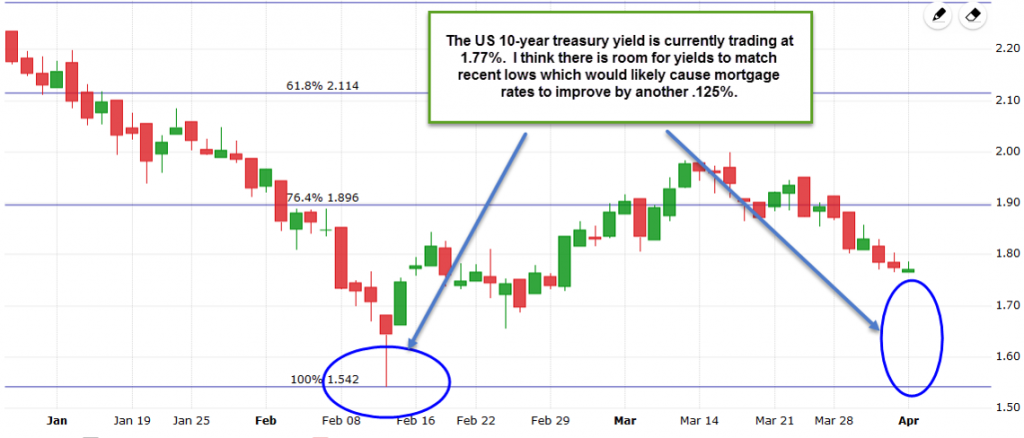
From a technical perspective mortgage rates look like they could make a run for another .125% improvement.  The US 10-year treasury yield is currently trading at 1.77% and recent lows occurred back in mid-February at 1.55%.
04-04-10yr yield-portland or mortgage broker

In comparison, Germany’s 10-year bund is currently trading at .14% and Japan’s equivalent is trading at -.08%.  That’s right, investors in Japan’s 10-year government bond  are actually paying .08% to invest.  As long as these rates remain low the US should experience low mortgage rates.

Current Outlook: floating

Mortgage Rate Update March 28, 2016

Welcome back if you were away for spring break!  Mortgage rates worsened slightly last week but remain very attractive.

US stocks ended last week slightly lower.  This follows five weeks of strong gains.  As I wrote about on Thursday (see HERE) I think the stock market looks vulnerable which could lead to lower mortgage rates.

Contributing to losses in the stock market last week were comments made by Fed officials.  Federal Reserve Bank of Atlanta President Dennis Lockhart said in a speech that a rate hike could take place as soon as the April meeting, which is scheduled for April 26th-27th.  In a separate speech Federal Reserve Bank of Richmond President Jeffrey Lacker said he was confident inflation would continue to increase to the Fed’s target of 2%.  Prior to these comments the markets had thought the next Fed hike would not be until later in 2016 if at all.  Fed Chairwoman Janet Yellen is scheduled to deliver a speech tomorrow so analysts will be listening closely to her comments for additional clues.

The economic calendar is jam packed with significant economic data this week.  The highlight will be Friday’s all-important jobs report.  The markets are expecting ~200,000 new jobs created for the month of March.  Another strong report would likely push rates higher and vice versa.

Earlier today the Fed’s favorite gauge of inflation was released.   The Core Personal Consumption Expenditures Price Index (Core PCE) was up 1.7% year-over-year which is unchanged from last month and still below the Fed’s target.

I am going to maintain a cautious floating bias.

Current Outlook: cautiously floating

Mortgage Rate Update March 24, 2016

Mortgage rates are unchanged from last week.

It’s been a relatively quiet week with regard to economic news.  Not only are people not paying attention because they’re on spring break but there is also not much to pay attention to.

Quietly, the US stock market has been on a nice rally.  Since mid-February the S&P 500 has had 21 positive trading days and only 8 negative days.  Over that timeline the S&P 500 has risen by ~11.5%.

03-24SP500-Portland mortgage rates

Is the market overheated?  One contrarian predictor of the stock market is investor sentiment.  When investors are “bullish” on the markets it’s usually a great time to sell and vice versa.  In a recent research note Peter Boockvar of CNBC pointed out that investor sentiment is currently at its highest level since July 2015.  In case you need a reminder on what happened in August last year refer to the chart above.

If stocks react lower in the coming weeks, as many analysts are starting to predict it would likely generate demand for safe-haven assets including US debt instruments which would drive yields lower.  I am going to maintain a floating bias to see if this pattern comes to fruition.

Current Outlook: cautiously floating

Mortgage Rate Update March 17, 2016

Good news!  Mortgage rates have improved this week.  I switched my outlook to ‘floating’ on Monday and for those who followed that guidance they are being rewarded with rates that are .125% better.

The catalyst for the shift in direction for interest rates was yesterday’s Federal Reserve monetary policy statement.  The markets were anticipating the Fed to sound upbeat on the labor market and more cautious regarding inflation.  However, in their statement the Fed did not acknowledge either of those factors and instead focused on the economic risks posed by international weakness.

The markets are now pricing the highest probability for the Fed to hike short-term rates only one more time in 2016.  If you’ll remember back the Fed had implied they may hike four times this year.  The Fed does not directly control mortgage rates but their view on the US economy carries a lot of weight and bad news for the economy tends to be good news for mortgage rates.

Hoping a little St. Paddy's Day luck will bring lower rates next week.
Hoping a little St. Paddy’s Day luck will bring lower rates next week.

The economic calendar has basically run its course so today and tomorrow I expect mortgage rates to react to technical trading patterns.  I rarely recommend getting greedy but given today is St. Patrick’s day I’m going to maintain a floating bias.  If rates can push below current technical support levels we could see them improve by another .125%.

Current Outlook: cautiously floating

Mortgage Rate Update March 14, 2016

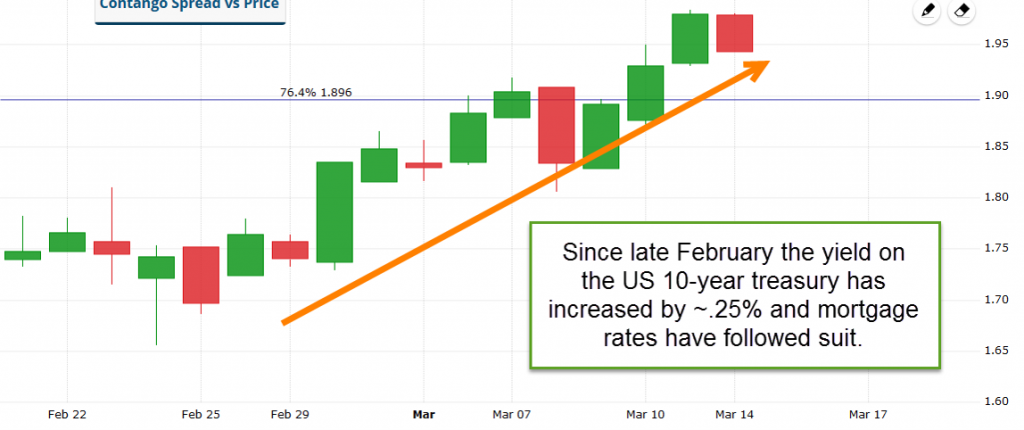
Mortgage rates continued to creep higher last week.  Since late February interest rates have been moving higher but still remain below where we started the year.

3-14-10yr-portland-or-mortgage-source

Although there is no significant economic news out today the remainder of the week features a busy schedule.  On Tuesday we’ll receive the monthly report on retail sales and the Producer Price Index.  On Wednesday we’ll see the Consumer Price Index, industrial production, and the Fed’s monetary policy statement.

The Fed is not expected to raise short-term interest rates at this meeting (reminder: the Fed does not directly set mortgage rates).  However, we won’t be surprised if they sound a little more upbeat regarding the US economy.  Furthermore, recent inflationary measures have revealed that price pressure may be building and that could encourage them to lay the groundwork for another rate hike in June.  Inflation is the enemy of mortgage rates.

From a technical perspective momentum over the past couple weeks has carried mortgage rates higher.  Is this move higher running out of steam?  Trading signals suggest this may be the case.  I will recommend a floating position for now but we need to be cautious as the Fed’s comments can overshadow technical trading patterns.

Current Outlook: cautiously floating

Mortgage Rate Update March 10, 2016

Mortgage rates have worsened by ~.125% this week.

The big news story of the week is the European Central Bank’s (ECB) announcement that they are enhancing quantitative easing measures designed to boost economy activity in their economy.  ECB President Mario Draghi outlined a multitude of aggressive measures including charging banks interest for depositing excess reserves (negative interest rates) and purchasing corporate bonds in addition to government bonds.

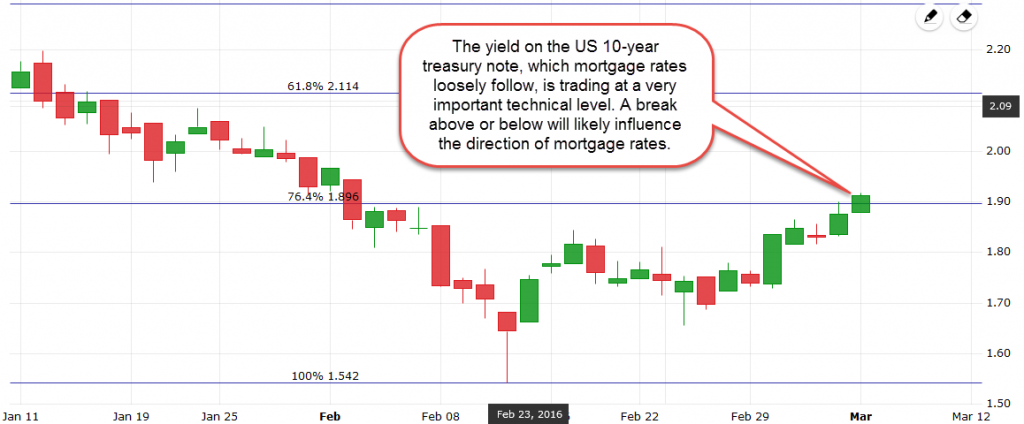
The US stock market initially reacted positively to the announcement but have since reversed into negative territory.  Despite the fact that stocks are trading lower US interest rates have been pressured higher.  The US 10-year treasury yield is not trading above an important technical level of 1.90%.

03-10-US 10yr-portland-or

This is a bad sign for mortgage rates.  As I wrote about on Monday (see HERE) there is room for the yield to move up by another .20% which could push mortgage rates up another .125%-.25%.

Current Outlook: locking

Thanks to my team and customers! #184 in the US!

Thank you to my hardworking team (Amanda Harvey, Camy Platt, and Michael Nardoni, and the entire support staff at Mortgage Trust)!  Furthermore, thank you to my customers and professional partners who place trust in our work!

I am happy and honored to announce that we ranked #184 in the entire United States for 2015 residential loan origination volume according to National Mortgage News.

orange metallic number 184 on white background.digitally generated image.
Thanks to everyone for their hard work and support. In 2015 we were ranked #184 in the nation for residential loan origination volume.

We look forward to continuing our service to customers in Oregon, Washington, and Idaho with professionalism and integrity.   Hopefully in 2016 we can march down that list!


Mortgage Rate Update March 7, 2016

Although mortgage note rates are unchanged from last Thursday pricing at these rates slightly worse.

Friday’s jobs report topped analysts’ expectations coming at +242,000 new jobs for the month of February.  Furthermore, as I thought may happen, previously released figures for December and January were reported higher.  As expected, mortgage rates worsened moderately following the better than expected results.

This week’s economic calendar is very light.  The highlight will come on Thursday when Europe’s Central Bank (ECB) meets.  Investors expect the ECB will lower short-term rates even further in an effort to boost liquidity into their economy.  As a reminder, the ECB’s current target rate is in negative territory which means they are actually charging banks to keep money on deposit.  Low rates overseas have helped keep rates low here in the US.

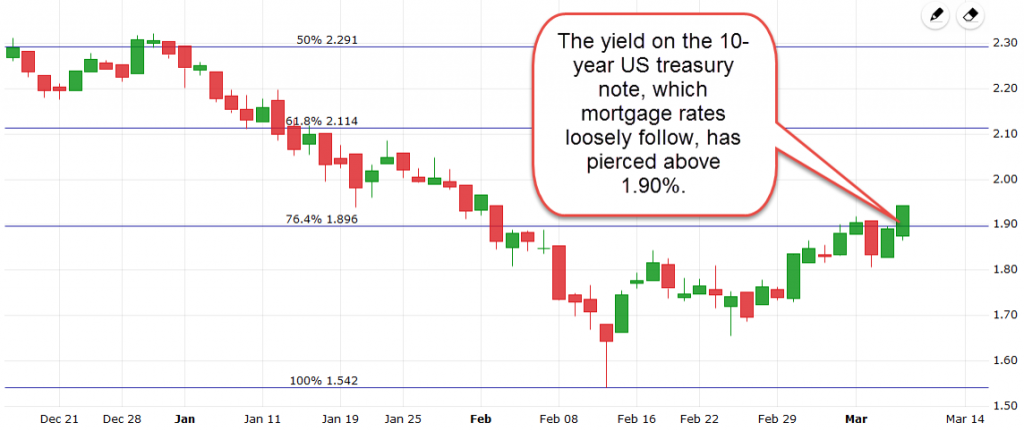
From a technical perspective we are keeping a close eye on the US 10-year treasury yield.  It is currently trading at 1.90% which is ~.20% higher than where we stood a couple weeks ago.  During that time mortgage rates have risen by .125%.

03-07-16-chart of yield mortgage rates portland ore

Should the yield break above this level it will likely creep higher by another ~.20% and we could expect mortgage rates to increase by .125%-.25%.  However, this level could also cause yields to reverse and trend back down.  If that happens I would expect mortgage rates to improve by ~.125%.

It’s a tough call.  I am going to shift my outlook to cautiously floating.

Current Outlook: cautiously floating

Mortgage Rate Update March 3, 2016

Mortgage rates are unchanged for the week.  That may all change tomorrow with the release of the all-important jobs report.

If you remember back to last month the jobs report missed expectations coming in at only 158,000 new jobs created.  This month analysts expect the report to show 190,000 new jobs created.  If the actual figure comes in higher than expected mortgage rates are likely to worsen and vice versa.

It’s always difficult to predict the monthly jobs report but based on what I am seeing I think there is more risk in floating than there is in locking.  Why?

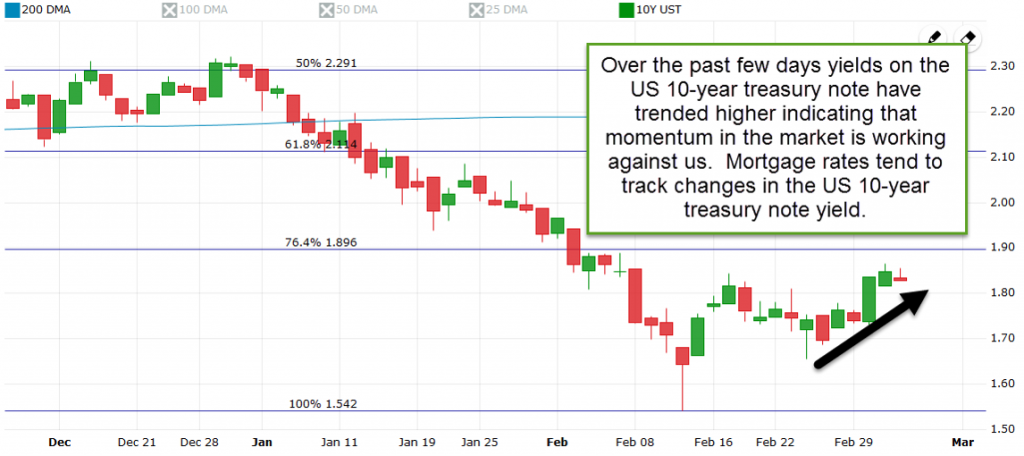
First, from a technical perspective momentum is working against us.  See the chart below.

03-03-US 10yr Mortgage Rates Portland Oregon

Second, recent domestic economic data has been relatively healthy.  Private Payroll company APD released its version of the monthly jobs report yesterday and it showed that 214,000 new jobs were created last month.  In a separate release, the Fed released a report which showed that consumer spending rose in much of the nation during the first part of the year.

Lastly, given that last month’s report was released well below expectations I believe that there is a greater likelihood that it will be subject to a revision higher which would put upward pressure on mortgage rates.

Current Outlook: locking

Comparing first-time homebuyers today to yesteryear?

Zillow’s real estate analytics blog released an interesting piece recently focusing on the characteristics of today’s first-time homebuyer.  You can read the entire piece HERE.  The author looked at a variety of financial and demographic trends of today’s first-time homebuyer and compared them to previous generations.  The findings?

A summary:

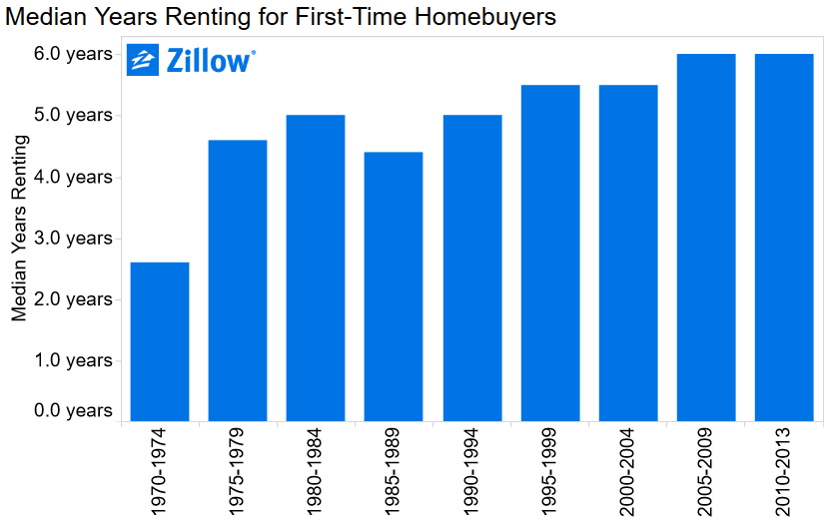
  • First-time homebuyers are older today and spend more time renting that previous generations.
  • First-time homebuyers are less likely to be married today than previous generations and increasingly purchase condo’s instead of single family homes.
  • Today’s first-time homebuyers have lower credit scores and down payments than previous generations.
Source: Zillow.com
Source: Zillow.com

The fact that homes are more expensive today relative to household income is likely influencing the findings.  How does your experience as a first-time homebuyer differ from your parents generation?  Please comment below.