Mortgage Rate Update May 9, 2016

Mortgage rates are modestly better to start the week.

In case you missed it Friday’s all-important jobs report was a miss.  The markets had been expecting 205,000 new jobs for the month of April and instead the report showed only 160,000.  This follows last month’s report which showed that only 156,000 new jobs were created during March.

Despite the smaller than expected gains the US unemployment rate remained low at 5.0%.  With unemployment at such a low level it’s hard to imagine that an economic slowdown is on the horizon.  However, take a peek at the chart below:
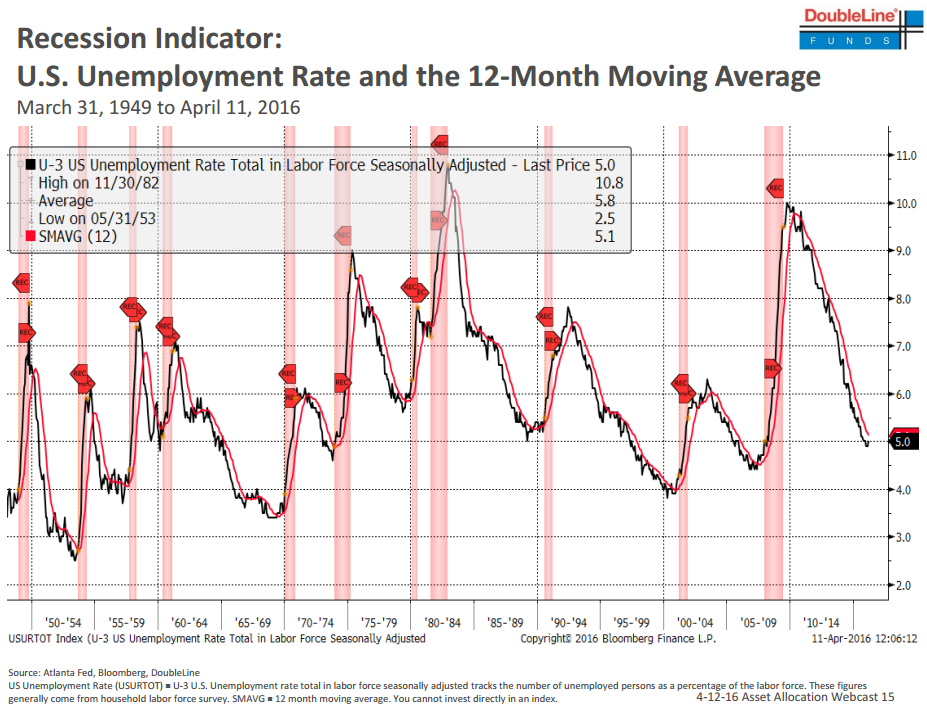
Unemployment Rate Before Resssion5-9-2016-Portland-or-mortgage-rates

This demonstrates that going back to 1950 every recession starts with the unemployment rate reaching a multi-year low just before the economy begins to contract (recessions marked by pink highlights).  We don’t know if/ when a recession will come about nor how severe it will be.  It is interesting to note that US mortgage rates tend to dip during recessionary periods.

The economic calendar is relatively light this week.  I will shift to a floating position.

Current Outlook: floating
Mortgage Rate Update May 5, 2016

Mortgage rates are essentially unchanged from the beginning of the week.

The economic highlight of the week arrives tomorrow when the Bureau of Labor Statistics releases the monthly employment report (click HERE to learn how the report impacts mortgage rates) for April.  Current expectations are that 205,000 new jobs will be announced.

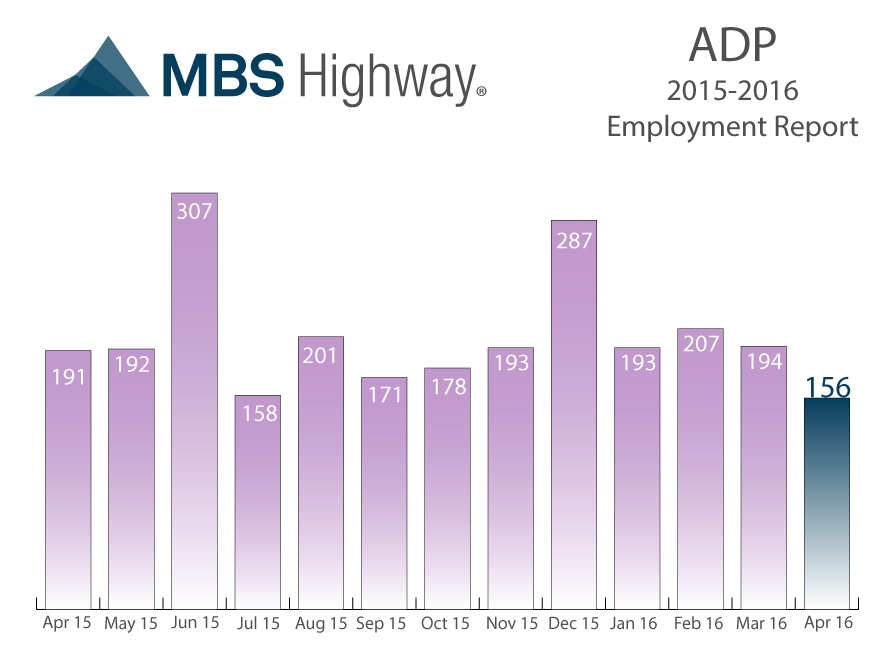
On Wednesday, private payroll company ADP released its version of the report which showed that only 156,000 new jobs were created last month.  This would suggest that tomorrow’s report may come in lower than expectations which would bode well for mortgage rates.

Portland mortgage rates ADP Employment Report5-4-2016


However, if you’ll remember back two weeks ago (see HERE) the weekly jobless claims numbers have been coming in at multi-decade lows.  This would leave us to believe that tomorrow’s report may be better than expectations.

As is the case every month this report is very hard to predict.  Given the current technical trading signals and the fact that mortgage rates are better this week than they were last week I am going to recommend locking in today.

Current Outlook: locking

Mortgage Rate Update May 2, 2016

Mortgage rates are unchanged from the latter half of last week.

Long-term interest rates, including mortgage rates, are inversely correlated to inflation.  This is because inflation essentially chips away at the return earned by lenders.  Inflationary pressure has been meek over the past few years as wages have been stagnant and commodity prices, including oil, have been low.  Is that beginning to change?

Strong gains in oil prices and a healthy labor market could lead to higher mortgage rates down the road.

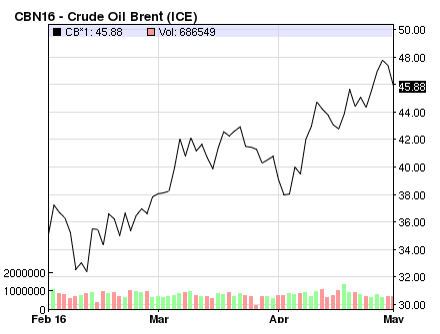
Oil prices have risen ~70% since the beginning of the year and as we know the labor market has been producing jobs at a healthy clip which should eventually create wage pressure that can lead to inflation.  We will learn more about wages when the all-important jobs report is released on Friday.  Recent weekly jobless claim releases suggest that this Friday’s report should be strong.  If the current trend continues we’ll need to be cautious about inflationary pressure and therefore mortgage rates.

In the near term the technical trading signals in the interest rate markets look favorable.  I am going to start the week with a floating bias but I anticipate shifting to a locking stance on Thursday before Friday’s jobs report is released.

Current Outlook: floating

Mortgage Rate Update April 28, 2016

Although mortgage note rates are unchanged today the pricing is improved from Monday so in fact conditions are better.  Applicants should be able to lock today with slightly lower closing costs compared to earlier in the week.

Pricing for mortgage rates improved following the release of yesterday’s monetary policy statement from the Federal Reserve.  In effect, the committee maintained the language from the March meeting in which they held silent on when they plan to hike short-term interest rates.  As you’ll remember at the beginning of the year the markets had expected four .25% rate hikes during 2016.  Thus far there have not been any following the December 2015 hike and the markets think the Fed will remain on hold until Q4.

In other Central Bank news the Bank of Japan also held steady on their monetary policy today.  The markets had been expecting further monetary stimulus which could have helped US interest rates improve due to the fact that the US dollar would likely have strengthened against the yen.

The Central Banks in the US and Japan keep investors guessing.

In economic news, the Commerce Department reported that the US economy only grew by a .5% annualized rate during the 1st quarter of 2016.  This is slower growth than analysts had expected.  Bad news for the economy tends to be good news for mortgage rates.

Despite the slower than anticipated growth inflationary pressure appears to be picking up which is bad news for mortgage rates.  The Personal Consumption Expenditure price index, the Fed’s favorite gauge for inflation, was shown to have increased by 2.1% year-over-year.  This is up from 1.3% last quarter.  Should inflationary pressures persist the Fed will be forced to hike short-term interest rates even if they are not confident in the economic recovery.

Although momentum is back on our side the technical outlook for further improvements does not look favorable so I will maintain a locking bias.

Current Outlook: locking bias

Mortgage Rate Update April 25, 2016

Mortgage rates are unchanged from the second half of last week.  As I wrote about last Thursday mortgage rates increased by ~.125% over the course of last week.

This week’s economic calendar is jam packed with significant releases that could impact mortgage rates.

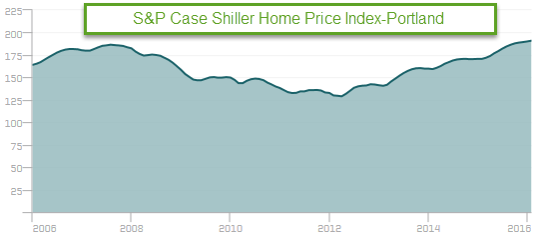
On Tuesday the latest version of the S&P Case-Shiller home price index is due out.  Portland has led the nation in year-over-year home price appreciation the past couple months and it will be interesting to see if we maintain the top spot.

04-25spcase

The Fed will conduct its regularly scheduled two-day monetary policy meeting Tuesday-Wednesday.  It is not expected that the Fed will raise short-term rates at this meeting but their comments regarding timing for future rate hikes would be an important market mover.  As a reminder the Fed does not directly control mortgage rates.

Later in the week we gets readings on personal consumption expenditures (inflation), personal spending, and consumer sentiment.

From a technical perspective as long as the US 10-year treasury yield is at or below 1.90% we can float in the hopes that it moves lower.  If it moves decisively above this level we need to lock in.

Current Outlook: cautiously floating

Mortgage Rate Update April 21, 2016

Mortgage rates have worsened slightly from the beginning of the week alongside the yield on the US 10-year treasury note.  On Monday the yield on the US 10-year treasury note was 1.77% and currently it is 1.88% (+.11%).

The culprit?  Positive signs for the labor are pressuring rates higher.

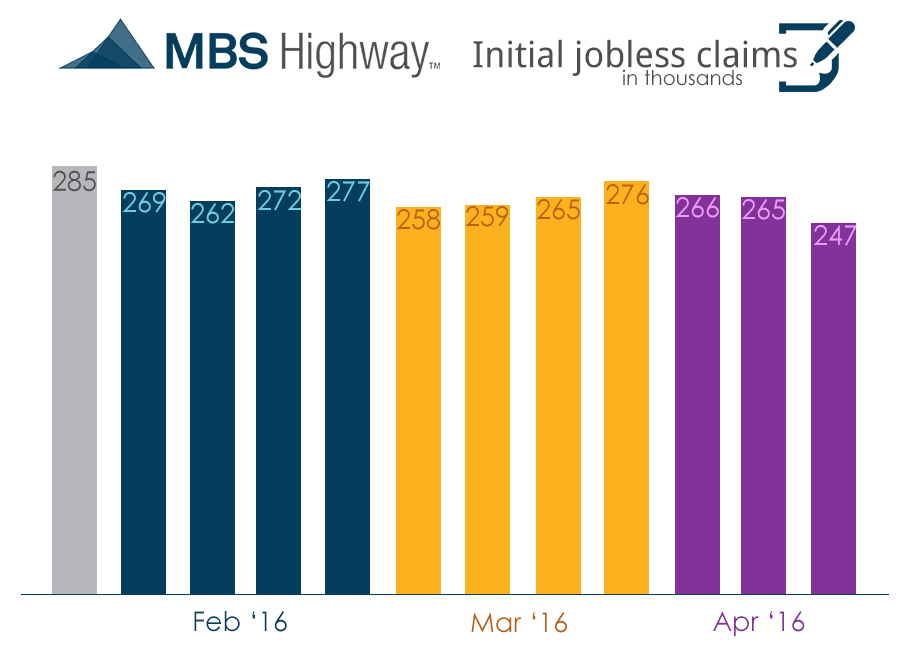
Each Thursday the Labor Department reports on the number of Americans who file for initial jobless claims.  The weekly indicator is a barometer for the health of the jobs market.  This week’s report showed that the number of Americans filing for jobless claims hit a 42-year low.  This week’s results will be factored into the next all-important jobs report scheduled for release on May 6th.  Good news for the labor market is often bad news for mortgage rates.

Initial Jobless Claims4-21-2016

From a technical perspective mortgage backed bonds look vulnerable to further price declines that would pressure rates higher.  The US 10-year treasury yield does have resistance that should help cap any additional moves higher.

Given that rates remain very attractive in historical terms I am going to recommend locking.

Current Outlook: locking

Mortgage Rate Update April 18, 2016

Essentially mortgage rates are unchanged from last week.  They have oscillated within a .125% range since the beginning of April with only minor volatility.

Anytime we see prolonged periods of sideways trading I get nervous that a “breakout” is near.  A “breakout” is when rates move sharply one way or the other and given that rates are already near historic lows we have to assume they have a higher probability to breakout higher.

This weeks economic calendar has plenty of housing related indicators.

This week’s economic calendar is fairly light.  However the limited number of releases are housing focused.  Today we got the National Association of Homebuilders market index which was in line with expectations (no surprises here).  Tomorrow we’ll get building permits/ housing starts and on Wednesday the National Association of Realtors will report existing home sales.  On Friday we’ll get the Federal Housing Finance Agency’s housing price index.

The technical signals are also fairly quiet right now.  I will maintain a floating bias.  I don’t expect rates to improve much but at least we can buy some more time on our locks.

Current Outlook: floating bias

Mortgage Rate Update April 14, 2016

We had switched to a locking bias on Monday and that has proven to be the right call.  Mortgage rates have worsened very mildly since Monday.  This statement will contradict what you’ll hear from the media over the next couple days.

The Freddie Mac Primary Market Survey, which is what major media outlets tune into, was released today and showed that rates dipped slightly from last week.  Freddie Mac’s survey lags the market.

Lenders voluntarily submit interest rate information Monday-Wednesday of every week and then Freddie Mac releases the results on Thursday.  The results today simply show that mortgage rates were lower this Monday-Wednesday as compared to last Monday-Wednesday.  Unless rates move lower Monday-Wednesday next week next Thursday’s report will confirm that rates have worsened slightly.

Looking at the markets, the Consumer Price Index (CPI) was released today by the Labor Department and it continues a trend of tepid inflationary pressure.  This is friendly news for mortgage rates as inflation is the nemesis of long-term interest rates.

In a separate report weekly jobless claims matched the lowest level in over 40 years.  This is a positive sign for the economy which tends to be bad news for mortgage rates but at this point rates have not reacted.

From a technical perspective the US 10yr treasury yield and mortgage-backed bonds are trading at important levels after worsening over the last 3 days.  I am cautiously optimistic that they will catch technical support and rates will return to the levels we had at the beginning of this week.  But we need to be cautious given that rates are very near all-time lows.

Current Outlook: floating bias

Mortgage Rate Update April 11, 2016

Mortgage rates remain very attractive.  The 30yr fixed rates available today are only +.25% off the all-time lows created in November 2012.

The big story in the financial markets this morning is the sudden increase to oil prices.  The price of a barrell is now trading above $40 and has increased by ~14% in the past week.   How may this impact mortgage rates?

Higher oil prices over the past week threaten to pressure mortgage rates higher.

Recently higher oil prices have also translated to higher stock prices and that is the case today.  The US markets are up ~.5%.  When stocks do well mortgage rates tend to suffer.  Furthermore, higher energy prices can eventually lead to inflationary pressure which we know is the nemesis of mortgage rates.

Looking ahead for the week the economic calendar is a little more active compared to last week.  There are two important inflation reports scheduled for release Wednesday and Thursday.  We’ll also see the latest retail sales report and consumer sentiment later in the week.

From a technical perspective mortgage rates appear to have stalled out after improving steadily since March 22nd.  Given that financial markets tend to operate in cycles I am growing concerned that mortgage rates may be poised to reverse and move higher.  Having said that the US 10-year treasury yield still has some room to the downside so it’s a tough call.

The safe play is to lock in with a long-term perspective that these rates are as good as we’ve seen throughout the past few decades.

Current Outlook: locking bias

Mortgage Rate Update April 7, 2016

Did you know that according to a recent survey approximately 40% of millennials think that lenders require a minimum of 15% down payment?  This misconception is keeping many from enjoying the benefits of homeownership.  Feel free to pass THIS POST on to others so we can spread the message that 0%-3% down options exist.

Mortgage rates have held steady this week and 2016 lows.

As I wrote on Monday the economic calendar has been light this week so it is not a surprise to see rates hold steady.  Lower yields in Germany and Japan continue to help suppress US interest rates.

Wall Street legend Art Cashin released a note this morning advising market watchers to pay attention to money supply.  This is a measure of how much currency exists in our economy and how frequently it turns over as a result of transactions.  The reason this rather obscure measure is important to watch is because of an equation which states that, “MV=PQ”, also known as the Quantity Theory of Money.

04-07-MVPQ

If money supply (M) increases along with velocity (V) and GDP (Q) holds steady or grows slowly then according to the equation inflation (P) must increase.  Inflation is the nemesis of mortgage rates.  More to come on this in future rate updates.

From a technical perspective the US-10 year treasury yield still have room to the downside so I will remain in a floating position.

Current Outlook: floating