Mortgage Rate Update June 20, 2016

Mortgage rates are essentially unchanged at multi-year low levels.

In-out-in-out-in-out…..A week ago I wrote (HERE) about how a poll released over the weekend had indicated a majority of British citizens favoring a “Brexit” from the European Union (EU) and how that helped mortgages rates in the US because of general uncertainty and a “flight-to-safety”.

Brexit. In or Out

This week a new poll shows that a majority of voters now favor remaining in the EU.  As a result, pricing on mortgage rates worsened very modestly this morning.  The bottom line is that Thursday’s vote is up in the air.  Here in the US we will learn the results after the markets closes on Thursday so to play it safe borrowers may want to lock ahead of that.  If Britain does depart the EU I expect mortgage rates to remain low and maybe even improve further.

The vote in Britain will overshadow other economic news stories this week.  The economic calendar is light in terms of the number of events but heavy in housing related reports.  On Wednesday we’ll see existing home sales, the FHFA housing price index report, and on Thursday we’ll get new home sales.  Recent housing reports have been “Goldilocks” meaning not too hot and not too cold.

Its very difficult to handicap the vote in Britain so I will favor a locking bias.

Current Outlook: locking

Mortgage Rate Update June 16, 2016

Mortgage rates remain at multi-year lows.

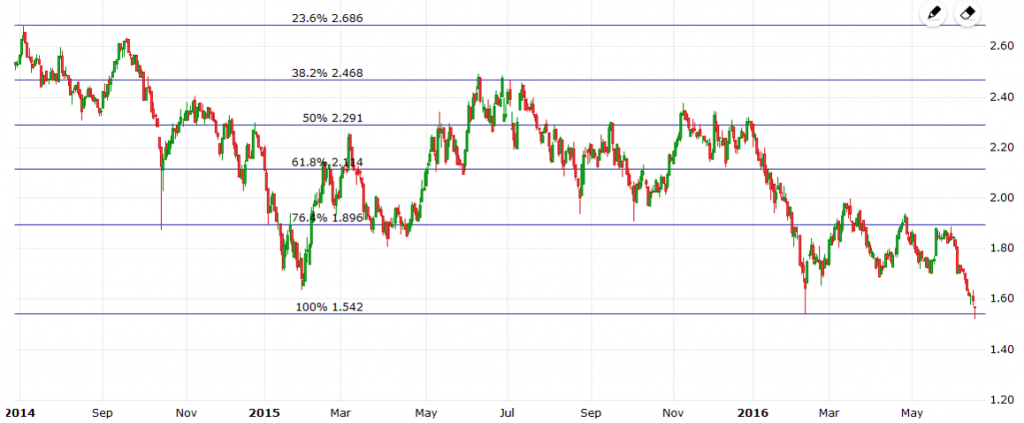
Below is a chart of the yield on the US 10-year treasury yield from 2014-current.  As you can see the current yield at 1.55% is the lowest going back that far.  Mortgage rates tend to track the direction on the US 10-year treasury yield.

Portland OR mortgage rates june 16 16

Why are rates so low?  There is currently a lot of uncertainty in the financial markets.  One week from today British voters will take to the polls and decide whether or not to remain in the European Union or exit.  There are many unanswered questions if they do leave.  Financial markets do not like uncertainty and as a result mortgage rates have declined on a “flight-to-safety”.

Central Banks around the globe are also contributing to uncertainty.  Earlier today the Bank of Japan left their aggressive monetary policy in place.  Many analysts had predicted that the Bank of Japan would implement additional measures to help stimulate the Japanese economy so the inaction caught the global financial markets by surprise.

Not surprising was the US Federal Reserve leaving short-term interest rates unchanged yesterday.  In the post-meeting press conference Fed Chairwoman Janet Yellen stated, “We are quite uncertain about where rates are heading in the longer term.”  Only a few weeks ago the Fed had set expectations for further rate hikes in 2016.  Now that is getting called into question.

From a technical perspective momentum remains on our side.  I will maintain a floating bias.

Current Outlook: floating

Mortgage Rate Update June 13, 2016

Mortgage rates remain at multi-year lows.


Britain’s referendum to exit the Eurozone or remain is scheduled for June 23rd.  This vote has been scheduled for many months but has flown under the radar here in the US because most of the polling has suggested a likelihood for the status quo.

However, this past Friday a fresh poll was released that showed a majority of Brit’s opting to “Brexit” the Eurozone (EU).  How might this impact US mortgage rates?

Britain's vote on June 23rd is likely to influence mortgage rates here in the US.
Britain’s vote on June 23rd is likely to influence mortgage rates here in the US.

Should Britain depart the EU it makes the possibility of other members exiting more likely.  For example, apparently Netherlands has already formed a coalition of citizens who would like to push for a “Nexit”.  The bottom line is that a “Brexit” will cause uncertainty and likely pressure mortgage rates lower in the near terms due to a “flight-to-safety” on the part of investors.

The economic calendar is fairly full this week.  The Fed is scheduled to meet tomorrow and Wednesday.  Following May’s weak employment report there is virtually no chance the Fed will raise short-term interest rates.  However, their comments can always move the markets.

We’ll also get more current readings on retail sales, inflation, manufacturing, and housing construction.

I recommend floating for now.

Current Outlook: floating

Mortgage Rate Update June 9, 2016

Mortgage rates remain at multi-year lows.

There is no shortage of fear in the marketplace about interest rates rising as a result of the Fed hiking short-term interest rates.  I overheard a conversation yesterday in which a real estate professional was advising a prospective homebuyer to buy a home sooner rather than later because mortgage rates were almost certain to be higher in the future.

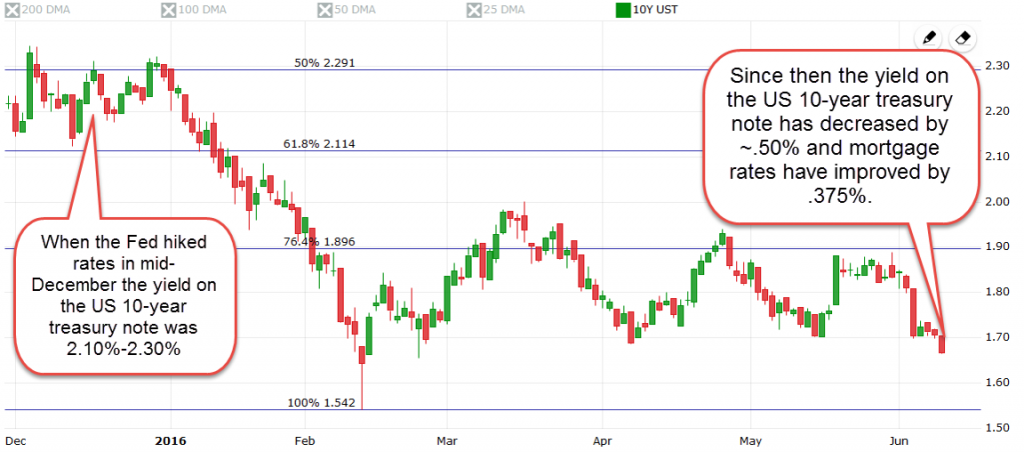
It is true that mortgage rates may be higher a year from now but Fed rate hikes will not be the primary cause.  The Fed does not directly set mortgage rates.  Case in point:  The Fed last hiked short term interest rates in December 2015 and mortgage rates are presently ~.375% lower than then.  The yield on the US 10-year treasury yield has decreased by ~.50%.

source: mbshighway.com

Equally as feared is that home prices will fall since they have been on a such a rapid ascent.  CoreLogic released its most recent Home Price Insights report earlier in the weak.  The report showed that home prices in Oregon increased by 10.3% in the past 12 months.  Furthermore, the report forecasts that in the next 12 months home prices will increase by 7.4%.  You can download the report HERE.

From a technical perspective momentum in the interest rate markets are working in our favor.  I will shift to a floating position.

Current Outlook: floating

Mortgage Rate Update June 6, 2016

Mortgage rates have reverted to the best levels in three years following Friday’s all-important jobs report.

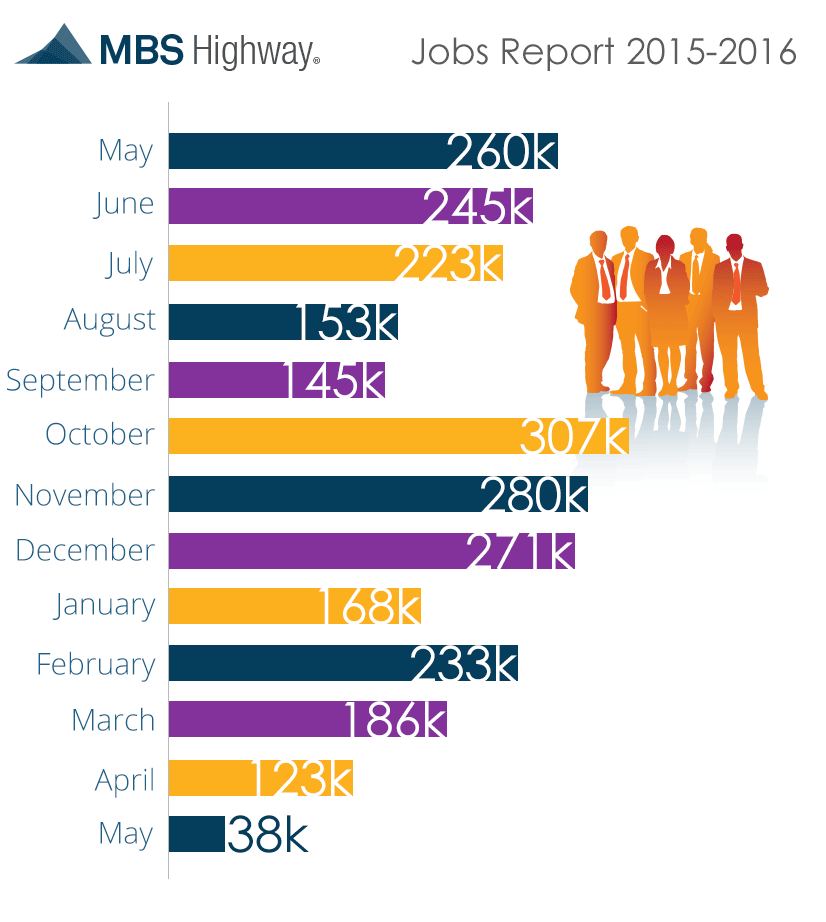
The markets were expecting Friday’s jobs report to show 155,000 new jobs created.  However, it showed that only 38,000 were added to the US economy in May. This is the weakest output in five years.  Bad news for the economy is good news for interest rates.  Speaking today, Fed chairwoman Janet Yellen communicated that a June rate hike was less probable.  According to CME Group there is currently a 6% chance the Fed hikes short-term interest rates in June.

Jobs-Report6-3-2016

This week’s economic calendar is pretty light.  Therefore, I expect mortgage rates to react to technical trading patterns and the stock market.

From a technical perspective mortgage rates are as good as they’ve been for 3 years.  I think borrowers have more to lose than to gain by not locking in at these levels.

US stocks have already recovered from Friday’s losses as investors forecast how lower interest rates will impact future corporate earnings.

I will maintain a locking bias.

Current Outlook: locking

Mortgage Rate Update June 2, 2016

Mortgage rates are unchanged.

Tomorrow the all-important jobs report will be released for the month of May.  During normal times this report is the most impactful release and currently it is even more amplified.  Why?

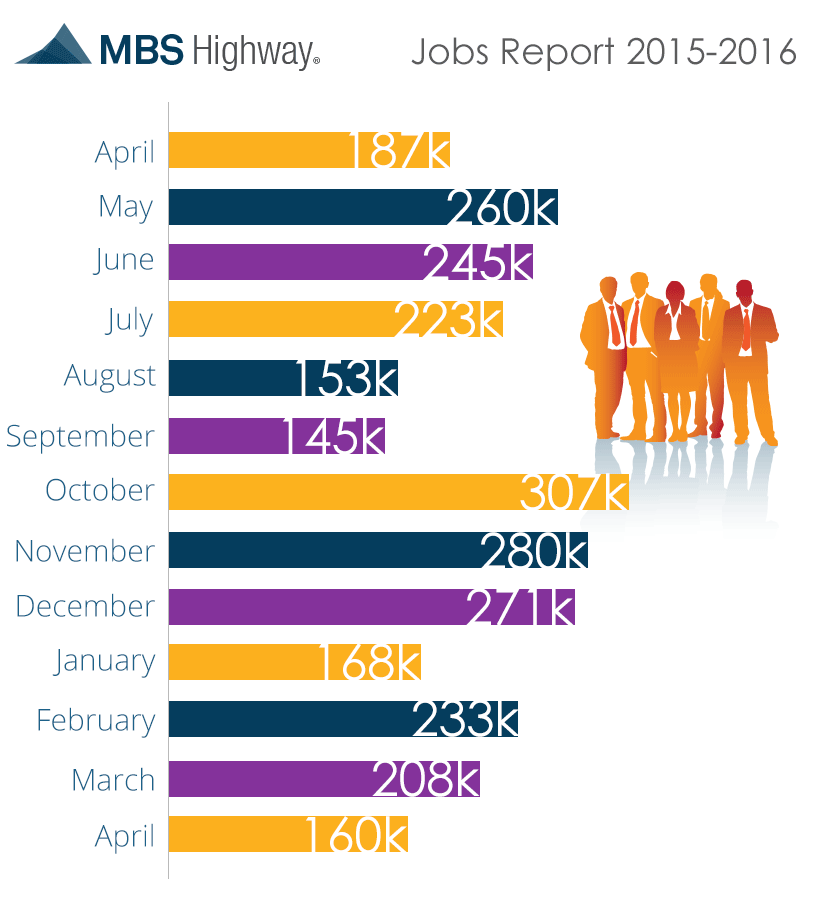
The Fed has been candid in their desire to hike short-term interest rates.  However, in order to do so they need reasonably strong employment figures for justification.  Inconveniently for them job growth in 2016 has been relatively modest.  The US economy has not created more than 250,000 new jobs in a given month since December.

Jobs report5-6-2016-portland-or-mortgage-rates

Current expectations for tomorrow’s report is that it will show +155,000 new jobs.  As always, if the report shows a figure greater than expectations we’d expect mortgage rates to worsen and vice versa.

All other economic news is overshadowed by the jobs report so we are solely focused on this event.  Given that mortgage rates are presently very near 3-year lows I think borrowers have more to lose than to gain so will recommend locking in today.

Current Outlook: locking

Mortgage Rate Update May 31, 2016

Mortgage rates are unchanged from last week.

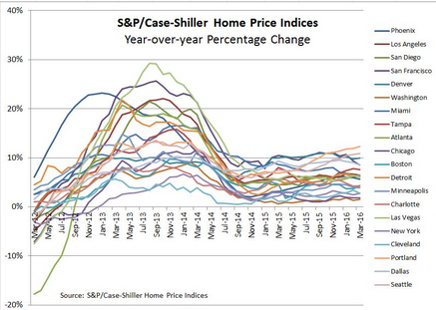
Let’s start off with some housing news.  The S&P Case Shiller Home Price index report was released earlier today and for the 6th straight month Portland led the nation in year-over-year appreciation coming in at 12.3%.  Tight inventory continues to push prices higher.

Source: S&P Case-Shiller

In a separate report released by the Commerce Department inflationary pressure, as measured by the Personal Consumption Expenditure (PCE) index, remains fairly tepid.  The PCE price index, which is the Fed’s favorite gauge of inflation, increased 1.1% year-over-year.  This marks the 48th straight month that annual inflation has been below the Fed’s target of 2%.  One would think that the Fed would be less likely to hike rates given that price pressure is so low.

Looking ahead for the remainder of this holiday shortened week the economic calendar is full and concludes with the all-important jobs report this Friday.  From a technical perspective conditions in the interest rate market look favorable.  I am going to recommend floating for now.

Current Outlook: floating

What Is The Difference Between A Pre-Qualification & A Pre-Approval?

AdobeStock_103978598.jpegPortland has one of the hottest housing markets in the country. For a home-buyer the difference between being “pre-qualified” and “pre-approved” is key in having an offer accepted instead of ignored. Furthermore, there are even varying degrees of pre-approval that can impact a buyers chances of purchasing the home they want.

Pre-qualification simply means that a loan officer has interviewed a potential home-buyer and recorded information regarding their income, credit history, obligations, and assets. Based on the information shared in that conversation the loan officer believes the home-buyer will be able to obtain a home loan. However, none of the information regarding the home-buyers financial situation has been substantiated and therefore is not deemed reliable for a mortgage underwriter who is ultimately the one who makes the determination on whether a home loan application will be approved (or not).

When a home-buyer has been pre-approved, it means that the loan officer has received a completed home loan application (contact information, residency history, employment history, income, assets, other obligations, and other real estate owned). In addition, a pre-approval requires that a loan officer has also obtained a copy of the applicant’s credit report and determined that the person is in fact eligible to obtain a home loan.

However, here at Swanson Home Loans we recommend taking the pre-approval process one step further. In addition to the aforementioned loan application and credit report, we typically require an applicant submit supporting documentation. This allows us to review it and verify that the information supplied on the loan application does match the financial documentation that the underwriter will eventually review. Often times this involves having the applicant submit pay-stubs, W2 forms, copies of previous year’s federal tax returns, asset account statements, etc. In fact, we even have a member of our team who is a trained underwriter and reviews all this documentation prior to issuing a pre-approval letter.

These additional steps offer a couple benefits for the home-buyer. First, it allows us to issue a pre-approval letter that explicitly states that these additional measures have been taken which communicates to the seller that there is very little that can go wrong with the home loan process. In a competitive offer situation a home-buyer who has “crossed more hurdles” is closer to the finish line and will win out against another buyer who has only obtained pre-approval based on their application and credit report. The seller bares less risk without approach.

Second, by taking these steps before the home-buyer makes the offer it is one less thing they have to worry about when they enter into the process of completing their inspections and submitting their earnest money. In addition, it also positions us to possibly process the loan quicker and offer the seller a quicker closing schedule (which may be another compelling reason to accept the offer over others).

In summary, the steps a home-buyer takes to arrange their financing upfront is analogous to the old adage in the field of computer programming: “garbage in, garbage out”. When a home loan applicant does the least amount of work upfronanissat, the pre-qualification/ approval a lender delivers is inherently less reliable than an applicant who took additional steps upfront to submit a complete application.

Hopefully this piece is helpful for you and your search. Please let us know if we can be a further resource to you. Also, if you have any personal experience with this topic I invite you to comment!

Mortgage Rate Update May 19, 2016

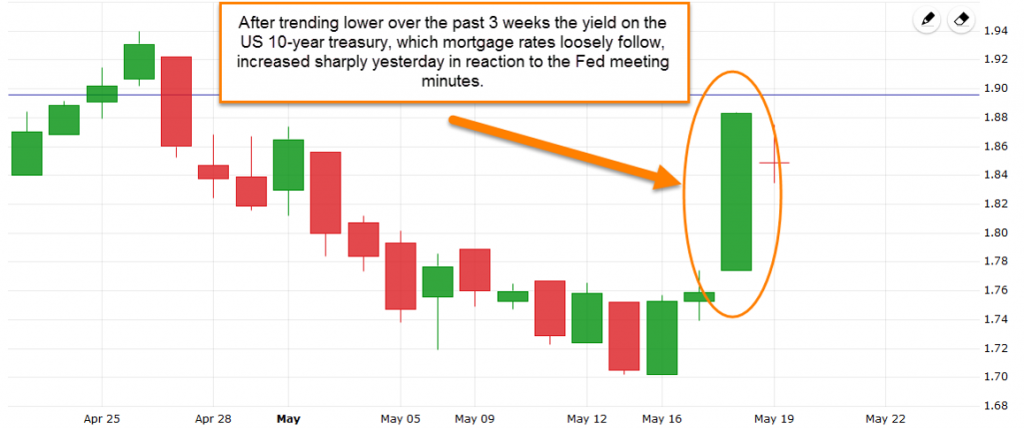
Mortgage rates worsened following yesterday’s release of the minutes from the most recent Fed meeting.  Have the markets overreacted?

The chart below shows the yield on the US 10-year treasury yield which increased sharply yesterday (mortgage rates followed suit).

05-19portland mortgage rates
Why this reaction?  The Fed meeting minutes signaled a possible Fed rate hike as soon as June (Fed meeting scheduled for June 14-15th).  However, in my view I do not believe this will happen.  The last Fed meeting took place in April before the most recent monthly jobs report was released.  As a reminder the most recent jobs report was weaker than expectations making it less likely that the Fed will hike rates.

I went into this week with a locking recommendation and that has proven to be the correct call.  Given that I believe the markets have overreacted to the release of the Fed meeting minutes I am going to shift back to a floating stance.

Current Outlook: floating

Mortgage Rate Update May 16, 2016

Mortgage rates remain near 3-year lows making it a great time to lock in a rate on a new home purchase or refinance.

Given that financial markets tend to operate in a cyclical manner I am currently recommending that customers lock their rate since they have trended lower over the past couple weeks (and therefore may “cycle” higher in the next couple weeks).

That said, many of the major banks have been revising their year end forecast for interest rates lower.  Last week Goldman Sachs lowered their expected yield on the US 10-year treasury yield following similar moves by Bank of America and Morgan Stanley.  Of course, if the banks knew for certain then there would be no need to revise so take this news for what it’s worth.

Recently, many of the major banks have peered into their crystal balls and revised their interest rate forecasts lower.

The economic calendar for this week is relatively short but there are some important releases.  Tomorrow the Labor Department will release the Consumer Price Index (CPI).  Inflation is the nemesis of mortgage rates and lately the year-over-year CPI figure has been creeping higher.  If this trend continues I wouldn’t be surprised to see rates tick higher.

On Wednesday the minutes from the most recent Fed meeting will be released.  Any additional information on the Fed plans certainly have the ability to move the markets.

I am going to recommend a locking bias simply because interest rates are extremely attractive levels.

Current Outlook: locking