Fed stays put as do mortgage interest rates

Seventy one years ago a wood raft carrying five people arrived at an island near Tahiti after a 101 day journey from Peru.  The raft was captained by Norwegian Thor Heyerdahl and supported his thesis that Polynesia’s earliest inhabitants may have migrated from South America.  

The story was later made popular in the best-selling book Kon-Tiki.  

The Fed

It looks like it will be about 101 days from the Fed’s last rate hike to the next one.  

As expected the Fed did not hike short-term interest rates last week.  According to CME Group there is a 93% probability that the Fed will hike by .25% when they meet in mid-September.  The Fed last hiked short-term interest rates back in mid-June.

As a reminder the Fed does not directly control mortgage rates but their comments and actions can influence them.  

Jobs Report

This past Friday the Labor Department released its monthly employment report.  It showed that the US economy created 157,000 jobs during July and wages grew modestly.

With the unemployment rate at 3.9% the labor market is deemed to be tight which we would expect to pressure wages higher.  If wages grow too quickly then it could lead to inflation which is not friendly for mortgage rates.

The Week Ahead

Speaking of inflation it is about the only significant event scheduled for release this week.  On Thursday we’ll get a look at the Producer Price Index and on Friday we’ll get the latest reading of the Consumer Price Index.

In the absence of a heavier economic calendar I would expect interest rates to react to technical trading patterns.  The technical signals suggest it will be much harder for rates to improve this week than for them to worsen.  I would recommend carrying a locking bias into the latter half of this week.

Current Outlook: locking
Home loan rates remain flat, risk of break out build

It all started with $6,000 in February of 1940 when the US Government granted that sum to a group of researchers who were curious about the potential for fissionable materials to be used for military purposes.  The original $6,000 later ballooned to over $2 billion and on this day in 1945 the Manhattan Project first “successfully” tested the atom bomb.

Home Loan Rates

Mortgage rates have been anything but explosive over the past two weeks.  Home loan rates have remained flat over that timeline.

Inflation

Price pressure is the primary driver of long-term interest rates.  

Last week both the Producer Price Index and the Consumer Price Index showed price increases above the Fed’s target of 2.0%.  The reports lend credibility for the Fed to maintain its rate tightening policy. It also increases the probability that mortgage rates will increase and not decrease.

Retail Sales

Although consumers may be paying higher prices for goods it does not seem to be slowing sales.  This morning the retail sales report showed better than expected activity.  Many analysts are pointing to federal income tax cuts as the primary reason why.  

Good news for the economy tends to be bad news for mortgage rates.

The Week Ahead

The economic calendar is fairly light this week.  Fed Chairman Jay Powell will be speaking on Tuesday.  On Wednesday we’ll get a look at housing starts and building permits.  On Thursday we’ll get leading economic indicators.

Technical signals

Mortgage rates have remained relatively flat for almost three weeks.  Any time rates remain flat for extended periods of time it increases the chances of a “break-out” which is when they move sharply higher or lower.  There is no telling when they will “break” and if they will break in our favor. The safe play is to lock in but ultimately it is a coin flip.

Current Outlook: neutral

Higher oil prices pressure home loan rates higher

They say that weddings are getting more and more expensive.  In fact, the average cost of one surpassed $30,000 in 2017.  That is enough to put 5% down and pay closing costs for a median priced home in Portland, OR..   

As I type there are four days, six hours, and 27 minutes until the royal wedding for Prince Harry and Meghan Markle.  That ceremony is estimated to cost $2.8 million which could be used to put 5% down on THIS HOME.

Mortgage Rates  

Unfortunately mortgage rates worsened modestly last week as US stocks rallied.  The US stock market registered its best week in over two months which put upward pressure on home loan rates.

Oil prices

Geopolitical tension in the middle east coupled with uncertainty around Iran economic sanctions further supported oil prices last week which are now at three and a half year highs.

Higher oil prices are problematic for interest rates because they tend to be inflationary and inflation is the primary driver of mortgage rates.  

The Week Ahead

This week’s economic calendar is relatively light.  It features a slew Fed officials speaking around the country.  The Fed does not directly control mortgage rates but their comments can certainly influence them.  

According to CME Group there is currently a 95% probability that the Fed will hike short-term interest rates at the next meeting on June 13th.  There is a 50% probability that the Fed will hike short-term rates three more times in 2018.

Outlook

Due to momentum and the longer-term trend for interest rates I favor a locking position this week.

Current Outlook: locking

Higher oil prices threaten mortgage rates

President Woodrow Wilson proclaimed the first Mother’s Day holiday this week in 1914.  For the past 104 years we have celebrated those special women in our society who desperately need a break yet do not want to miss a single minute.  Thank you moms!

Mortgage Rates  

Interest rates improved modestly last week but not enough to get excited about.  For most applicants their note rate is unchanged but the accompanying closing costs are lower.

Oil prices

Oil prices have been on the rise which does not bode well for mortgage rates.  In the past month they have increased by 10% reaching the highest levels since 2014.  

When oil prices rise it tends to cause inflationary pressure in the economy.  Inflation is the primary driver of long-term interest rates.  

The Week Ahead

Speaking of inflation we’ll get the latest reading on the Producer Price Index this Wednesday and the Consumer Price Index on Thursday.  If those reports come in hotter than expected I would expect rates to worsen.

Also on Wednesday the US Treasury is scheduled to auction $25 billion of 10-year treasury notes.  The added supply could make it hard for mortgage rates to improve for the second week in a row.  

From a technical perspective the yield on the US 10-year treasury note is currently at ~2.95%.  Fortunately the 3.00% level has acted as resistance so if we test that level again I am hopeful it will hold.  

Outlook

I am less optimistic than I was last week but still feel like rates will not move meaningfully higher in the near-term.  I will shift to a neutral position.

Current Outlook: neutral

Home Loan Rates stable….for now

With today being the first Monday after daylight savings I think we can all agree this is the “Mondayest” Monday of the year.

Mortgage rates stable?

Mortgage rates fared ‘OK’ last week.  For the most part home loan rates were unchanged despite US stock indexes moving higher.  Normally interest rates worsen when stocks do well.

Don’t look now but mortgage rates have traded within a .125% range since mid-February.

Jobs report

Last Friday’s all-important jobs report showed much stronger employment growth than was expected.  However, wage growth actually slowed modestly which is probably why mortgage rates didn’t move higher on the news.  Higher wages can lead to inflation which is the nemesis of mortgage rates.

Rates getting squeezed

The technical outlook for interest rates has me concerned that we may experience a “breakout”.  The yield on the US 10-year treasury note is trading in a tight range between technical support and resistance.  When this happens we sometimes see yields sharply bounce outside of the compressed range.

The week ahead

This week’s economic calendar features a variety of reports that can drive interest rates. Later today the US Treasury will auction off $21 billion in US 10-year treasury notes.  If demand weakens for this asset it would likely pressure home loan rates higher.

On Tuesday we’ll get the latest reading of the Consumer Price Index, on Wednesday Retail Sales, and on Thursday the Producer Price Index.

The safe play is to lock and avoid any possible breakout.

Current Outlook: locking bias

Can a cosigner help me qualify for a mortgage?

I often get asked if a cosigner can help a person qualify for a mortgage.  As is often the case in the home loan industry my answer is “it depends”.

Cosigners and poor credit

Can a person use a cosigner to overcome low credit scores?  Unfortunately, the answer is no. That’s because a mortgage underwriter will default to the lower of the two credit scores in a joint mortgage application.

For example, let’s assume we receive an application from a homebuyer who has a credit score of 550 which is too low to qualify for a conventional loan.  If their parents, who happen to have excellent credit scores, submit an application as a cosigner it does not change the credit decision because the underwriter will still use the 550 credit score in evaluating the application.

When cosigners can help

Typically, cosigners are included with a loan application when a person does not have enough qualifying income to be approved for a loan.

Let’s assume we have a homebuyer who is in a new career and does not have sufficient history of earning their income according to underwriting guidelines.  In that instance they may ask a parent or sibling to cosign.  We can then measure the cosigner’s income and existing obligations and use additional cash-flow to help the homebuyer qualify.

Cosigners and down payment help

Regarding down payments, theoretically a cosigner can help with a down payment for a homebuyer.  However, most loan programs allow for gift funds from family so there’s really no reason to go through the trouble of having the family member cosign if they’re not required to.

Primary residence only

Cosigners can typically only be used on a loan that is connected to a primary residence, not for buying rental property.  Furthermore, most jumbo mortgage loan programs have restrictions against using cosigners even if the loan is being made on a primary residence.

Cosigners be aware

Cosigners need to know that they are going to be obligated on that mortgage and that the account will show on their credit record.  Regardless of any agreements between the homebuyer and cosigner if any party fails to make payments on the home loan and causes a default that negative credit information will appear on both party’s credit reports.

If you have questions about qualifying for a mortgage or using a cosigner for your own situation, I would love to be a resource. Contact me today for a no obligation conversation.

Despite stock market losses home loan rates rose last week

The winter Olympics are fully underway in South Korea and I find it inspiring to watch all the athletes who have trained tirelessly for the past four years to compete for gold.  My idea of training?  I named my dog six miles so I could tell people that ‘I walked six miles today’.

Typically when stocks perform poorly interest rates benefit.  Last week the US stock market lost ~5% of its value yet interest rates continued to march higher.  Why?

S & D

I wrote about the topic last week and I am going to harp on it again.  One of the primary factors pressuring interest rates higher is supply and demand.

The supply of US Treasury notes is expected to increase following passage of the tax reform bill and the latest two-year federal budget.  Both create substantial deficit spending which will have to be financed with a greater supply of US debt.

Meanwhile, demand for US Treasury securities is expected to decline as central banks around the world cut back on quantitative easing measures which are a legacy of the great recession.

An increase in supply met with a decrease in demand drives prices lower which in turn pressures yields higher.

Four-year highs

The average rate for a conventional 30-year fixed rate mortgage is now at the highest level since 2014.  15-year fixed rate loans are at the highest level in over five years.

Since September mortgage rates have increased by over .50%.  A .50% increase to interest rates has the same impact on mortgage payments as home appreciation of 6%.  In other words, even without appreciation homes “feel” more expensive for buyers.

Interestingly, according to a recent survey only 6% of respondents said they would cancel their plans to buy a home if mortgage rates surpassed 5%.

The week ahead

The meat of this week’s economic calendar kicks off Wednesday with retail sales and the Consumer Price Index.  On Thursday we’ll get industrial production and the homebuilders’ index.  On Friday we’ll see housing starts and consumer sentiment.

The technical outlook is mixed.  Interest rates are currently trading at important technical levels that could help them reverse and move lower.  However, recent momentum is too much for me to ignore so I will maintain the locking position we;ve held for the past month.

Current Outlook: locking

Decreasing demand and increasing supply causes mortgage rates to rise

Congratulations to the Philadelphia Eagles who won their very first Super Bowl Championship yesterday.  As for the Patriots, do you know the difference between a New England fan and a carp?  Answer: One is a bottom-feeding, scum sucker, and the other is a fish.

Mortgage rates continue to march higher.  I know this may seem repetitive but it’s not like we didn’t see this coming (see HERE, HERE, and HERE).

Supply & Demand

The basic concept of supply and demand can explain why we’re witnessing home loan rates rising.  Rates are effectively determined by the price of mortgage-backed bonds (MBS’s).  When the price of bonds fall then mortgage rates rise and vice versa.

The Federal Reserve

Starting in 2017 the Fed began to unwind the balance sheet which they accrued during the aftermath of the housing crash.  The Fed had been investing billions of dollars per month into the fixed income market including MBS’s.  In the absence of the Fed’s investment demand for MBS’s has declined pushing prices down and yields up.

European Central Bank

The US central bank was not the only entity dumping money into quantitative easing (QE) measures following the recession.  The European Central Bank followed the US’s lead and became a major investor in the European fixed income market.  They recently discontinued their QE and that has also drawn demand away from the US further pressuring prices down and yields up.

Higher deficits

Not only is demand for fixed income securities declining but the US government will be increasing the supply of US Treasury notes and bonds in the coming years in order to fund the recently passed tax cuts.  Should congress and the president also sign an infrastructure bill into law we could expect to see higher deficits and a greater supply of fixed income securities competing with MBS’s.

The bottom line is that we are in an environment where the demand for MBS’s has declined and the supply of competing debt securities is increasing.  As a result yields are rising.

I expect this trend to continue in the immediate term.  I think mortgage rates will worsen by another .125%-.25% before stabilizing.

Current Outlook: locking

The stock market rally is not helping home loan rates

On this day in 1803 President Thomas Jefferson requested funding from Congress for the Lewis and Clark expedition.  The funding package was for $2,500 in 1803 dollars which equates to $52,252 in today’s dollars.  Any guesses as to whether or not our current government could accomplish the same feat as cheaply?

Government expeditions aren’t the only thing that have become more expensive.  Just take a look at the stock market.  Earlier today the Dow Jones Industrial Average (DJIA) eclipsed 26,000 for the first time.

Only seven trading sessions have passed from when the DJIA eclipsed 25,0000.  Should it close above 26,000 later today it would be the first time in the market’s 120-year history that it has increased by 1,000 points this quickly.

Typically, when stocks rally it hurts mortgage rates because it encourages money to flow out of the bond market and into equities.  As we know mortgage rates have increased by ~.25% over the past few weeks and the stock market has had an influence.

Momentum in the stock market suggests that home loan rates will have a difficult time moving lower in the near-term.  I think the best we can hope for this week is for them to remain constant and I won’t be surprised to see them edge higher.

In my personal opinion US stocks are currently overvalued as compared to long-run valuation comparisons (see HERE) but that doesn’t mean we’ll see a near-term correction.

For now I recommend locking.

Current Outlook: locking

A flattening yield curve may signal higher rates in the future

Interest rates and US stocks got off to a good start last week but had a rough finish.  For the week mortgage rates worsened very modestly.

We are 30 days away from the next Fed meeting and according to CME group there is currently a ~97% probability that the Fed will hike short-term interest rates.  I am guessing media coverage will pick up on this topic after the Thanksgiving Holiday.

As a reminder the Fed does not directly control mortgage rates.  The Federal Funds Rate is charged on overnight loans between banks and a mortgage can last 30 years.

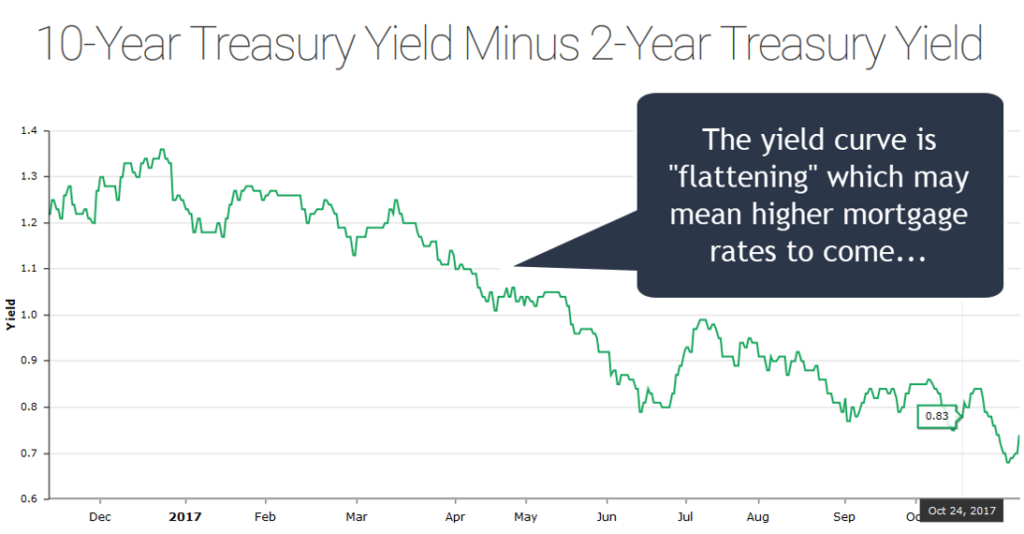
What’s interesting is that as the Fed has hiked short-term interest rates yields for shorter-term loans (i.e. less than three years) have increased yet longer-term durations have remained relatively low.  A look at he spread between the 2-year and 10-year treasury notes tell the story:

The yield curve is “flattening” which may mean long-term rates, including mortgages, will rise in the future or could also signal a recession.  Time will tell.

As I had written about last week (see HERE) sentiment regarding the tax overhaul is driving the direction of the financial markets. I expect much of the same this week.

The Senate version of the tax overhaul legislation, which was released on Thursday, will now be reconciled with the House version.  Given the vast differences investors now seem pessimistic that a compromise will be made.  Given that the tax overhaul is seen as inflationary this could actually help interest rates remain low……for now.

The economic calendar is busy this week.  Although we lost ground last week I will remain cautiously floating.

Current Outlook: cautiously floating