Mortgage Rate Update May 21, 2015

Mortgage rates are mostly unchanged from Monday’s ‘rate update’.  Although my last couple updates have reported unchanged levels of interest rates there has been volatility in between my posts.

Minutes from the most recent Federal Reserve monetary policy meeting were released yesterday and showed that the Fed will continue to be patient in raising short-term interest rates.  According to the release most Fed officials do not see the economy strengthening enough to be able to raise rates at their next scheduled meeting June 16-17th.  For the time being this is good news for mortgage rates.

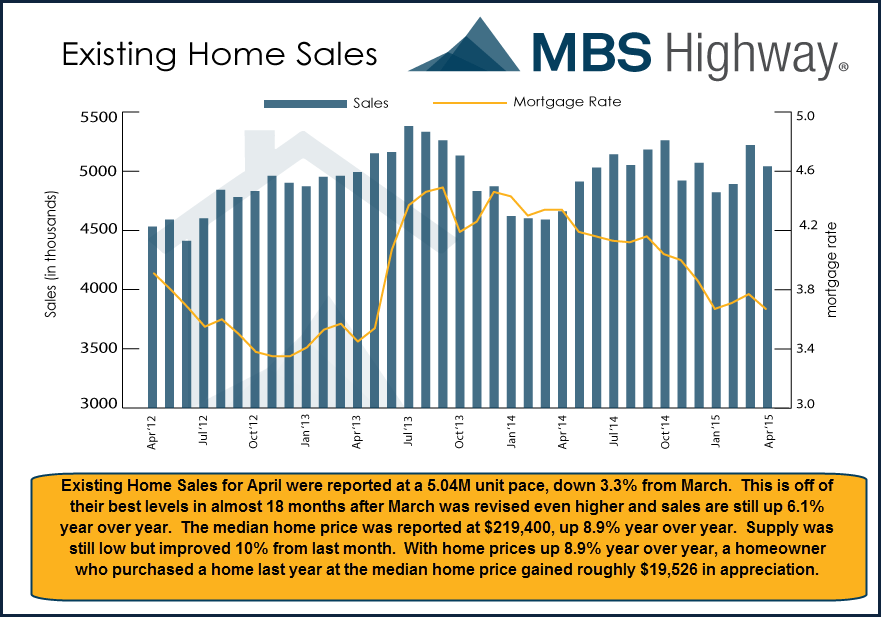
Earlier today the National Association of Realtors released the latest reading on existing home sales.  In terms of volume of sales the number of transactions fell in April by ~1% from a year earlier.  At first glance one might think this would signal weakness in the housing market.  However, given that the median home price continued to pace higher (+8.9% year-over-year) we know that the drop in sales is not a result of weak demand but instead low supply.
existing-home-sales-5-21-1522E9D432B20E

From a technical perspective mortgage rates are trying their best to eek their way back down but they have not convincingly broken through important technical resistance.  For now we can float but should rates reverse higher, which I anticipate, we’ll need to lock in.

Current Outlook: carefully floating

Mortgage Rate Update May 14, 2015

Mortgage rates are worse today compared to Monday morning.  Interest rates in the US and Germany closed at their worst levels in five months yesterday.

As I highlighted last Thursday the yield on the US 10-year treasury note is still hovering near the 2.25% level.  The last two times yields have drifted to this level they have improved in the week following.  We are still waiting to see if this pattern will repeat this time around.

Yesterday’s Retail Sales report showed continued stagnation on the part of US consumers.  Overall sales have been flat or slightly lower for four of the past five months.  What about inflation?  This morning’s Producer Price Index (PPI) showed inflation at the wholesale level of the US economy is still very low.  At this point it appears the Fed has little to worry about.

The meat of the economic calendar has been released for this week.  I expect mortgage rates to react to technical trading patterns the through tomorrow.  Thus far this morning mortgage-backed bonds are trading favorably so I will recommend floating at least into tomorrow.

Current Outlook: locking bias

Mortgage Rate Update May 11, 2015

Mortgage rates are very similar to the levels we saw on Thursday of last week.  Mortgage rates continued marching higher Monday-Wednesday last week and finally caught a break on Thursday-Friday as we thought might happen.  Unfortunately we are not getting any follow through this morning as yields are trending higher once again.

In case you missed it Friday’s all-important jobs report is being referred to as a “goldilocks” report.  With 223,000 new jobs created in April the labor market is “not too hot” and “not too cold”.  With a neutral result the Fed remains on course to raise short term interest rates but likely not at either of their next two meetings.  The markets currently place a 19% likelihood that the Fed will raise short-term interest rates at the September meeting and 37% for October.

jobs-report-5-8-15

Speaking of the Fed, Janet Yellen commented last week that “Long-term interest rates are at very low levels…we could see a sharp jump in long-term rates when the Fed begins its tightening cycle.”  Have we seen the end of less than 4% 30-year fixed rates?  Time will tell.

The economic calendar is light this week with the highlights coming on Wednesday (Retail Sales) and Thursday (Producer Price Index).

The technical outlook has shifted and has me concerned that rates are poised to move higher so I will shift to a locking bias.

Current Outlook: locking bias

Mortgage Rate Update May 7, 2015

Mortgage rates have had a very difficult run from April 21st to today.  During the past couple weeks mortgage rates have risen by ~.25% and the yield on the US 10-year treasury yield went from ~1.90% to 2.25%.

Will rates continue to trend higher or are we in for a reversal soon?  If recent history is any lesson then the outlook is promising.  The last two times that the yield on the US 10-year treasury yield reached 2.2% (December 24th & March 9th) rates declined sharply back to 1.90% within 8 trading days.

10yr May 7th

Based on this pattern it would seem that floating is the best option.  However, tomorrow we get the all-important jobs report.  As we know this is typically the most influential monthly economic report.  Should the report come out stronger than expected then we’d expect rates to move higher and vice versa.

Knowing that the Fed is looking for signs of inflation it will also be important to pay attention to the average hourly earnings growth.  Assuming wages are growing this would likely pressure prices higher and force the Fed to begin raising short-term interest rates.

Current Outlook: floating bias

Mortgage Rate Update May 4, 2015

Mortgage rates remain at similar levels to last Thursday.  After going unchanged for the better part of April mortgage rates increased by .125%-.25% during the last week of the month.

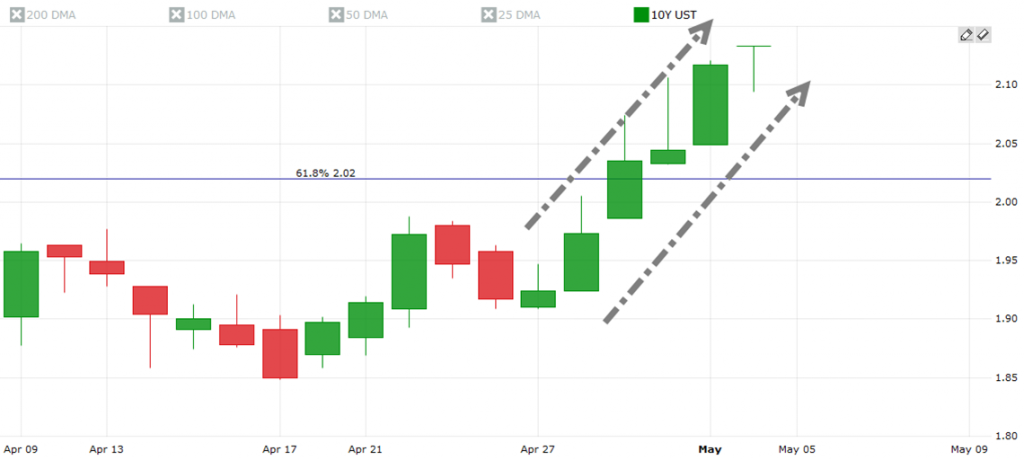
A look at the US 10-year treasury yield tells us all we need to know.  From April 27th to today yields rose from 1.92% to 2.13%.

05-04-10yr1

US interest rates are following Germany.  From April 20th to today the yield on a 10-year German bund increased from .07% to .416%.

Will rates continue to move higher?  The trend is certainly not favorable.  The economic calendar is fairly quiet until Wednesday when the trio of employment reports get released.  On Wednesday we get the ADP report, on Thursday weekly jobless claims, and then the all-important jobs report on Friday.

We shifted to a locking bias on Thursday of last week and will maintain it today.

Current Outlook: locking bias

Mortgage Rate Update April 30, 2015

Mortgage rates have finally broken outside of the tight .125% range they’ve remained within since the beginning of April.  Unfortunately they’ve broken out in the wrong direction.

In yesterday’s Fed statement officials reiterated their stance that they are prepared to raise short-term interest rates but that they will not begin that process until conditions in the labor market improve and inflation moves towards 2.00%.

Speaking of….. the Fed’s favorite gauge of inflation known as the Personal Consumption Expenditure Price Index (PCE) was released this morning and showed very tepid price pressure.  When stripping out volatile food and energy prices inflation was just 1.3% for the past year.

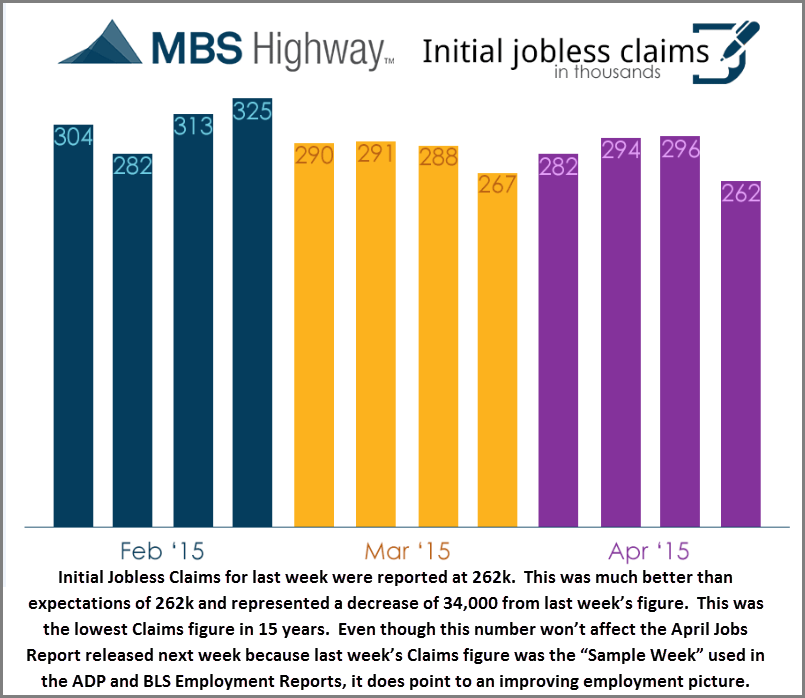
However, in a separate release from the Labor Department the Employment Cost Index showed that wage and benefit costs for employers rose by 2.6% during the first quarter of 2015 after increasing by only 2.2% in the second half of 2014.  An acceleration in labor costs could signal wage-based inflation which could be the catalyst for higher inflation and interest rates in the future.  Furthermore, weekly jobless claims for last week were at the lowest level in 15 years.  Good news for the economy is often bad news for mortgage rates.

claims-4-30-15

From a technical perspective the picture is not terribly encouraging.  The US 10-year treasury yield, which mortgage rates loosely follow, is up ~.2% in the past three days.  Mortgage rates have risen .125%-.25% and we could see things get worse before they get better.

Current Outlook: locking bias

Mortgage Rate Update April 27, 2015

Mortgage rates have effectively remain unchanged for the entire month of April.  I cannot recall a period as long as this where rates have remained so stable for so long.  The economic calendar is busy this week so I would not be surprised if we see rates for better or worse.

Looking ahead for the week Standard & Poors will release the monthly Case-Shiller home price index tomorrow.  On Wednesday we’ll get a reading on the US Gross Domestic Product and the Fed will release its latest monetary policy statement following their regularly scheduled meeting.  We continue to believe that the Fed will not raise short-term interest rates at this meeting but may offer clues as to when that first hike will take place.  On Thursday we’ll see readings on personal income/ spending and the Fed’s favorite gauge of inflation known as “PCE”.

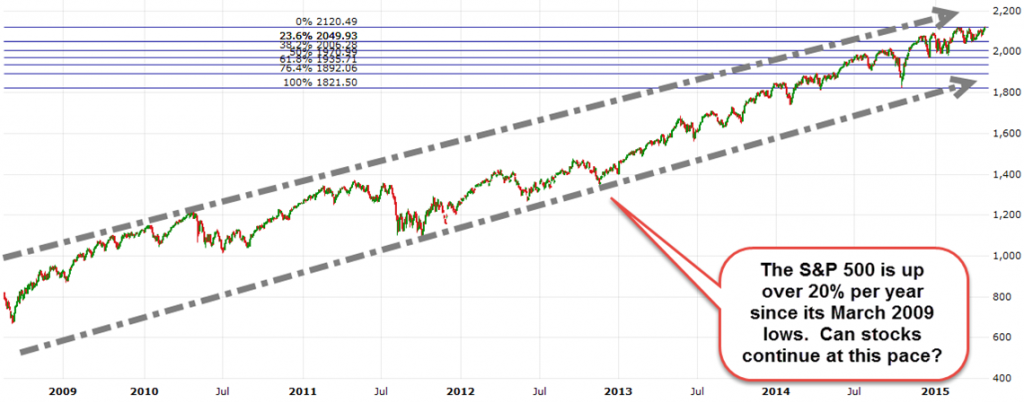
Mortgage rates remain near historical lows despite US stocks continuing to rally (generally speaking when stocks rise it puts upward pressure on interest rates).  The S&P 500 is currently trading at ~2,120.  On March 2009 it traded @ 675 which means the S&P 500 has earned an 18.91% annualized return (not including dividends) since then.  Can stocks continue on at this pace?  No knows for certain but I am skeptical of current valuations in the US stock market.

04-27sp5001

From a technical perspective mortgage-backed bonds are currently trading at an important layer of support.  We need to see prices hold for rates to remain at these levels.  The safe play is to lock but based on the last month there may be moderately better pricing later in the week.

Current Outlook: floating

Mortgage Rate Update April 23, 2015

Although mortgage note rates are unchanged today the accompanying closing costs have worsened slightly this week.

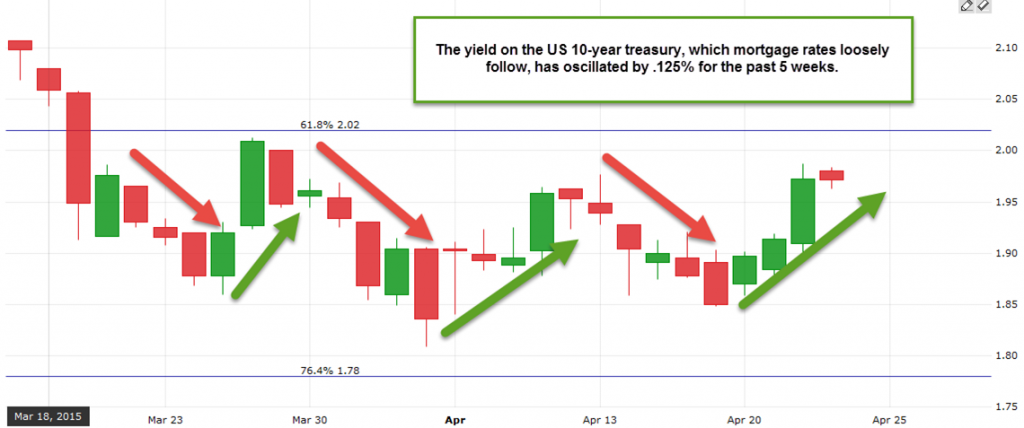
As I have been writing for the past couple weeks interest rates are trading sideways within a tight range.  Currently, the pricing on mortgage rates are at the worst levels since the middle of March (on a historical scale rates are still very attractive).  This pattern is evident by looking at the yield on the US 10-year treasury yield, which mortgage rates loosely correlate with, since St. Patrick’s Day:

4-23-15 US 10yr
As you can see the yield has drifted lower then higher then lower then higher, etc. within a well defined range.  Should this pattern continue then we’d expect pricing on rates to improve over the course of the next few days in which case it makes sense to float.

However, should this pattern break it would likely mean that interest rates continue to worsen so this position is a risk.  For now I will recommend a floating position and should yields on the US 10 year note worsen to 2.00% or higher we’ll need to lock.

Current Outlook: floating

Mortgage Rate Update April 20, 2015

Mortgage rates continue on a sideways path with no meaningful movement up or down.  Might we see some volatility this week?  The economic calendar is very light.  The only meaningful data scheduled for release this week is existing home sales (Wednesday), new home sale (Thursday), and durable goods (Friday).

In the absence of significant readings on the economy mortgage rates are likely to react to technical trading patterns and the stock market.

From a technical perspective mortgage-backed bonds (MBS’s) have traded within a fairly narrow range since April 1st.  Anytime we see prolonged periods of time where MBS’s trade within a tight trading range it increases the risk for “breakout” where interest rates react quickly for better or worse.

A look at the yield on the US 10-year treasury note may offer clues.  In the past 5 weeks the yield on the US 10-year treasury note has made three attempts at moving below 1.85%.  Thus far none of these have proved successful.  It looks like they are gearing up for another attempt.  Should yields break below this level we would expect them to touch 1.78% which may squeeze an additional .125% improvement for mortgage rates.

4-20-15 10yr


For now, we’ll float to see if rates can move a bit lower.  Should he yield on the US 10-year treasury note reverse higher I will shift to a locking position.

Current Outlook: floating

Mortgage Rate Update April 16, 2015

It’s a lot more of the same this morning as mortgage rates have effectively been unchanged for over two weeks now.

US interest rates look as if they want to move higher following comments from Federal Reserve Vice Chairman Stanley Fischer.  Earlier he stated that he sees signs of wage pressure building in the economy.  The Fed is not going to raise short-term interest rates until they see inflation move higher to ~2%.  If wages due rise in our economy it would likely pressure inflation higher which is a bad sign for mortgage rates.

10 german

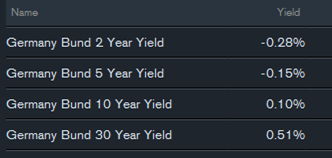
Meanwhile, interest rates in Germany remain ultra-low.  Currently yields on German government 2-year and 5-year notes are negative.  This means investors are actually paying money in order to lend the German government money.  The 10-year German bund is yielding only .10% (US 10-year note is at ~1.9%).  As long as rates remain low in Germany it should keep somewhat of a ceiling on US interest rates.

From a technical perspective mortgage-backed bond prices are trading within a fairly tight range and have been for nearly three weeks.  Anytime we see prolonged periods of sideways movement it increases the risk of a “breakout” where bond prices move sharply up or down.  These are very difficult to predict.

At this point I believe borrowers have more to lose than to gain so I will take a locking bias.

Current Outlook: locking bias