My blog is a tool for me to provide updates on what is happening in the financial markets that will impact mortgage rates, update professional partners on what is happening in the mortgage industry, and write about general financially related topics.
After spending over 16 years in the mortgage lending industry I have identified seven myths that consumers commonly hold regarding their credit score. Over the course of the next few weeks I am going to breakdown each myth and help you better understand how your credit scores are determined so that you can achieve a better outcome for your next loan application.
The first myth is that we all only have one credit score. In fact, consumers have over 40 different credits scores which are determined by various algorithms that specific industries subscribe to. Please watch this short video to learn more:
Want to learn more? I found THIS ARTICLE in Forbes online which goes into greater detail.
Please contact me today to learn more about how your credit will impact your next home loan process.
Christmas has come early to homeowners and prospective home-buyers in the Portland housing market!
Despite median home prices increasing by only +5.1% over the past twelve months the Federal Housing Finance Agency announced that the conforming loan limits in 2019 will increase by 6.9%.
The maximum conforming loan amount for 2019 will be $484,350 for a one-unit property, up from $453,100.
I still wish they would round the loan amount to an even $484,000 but hey, beggars can’t be choosers.
What do you call a cow with a twitch?….beef jerky……Happy National Craft Beef Jerky Day!
US Stocks & Interest Rates
Economic uncertainty is taking a toll on the stock market and helping mortgage rates improve.
In an interview with the Wall Street Journal President Trump said it was “highly unlikely” that the US would accept a request from China to hold off on additional trade tariffs as the two countries head into a trade summit.
US interest rates are currently at two-month lows.
Housing Prices
As interest rates decline so do appreciation rates for homes. Home prices are still increasing year-over-year but not as rapidly as they have over the past few years.
Josh Lehner of the Oregon Bureau of Economic Analysis recently wrote THIS PIECE which explains how the housing market is re-balancing after years of under supply and strong demand.
The Week Ahead
This week’s economic calendar is busy. On Wednesday we’ll see new home sales and Fed Chairman Jerome Powell is scheduled to speak. On Thursday we’ll get minutes from the last Fed meeting and their favorite gauge of inflation (PCE price index).
Given that mortgage rates are at recent lows I recommend locking in.
The irony of Thanksgiving and Black Friday on back-to-back days has always seemed funny to me. How is it that we spend one day acting grateful for everything we already have then spending the next day trampling over each other to buy new things?
I wish you a warm and blessed Thanksgiving Holiday!
Mortgage Rates
Home loan rates are on a nice run lower thanks to weakness in the stock market. When stocks do poorly investors typically park their money in perceived safe places which includes the US debt markets. The additional demand for these securities drives yields lower.
US Stocks
The US stock market was trading at all-time highs only seven weeks ago. Since then the S&P 500 has fallen approximately 10%. Since July Facebook, Amazon, Netflix, and Google have lost nearly $1 trillion in combined market capitalization.
Is the loss of stock market wealth contributing to the slowdown in demand for home sales? Afterall, in order for a person to make a large financial commitment like purchasing a home they have to feel confident about their future prospects. Lower wealth could cause some people to hold off on buying a home.
Consumer Confidence
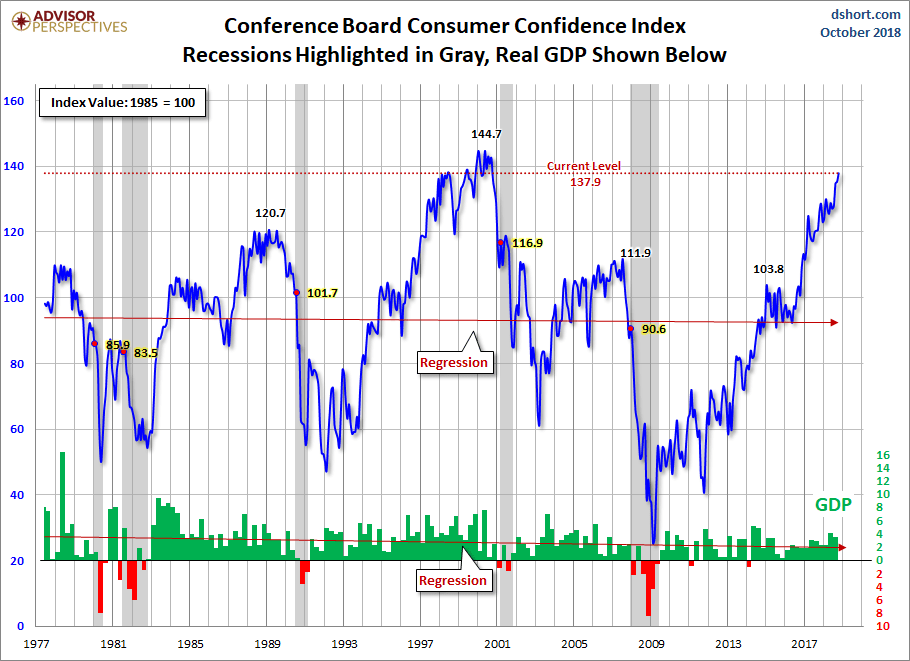
According to the Conference Board the Consumer Confidence Index (CCI) is currently at 137.9. This is the highest level since September of 2000 when it stood at 142.5 so according to this measure households are still feeling pretty good.
However, the CCI has a pretty good track record of being a contrarian indicator as the graph below shows.
Source: Advisor Perspectives
The Week Ahead
It is a holiday shortened week and the economic calendar is relatively light. I expect US mortgage rates to react to the stock market. If stocks can rebound and move higher then home loan rates will likely worsen and vice versa.
There is so much that I feel gratitude for. Thank you for all of you who support our business and lives. With sincere thanks we want you to know that we appreciate you.
The housing market here in Portland is shifting and I wanted to offer a candid and honest assessment of how I see things. Please take a moment to watch this short video where I explain and provide some data.
Have a warm and safe Turkey Day! As always we are here to help anyone seeking home loan services without surprises! Thanks!
A sincere THANK YOU to those who have served and continue to serve our country!
As an Oregonian I am proud that we are one of five states that honors our veterans by offering a subsidized home loan program which allows those who have served in the military to own a home with more attractive loan terms than a conventional loan. Learn more about the ODVA loan program HERE.
Mortgage Rates
Although mortgage note rates are mainly unchanged from last week the underlying costs associated with each interest rate improved so overall rate sheets are more attractive for consumers to start this week.
Lower delinquencies could encourage lenders to ease credit requirements for loan approval. This pressure coupled with a lack of enforcement from the Federal Government raises some concerns for me about irresponsible lending moving forward.
The Week Ahead
The economic calendar heats up starting on Wednesday when we’ll see the Consumer Price Index. I will also be watching out for monthly Retail Sales due out Thursday and Industrial Production on Friday.
If you listen to one side there are always too many democratic congressman being elected. The other side will say there are too many republican congressman being elected. My question is when do we get the opportunity to elect a US congressman?
Best of luck to all the candidates today. Please don’t forget to pull your TV ad spending after today so we can watch football in peace this weekend.
The election
Today is election day. The polls do not suggest a landslide in either direction so we don’t expect the results to influence home loan rates.
Jobs Report
Mortgage rates were enjoying some improvement last week until the all-important jobs report was released on Friday. The report showed the US economy added 250,000 new jobs last month which was stronger than expected. Average wages for US workers also increased more than expected (+3.1%). As expected, mortgage rates moved higher following the release.
The Fed
The Fed will conduct its regularly scheduled monetary policy meeting over the next two days. The Fed is not expected to hike rates at this meeting but their policy statement may cement their intent to hike at their next meeting in six weeks. The Fed does not directly control mortgage rates but their comments can influence their direction.
US 10-year treasury note
The US 10-year treasury note is currently yielding 3.20%. If yields worsen and close above the 3.25% threshold that would be a very bad signal for mortgage rates. We’ll need to keep a close eye on that.
The Week Ahead
On Thursday we’ll see the Fed’s policy statement and on Friday we’ll get the latest reading on the Produce Price Index.
As a father of two I wish Halloween fell on the weekend. Ever wonder why it is celebrated on October 31st? You can find out HERE.
Interest rates
After hitting recent highs back on October 9th mortgage rates have improved very modestly. Weakness in the stock market is likely the cause for the improvement in interest rates.
The Case-Shiller home price index was released today. The report showed that Portland home prices increased by 5.4% from last year. However, compared to the month before home prices were off by .1%.
Although home prices here in Portland continue to increase (as measured year-over-year) they are doing so at a slower rate. The +5.4% increase is the slowest rate of appreciation since 2012 and the Portland market now lags the national 20-city composite index which increased by +5.8%.
Seller Buydown strategy
Please take a moment to watch the video below which is a creative strategy to help bridge the gap between sellers’ willingness to make concessions in the current market and buyers who feel pinched by affordability pressures.
The Week Ahead
The Bureau of Labor Statistics will release its all-important monthly jobs report this Friday. The markets are currently expecting +202,000 new jobs. I won’t be surprised if the actual numbers miss expectations given the volatile weather in the southeast.
Think Portland has grown? According to Wikipedia there are currently 647,805 residents inside the city limits.
Comparatively, there are 102 cities in China with a population of 1 million or more. Shanghai is the largest with 22 million people. The US currently has 10 cities with a population of 1 million or more.
When stocks do poorly it encourages investors to sell equity holdings and reinvest the proceeds into the bond market. That additional demand for bonds is what drives yields lower. As a result, home loan rates tend to benefit when stocks sell off.
Although mortgage note rates have not declined they have at least stalled which is a win compared to the sharp increases we saw during the first week of October.
What’s next?
Should stocks continue to sell off I would expect home loan rates to improve modestly. However, if stocks gain footing and recover last week’s losses then it will put further pressure on mortgage rates to move higher.
Dating back over 100 years there have only been two times when this metric has been above 30, 1929 and 1999. In my view US stocks are still expensive which leads me to believe that values will correct at some point in the future which should help US interest rates.
If you are a believer in the proverb “what goes up must come down” then last week doesn’t hurt so bad.
Home Loan Rates
Mortgage rates suffered the biggest increase in one week since the presidential election in November 2016. Interest rates rose by +.25% last week.
Affordability
It seems obvious that as the cost of borrowing increases affordability of homes worsens. But how much? For every 1% increase to interest rates purchasing power decreases by 12% for homebuyers.
Therefore, homes got 3% more expensive in five short days.
Wages
The good news and bad news is that average hourly wages are increasing in the US. Over the past year American workers have seen their pay increase by 2.9%. That is good news because it allows households to afford higher mortgage payments but bad news because it helps contribute to higher interest rates via wage-based inflation.
Why are rates rising?
One of the primary reasons why we’re seeing mortgage rates rise is because the Fed is no longer supporting them. I explained this concept back in February (HERE). For years the Fed had been purchasing mortgage-backed securities via quantitative easing. Instead of stopping the support immediately they gradually tapered their activity.
As recently as September they had been reinvesting some of their capital into the mortgage-backed securities market. Starting on October 1st that activity has ceased and as a result interest rates have risen in order to attract capital from other places.
The week ahead
The economic calendar is relatively light this week. There are three Fed officials speaking today. Tomorrow we’ll see the producer price index and on Thursday we’ll get the consumer price index. Since mortgage rates increased so sharply last week I am going to recommend floating this week in the hopes that what goes up must come down.