Mortgage Rate Update February 4, 2016

Rates are mainly unchanged from Monday.  Mortgage rates have improved by .25%-.375% over the past 3 months. The chart below demonstrates the correlation between changes in the US-10 year and mortgage rates.
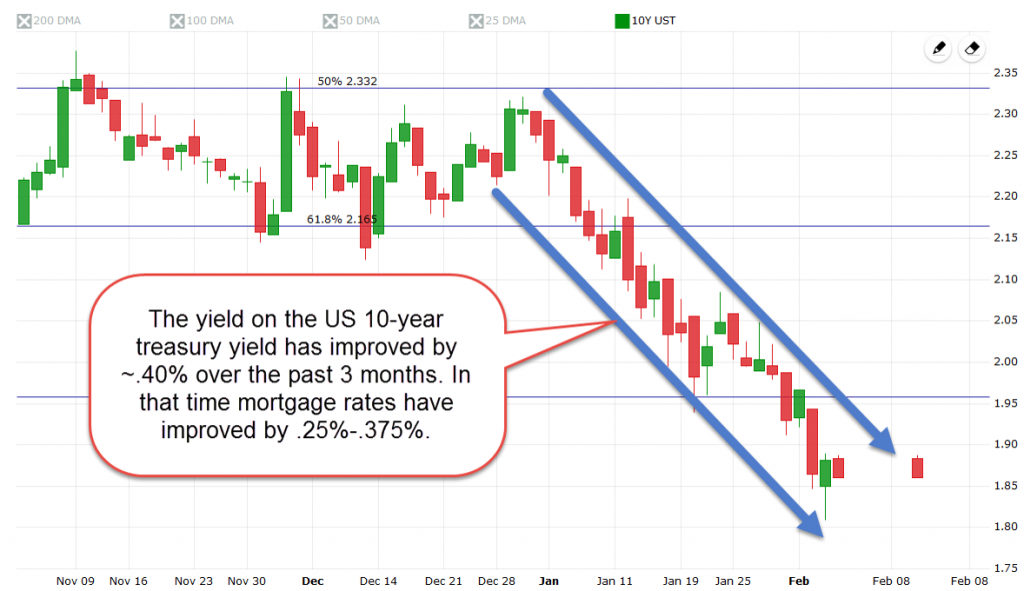
02-04-10yr

Tomorrow we get the latest all-important monthly jobs report from the Bureau of Labor Statistics.  In case you’ve forgotten last month’s report showed that 292,000 new jobs were created but a deeper look into the report showed that many of those were seasonal.  As a result, despite the stronger than expected headline number mortgage rates did not increase you we would have expected.

The markets are currently expecting only 188,000 new jobs created during the month of January.  Given the lower bar it would seem more likely that the report could surprise to the upside which would hurt mortgage rates.  However, looking at the aforementioned chart we do have momentum on our side.

The next Fed meeting is scheduled for March 15th-16th so this jobs report will not have as much significance because there will be one more released on Friday, March 4th.

The monthly jobs report is always difficult to handicap.  The momentum in the marketplace is playing to our favor so I am inclined to float.  That said, we’ve had a great run in the past 90 days so the safe play is to lock in while we’re ahead.

Current Outlook: locking bias

Grant Program to be eliminated

Back in 2014 the National Homebuyer Fund (www.nhfloan.org) made buying a home with 0% down possible again by arranging down payment grants to qualifying buyers.  I wrote about the program HERE.

It was announced yesterday that this grant program would be suspended as of February 29, 2016.  Homebuyers utilizing the grant program can close after February 29, 2016 but reservations and locks must be received no later than that date.

It remains to be sen if another entity will come in ad fill this void.

Mortgage Rate Update February 1, 2016

Mortgage rates are slightly better as compared to last week.

Last Friday the Bank of Japan, which is the central bank, surprised the global markets by cutting short-term interest rates in that economy.  Their short-term interest rates are now negative which means commercial banks must now pay the Bank of Japan for the privilege of parking cash in their vaults.  The purpose is to encourage banks to lend money to businesses and consumers to increase economic activity in that country.

Last week the Bank of Japan surprised the global markets by cutting short-term rates into negative territory.

That announcement coupled with the possibility that the European Central Bank increasing stimulus efforts in March puts the United States Federal Reserve in an awkward position because they had intended on hiking short-term interest rates this year.

In domestic economic news, the personal spending report was released earlier today.  embedded inside this release is the Fed’s favorite gauge on inflation known as the Personal Consumption Expenditure Price Index (PCE).  The PCE showed that prices in the US economy increased by only 1.4% over the past 12 months which is well below the Fed’s target of 2.0%.  One thing to note about the PCE is that it does not include out of pocket costs for health care or the cost of housing (rent/ home prices).   Given that home prices and rents have risen so rapidly in the past 24 months I think we need to accept today’s report with a giant grain of salt.

Looking ahead and the remainder of the week the all-important jobs report will take center stage.  From a technical perspective mortgage rates have had a great run.  I am concerned that we will see a reversal of sentiment in the markets.  I am maintaining a locking bias.

Current Outlook: locking bias

Mortgage Rate Update January 28, 2016

Mortgage rates are unchanged from Monday.

Yesterday the Fed concluded their latest monetary policy meeting and delivered the highly anticipated statement.  As we expected (see HERE) the Fed did come slightly more “dovish” in their outlook for hiking short-term interest rates in 2016.  As a reminder the Fed does not directly control mortgage rates.

Following the December meeting the Fed had led the markets to believe that they would hike 4 times during 2016 for a total increase of 1.00%.  Since then the US stock market has declined by ~10% and equity markets in Japan, China, and France are down even more.  In their statement the Fed acknowledged the shift in the economic outlook and said they’d be “…closely monitoring global economic and financial developments…”.  At this point the markets a placing a very low probability on a rate hike at the next meeting scheduled for March.

According to the most recent S&P Case-Shiller Home Price Index report Portland led the nation in annual home price appreciation for the year ending in November 2015.

In housing news the S&P Case-Shiller Home Price Index report was released on Tuesday.  The report covered home price changes for the month of November 2015.  In case you missed it Portland led the nation in annual home price appreciation at 11.1%.  That report coupled with the Pending Homes Sales report released by the National Association of Realtors today indicate a market where demand remains strong and supply is scarce.

From a technical perspective interest rates remain very attractive going back a couple years.  I am going to recommend a locking bias.

Current Outlook: locking bias

Mortgage Rate Update January 25, 2016

Mortgage rates are unchanged from last week and remain at multi-month lows.

It’s Fed week so I anticipate the financial markets will trade sideways until the monetary policy committee releases its statement on Wednesday at 11AM PST.  As a reminder, the Fed does not directly control mortgage rates but their comments and actions do impact the financial markets, including mortgage rates.

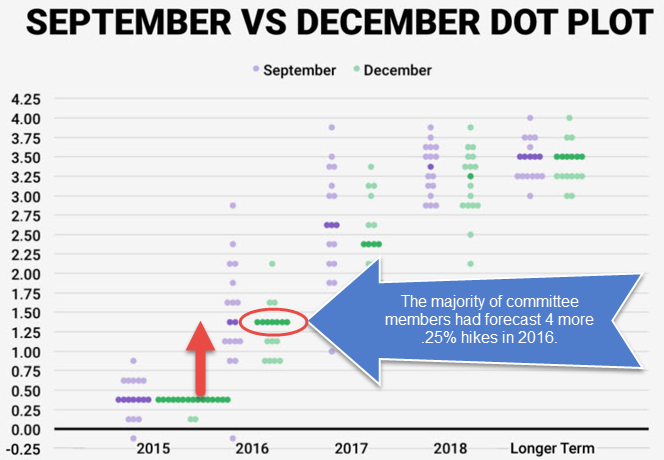
As we know the Fed embarked on a rate hiking cycle at the mid-December meeting.  In addition, the Fed released the chart below showing where the individual committee members forecast the Federal Funds rate to be in the future.

Source: The Federal Reserve

This chart shows that the majority of committee members had forecast 4 more +.25% hikes during 2016 (for a total +1.00%).  I use the term ‘had’ in the previous sentence because there is speculation that the Fed will back off this forecast given the recent turmoil in the financial markets.  Keep in mind, the US central bank is tightening monetary policy while its counterparts in Europe and Japan are all easing.

If the Fed does publish a less “hawkish” statement it could spark a rally in stocks which we know would not be favorable for mortgage rates.  Given that I think this is a real possibility I am going to recommend locking before Wednesday.

Current Outlook: locking before Wednesday

Mortgage Rate Update January 21, 2016

Mortgage rates are unchanged from the beginning of the week and remain at multi-month lows.  If you missed the window for refinancing in October 2015 now is your time to revisit your options.

As I wrote about on Tuesday weakness in the stock market continues to help mortgage rates improve.  Much of the media focus here in the US has been on our domestic equity markets which are off by approximately 10% in the past month.  Did you know Asia is faring much worse?

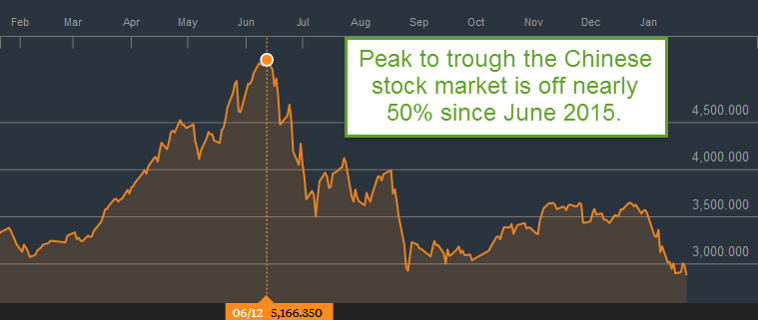
From the “it could be worse department” Japan’s Nikkei 225 stock index is off by approximately 20% since the beginning of December and China’s Shanghai Stock Index is off nearly 50% since June.

Source: Bloomberg.com

Global stock market volatility encourages investors to dump equity holdings and seek “safe-havens” for their capital.  This additional demand for US fixed income securities drives yields lower which is why mortgage rates have improved by .125%-.25% over the past month.

Will this trend continue?  It’s always difficult to know.  Many stock markets analysts have turned cautious.  I am going to recommend a floating bias since momentum is on our side.

Current Outlook: floating

Mortgage Rate Update January 19, 2016

Interest rates are extremely attractive.  They are currently at the best levels since October of last year.

I’ve written numerous times about how the stock market can impact mortgage rates.  All else being equal when stocks do poorly interest rates benefit as a result of a “flight-to-safety”.  Want to see a great example of this?

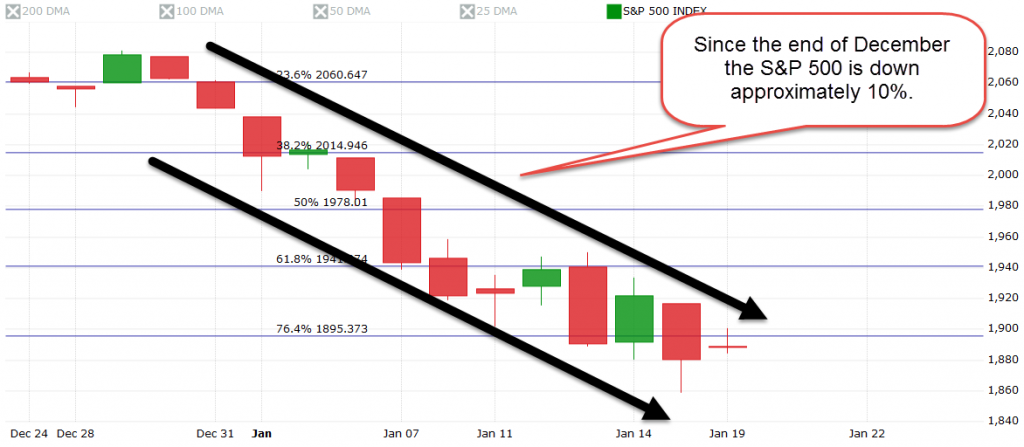
Over the past month the S&P 500 has fallen by approximately 10% (on a related note see HERE).

01-19SP500
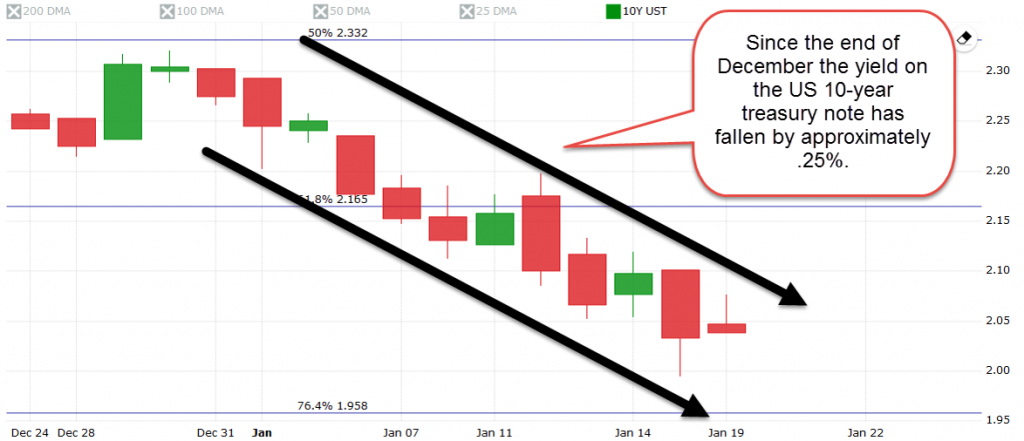
Over that same time period the yield on the US 10-year treasury note, which mortgage rates tend to track, have improved as well.

01-19-US 10yr treasury

The stock market will likely overshadow other factors in this holiday shortened week.  If stocks rebound then mortgage rates may reverse higher but if they continue to slump we could see rates move even lower.  If I knew with certainty what was going to happen you and I could make a lot of money.

Given that mortgage rates have improved by .125%-.25% in the past month I am going to recommend a locking bias even though I can see stocks continuing to struggle.

Current Outlook: locking bias

Mortgage Rate Update January 14, 2016

Mortgage rates are essentially unchanged from the beginning of the week and remain at 2-month lows.

As I have repeatedly written over the past few months the Fed does not directly control mortgage rates.  In mid-December the Fed increased short-term interest rates by +.25%.  Since then mortgage rates have improved by ~-.25%.  There you have it.

With an assist to Art Cashin, I want to take a moment to focus on the stock market.  As we know, when stocks do poorly mortgage rates tend to benefit and vice versa.  Below is a chart of the S&P 500 for the past 6 months.

01-14-SP500

As you can see the S&P 500 has experienced two 10% corrections in the past six months.  In the past 100 years this has only happened three other times.  The other three occurrences took place in 1929, 2000, and 2008.  Do you need a reminder on how those years turned out for the stock market?  Of course there is no guarantee that history will repeat itself but this is certainly a concerning prospect.

From a technical perspective mortgage rates appear ripe for reversal.  I am going to recommend a locking position.

Current Outlook: cautiously floating

Mortgage Rate Update January 11, 2015

Mortgage rates are improved from the beginning of last week.

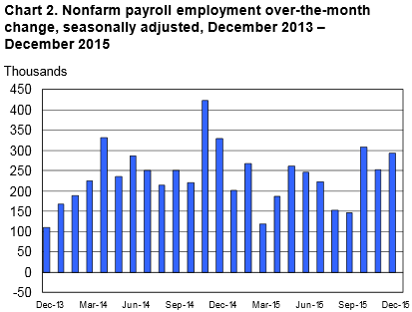
In case you missed it the headline numbers that accompanied the all-important jobs report were better than expected.  According to the report the US economy added 292,000 new jobs during the month of December, far more than the ~200,000 that was anticipated.

Source: Bureau of Labor Statistics

Normally, we’d expect mortgage rates to suffer in reaction to a stronger than expected jobs report.  However, when you dive into the report you realize that many of the gains were made by teenagers and many appear to be seasonal.  Therefore, mortgage rates did not react as we’d expect.

Looking ahead for this week the economic calendar is fairly quiet until Friday.  At the end of the week we’ll get readings on retails sales, manufacturing activity, and inflation (Producer Price Index).

In the meantime, I expect interest rates to react to global stock markets and technical trading patterns.  Globally, stock markets remain vulnerable as concerns regarding the outlook for the Chinese economy reverberate around the world.  When market sentiment is negative about the Chinese outlook is helps US interest rates because investor seek “safety” here.  The opposite is also true.

From a technical perspective the near-term outlook looks favorable.  I am going to recommend floating for now but that may change before I post Thursday’s ‘rate update’.

Current Outlook: cautiously floating

Interest Rate & Housing Outlook for 2016

It was John Kenneth Galbraith who once said, ‘Economists don’t answer because they know.  They answer because they are asked.‘  The reality is that no one has a crystal ball.  That said, economists tend to use technical sounding language and accompany their forecasts with plenty of graphs so many of us like to think they may be able to accurately peer into the future.

One of the most esteemed housing economists is Dr. Frank Nothaft who holds the position of Chief Economist for Core Logic.  His national housing outlook for 2016 was published in the December 2015 issue of ‘The Market Pulse’ report.  His predictions are:

  • Mortgage rates up 0.5%
  • Household formations exceed 1.25 million
  • Rental market remains ‘tight’: vacancy low, rents rise
  • Owner  market: sales up 5%, home prices up 4-5%
  • Originations: less single-family, more multifamily

Looking for a more local outlook?  the ‘Portland Business Journal’ released THIS OUTLOOK in their latest issue.

Most economists are predicting another strong year for housing in 2016.

Want to know what I see?  I tend to think the Portland housing market will remain strong in 2016.  The outlook for the local job market is robust when you take into account the Nike expansion, OHSU Knight Cancer Research Center expansion, Under Armour relocation, and the local tech industry.  The question is whether housing inventory will begin to loosen or remain ultra-tight.  I believe mortgage rates will increase gradually over the course of the next 12 months (assuming no unforeseen adverse economic or geopolitical event) but remain below 5.00% for a 30-year fixed rate.  The reality is inflationary pressure is still meager which will prevent rates from increasing more than that.  With rates rising gradually I am hopeful, but not convicted, that would-be sellers will be encouraged to bring their homes to market and relieve some of the imbalance between demand and supply.  In another year, I think we’ll look back and see that the median home price will have increased by 5-7% locally with multi-family properties outperforming single family residences.

What do you think?  Feel free to leave your view in the comment section below.