Mortgage Rate Update January 4, 2016

Mortgage rates are unchanged from last Monday.

Global influences are helping the outlook for mortgage rates.  Chinese officials had to put a halt to trading earlier today as the Chinese stock market fell 7% after a report showed a decline in factory activity there.

THE CHINESE STOCK MARKET TRADED SHARPLY LOWER TODAY WHICH IS HELPING US MORTGAGE RATES.

Geopolitical tensions are rising in the middle east following the execution of 47 individuals by Saudi Arabia over the weekend.  Saudi Arabia announced that they would cut diplomatic ties with Iran.  The financial markets are concerned about this event spiraling into an armed conflict.  When geopolitical tensions rise, US interest rates benefit.

In response US stocks are trading sharply lower to start the new year.  The Dow Jones Industrial Average is currently off 422 points (-2.4%).  When US stocks trade lower mortgage rates tend to improve.

The economic calendar is fairly quiet this week until we get to the all-important jobs report on Friday.  I will focus on that in this Thursday’s update.

Current Outlook: floating

Mortgage Rate Update December 28, 2015

I hope you had a great holiday weekend!  Mortgage rates are slightly worse as compared to last Monday.

As you might imagine the economic calendar is fairly light this week.  The highlights include the Case Shiller Home Price index (Tuesday), Consumer Confidence (Tuesday), and Pending Home Sales (Wednesday).  The bond market will be open for a half day on Thursday and closed Friday.

I don’t expect mortgage rates to move significantly one way or the other.  Have a fantastic New Year holiday!

Current Outlook: floating

Mortgage Rate Update December 21, 2015

Mortgage rates are unchanged from last Thursday’s update.  The bond market will close early on Thursday and be closed on Friday so this update will be the only one for the week.

I hope you have  a fantastic holiday season and Happy New Year!

HAPPY HOLIDAYS!
HAPPY HOLIDAYS!

Although it is a holiday shortened week the economic calendar is relatively full.  The highlights include the FHFA housing price index (Tuesday), existing home sales (Tuesday), durable goods orders (Wednesday), personal consumption expenditure price index (Wednesday), and new home sales (Wednesday).  Given that trading desks are lightly populated this week we could see some volatility since there will be fewer buyers and sellers in the marketplace.

From a technical perspective mortgage-backed bonds are trading in a relatively tight trading range between support and resistance.  The US 10-year treasury yield has improved by ~.125% following the Fed’s rate hike last Wednesday.  At ~2.19% the yield has a stiff floor of resistance that will make it hard for rates to move lower.

Current Outlook: locking

Mortgage Rate Update December 17, 2015

Mortgage rates worsened slightly Monday & Tuesday this week but have since rebounded so that we’re currently unchanged on the week.

Unless you live under a rock you are well aware that, as expected, the Fed did raise short-term interest rates by .25% yesterday.  The move will increase the borrowing costs on loans based on the Prime Index such as credit cards and home equity lines of credit but does not directly impact mortgage rates.

In conjunction with announcing the increase the Fed said they were likely to continue to bump short-term interest rates higher at a “gradual” pace.  What does that mean?

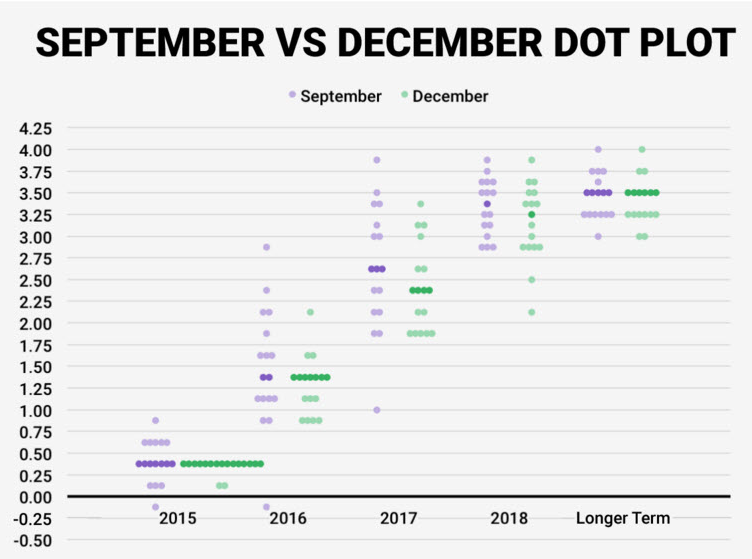
December Fed Dots12-17-2015

A look at the “dot chart”, which is a graphical representation of the various Fed members’ forecasts for future rates, the markets currently believe the Fed will bump rates by .25% 4 times in 2016 and 2017.

From a technical perspective mortgage rates are trading within a fairly tight range which leads me to believe that rates will likely trade sideways.  That said, next week is a holiday shortened week and it’s likely that trading desks will sparsely occupied so starting Monday we run the risk of seeing some volatility.  I would recommend locking before the week is out.

Current Outlook: locking before the week is out

Mortgage Rate Update December 14, 2015

Mortgage rates are more or less unchanged from last week.

The big economic news story of the week is actually no news at all.  The Fed will meet tomorrow and Wednesday and make a monetary policy statement at the conclusion of the meeting.  There is a very high probability that the Fed will raise short-term interest rates by .25% on Wednesday.  This will not be a surprise as the markets are expecting it.

This week's headlines will focus on the Fed but the markets are already anticipating their next move.
This week’s headlines will focus on the Fed but the markets are already anticipating their next move.

Looking at this decision in a broad context it makes perfect sense.  During the last recession the US economy lost 8.7 million jobs.  We’ve since added 13 million jobs.  Although inflation and wages have only accelerated modestly over this time period they are starting to increase at a more aggressive clip.

Speaking of inflation, tomorrow we’ll get the latest reading on the Consumer Price Index (CPI) which is expected to reach 2.0% on the core reading for the first time in 19 months.  The rest of the economic calendar is relatively light.

From a technical perspective interest rates are trading between support and resistance.  For now we can begin the week by floating.

Current Outlook: floating

Mortgage Rate Update December 7, 2015

Housekeeping note:Rate update’ will be on vacation (and hopefully on a golf course) this Thursday.  You can expect it to return one week from today.

Mortgage rates are unchanged from last Thursday.

We are now only 9 days from the Fed’s next announcement regarding US monetary policy.  The financial markets have priced an ~80% probability that the Fed will hike short-term interest rates at this next meeting.

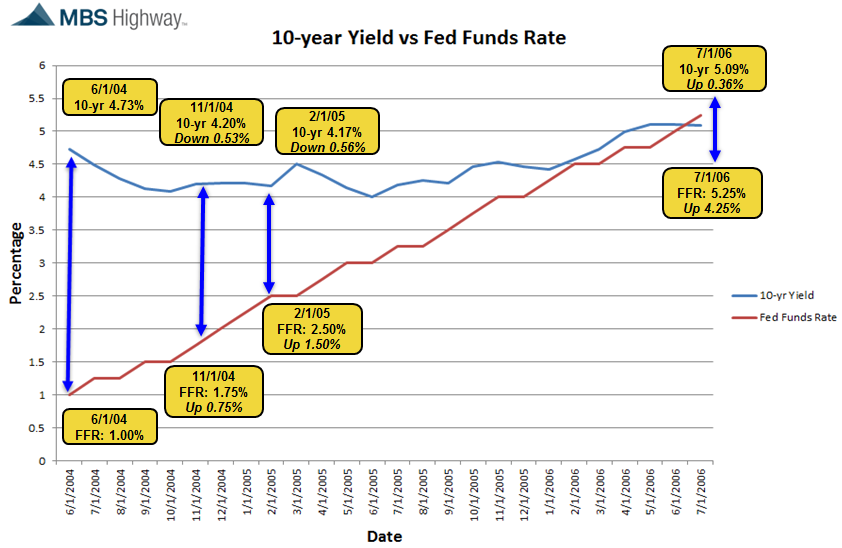
As I have stated numerous times on this blog a Fed rate hike does not necessarily mean that mortgage rates will immediately increase.  My friends over at mbshighway.com put together a great graph showing how mortgage rates reacted to the last tightening cycle which took place from June 2004 until July of 2006.

10-year Yield vs Fed Funds Rate12-7-2015

As you can see mortgage rates actually initially declined and then held mostly stable over the duration of this period.  How is this possible?  When the Fed raises short-term interest rates their objective is to curb inflationary pressure in our economy.  Inflation is the nemesis of mortgage rates.  Therefore, as the Fed hikes rates they concurrently curb inflationary expectations which is positive for long-term interest rates, including mortgages.

The economic calendar is relatively light this week.  We can start the week by floating.

Current Outlook: floating

Mortgage Rate Update December 3, 2015

Mortgage rates are slightly worse from Monday.

Yields here in the US are up across the board this morning in reaction to the much anticipated announcement from the European Central Bank (ECB).  I had written on Monday how monetary policy in the US and Europe are on the brink of diverging.  The US is about to embark on a tightening cycle while Europe is moving to loosen monetary policy.

In the aforementioned blog post I wrote how this was actually benefiting interest rates in the US because capital was flowing out of Europe and into the US improving demand for US dollar-denominated assets and driving yields lower.  So why are rates worsening today?

This is a perfect example of the old Wall Street saying ‘buy on the rumor and sell on the news’.  It turns out the ECB did loosen their monetary policy today but not by as much as had been rumored.  As a result, many of the trades that were made in anticipation of their announcement are now unwinding and rates in the US are moving back up.

Today's European Central Bank announcement is hurting mortgage rates in the US.
Today’s European Central Bank announcement is hurting mortgage rates in the US.

Fed Chairwoman Janet Yellen is testifying in front of lawmakers in our nation’s capital as I type.  According to the live feed she is emphasizing that the Fed will raise rates slowly.  The markets remain fairly certain that the Fed will raise short-term rates at the next open market committee meeting scheduled for Dec. 15th-16th.  That reality is already priced into the mortgage rates you see today.

Tomorrow is the all-important jobs report.  The financial markets are expecting ~185,000 new jobs created in November.  There were 268,000 new jobs posted in October according to last month’s report.  Given the news out of Europe and the difficulty in handicapping this report I recommend locking.

Current Outlook: locking

Pfau Makes Case for Emergence of Reverse Mortgage

The prevailing reputation for reverse mortgages in our society is not healthy.  Stories of elderly abuse, high fees, and financial deceit are wrapped into the memories of many of our nations aging population.  However, over the past few years the Department of Housing and Urban Development has significantly overhauled the program by instituting measures that prevent financial abuse and reduces the fee structure on these loans.

Over the past couple years I have studied the reverse mortgage programs and given my financial planning background have recognized that the reverse mortgage could help solve many of forecasted problems with underfunded retirement plans by eliminating a mortgage payment for many Americans in retirement (studies show that today’s baby boomers are entering retirement with more debt and less retirement savings than any other age cohort in our history).

Wade Pfau, a personal financial planning expert who often contributes to the Journal of Financial Planning, wrote a piece back on November 30th for the Wall Street Journal making the case for how the reverse mortgage can help household bridge the financial gaps in retirement.  SEE HERE to read the entire piece.

If you have any interest in retirement planning then its worth a read.

Mortgage Rate Update November 30, 2015

Mortgage rates are slightly improved from last week.

Mortgage rates are benefiting from the projected divergence in monetary policy between the US and Europe.  Here in the US the Fed is likely to raise the Federal Funds rate at their next meeting scheduled for mid-December.  Meanwhile, speculation across the Atlantic is that the European Central Bank will move to further loosen monetary policy as soon as this Thursday.

When central banks loosen monetary policy, as Europe is expected to do, it effectively adds to the money supply and devalues the currency.  Conversely, when central banks tighten monetary policy, as the US is expected to do, it reduces the money supply and adds relative value to the currency.  Therefore, we are seeing investment capital flow into the US in anticipation of these moves and that is driving yields down slightly.

The US and Europe are taking divergent paths with regard to monetary policy.

In housing news, the National Association of Realtors reported that pending home sales rose by less than expected in October.  That said, the headline number is somewhat misleading because they also revised September’s previously released number up and without that adjustment the increase in pending sales would have been in line with expectations.

This week’s economic calendar is packed with significant data points.  The most attention will be focused on this Friday’s all-important jobs report.  Market expectations are for ~185,000 new jobs created last month and a number in line or better than expectations would cement expectations for a Fed rate hike in mid-December.  A severe miss in the new jobs number would definitely cause uncertainty in the financial markets.

Current Outlook: locking bias

Mortgage Rate Update November 23, 2015

Mortgage rates are unchanged from last week.

Let’s start off the week with some housing news.  The National Association of Realtors released its existing home sales for October.  The headline number of existing home sales fell from September but remains ~4% above October 2014.  Within the report there are some interesting details.

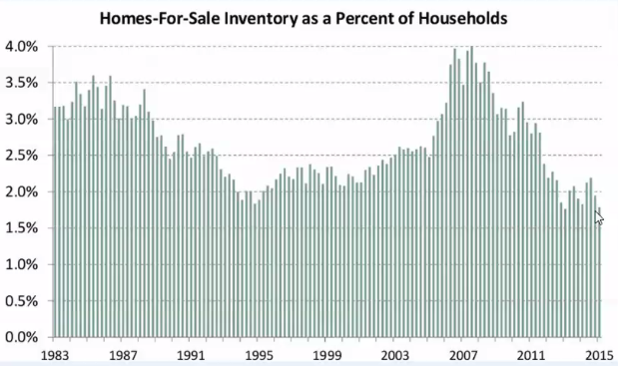
The inventory level for homes remains tight.  As a percentage of US households only 1.75% of the housing stock is currently available for sale.  This is well below the historic average of ~2.6%.  A tight supply is one main reason why prices continue to rise.  Speaking of prices rising, the median home price in the Western Region increased by 8% from a year ago.

Source: mbshighway.com

First time homebuyers accounted for 31% of all purchases, up from 29% in September.  Conversely, the number of distressed sales (foreclosure or short sale) declined and currently are 9% below October 2014.

The remainder of this compact work week is jammed with significant economic data.  Tomorrow we’ll get the second estimate for third quarter GDP and the latest S&P Case Shiller Home Price Index report.  On Wednesday we’ll get personal income, personal consumption expenditure price index, the FHFA home price index, durable goods, and new home sales.  Needless to say we could see volatility for the remainder of the week especially since many trading desks will likely be vacant on Wednesday.

From a technical perspective mortgage rates are trading near important technical levels.  We will want to keep an eye on the US 10-year treasury yield this week.  It is currently trading at 2.27%.  Should it pierce above 2.33% I will shift to a locking position.

Current Outlook: floating as long as the US 10-year treasury is at or below 2.33%.