A look ahead to 2018, will rates and home prices move higher?

Happy New Year!  Welcome to 2018.  Want to feel old?  Students in the class of 2018 that graduate from high school this year were born in 2000-2001.  They’ve never known Star Wars to be a trilogy or “rolled down a window”.

Assuming home ownership rates remain similar then approximately 63% of them will purchase a home in the future.  What interest rates will they lock on their loans?  If you believe in “reversion to the mean” then this chart above may offer a clue.

I believe mortgage rates are likely to increase in 2018.  Why do I think this?

Yield Curve

The yield curve flattened during 2017 as the Fed hiked short-term interest rates while yields at the long end of the curve remain more or less unchanged.

This is evident in the fact that the difference between the yield on a US 10-year treasury note and 2-year note fell last year.  A flat yield curve typically predicts an economic recession, which does not seem likely in the near-term, or higher long-term rates in the future.  I think the latter is more likely.

I do not have a crystal ball but am forecasting 30-year fixed rate mortgage rates to increase by .50%-.75% during 2018.

Home Prices

Home price appreciation for Portland has been on a steady decline since the summer of 2016 but remains above historical averages.  In Portland home prices are increasing at a ~7% annualized rate according to the Case-Shiller Home Price Index report.
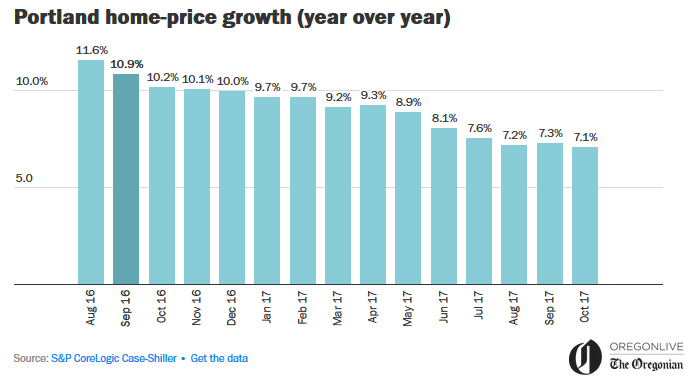
Given that demand is expected to remain strong as people continue to move here and supply of housing remains constrained I think it will be more of the same in 2018.  I am forecasting home prices in Portland to increase by 6.0% over the next 12 months.

How do you see 2018 playing out?  Feel free to leave comments here.

Current Outlook: locking
The Fed does not set mortgage rates

Later today the Federal Reserve Bank Open Market Committee (FOMC) is widely expected to hike short-term interest rates.  Contrary to popular belief a Fed rate hike could actually help mortgage rates improve.

To understand why one must consider the reason why the Fed is hiking rates in the first place.

The Fed has a dual mandate which is to maintain:

  1. maximum employment
  2. stable prices and moderate long-term interest rates

Interest rate hikes are a tool the FOMC uses to help stabilize prices (AKA curb inflationary pressure).  Inflation is the primary enemy of mortgage rates because it erodes the purchasing power of the money used to repay the loan.

Consider if you were planning on lending someone money today and deciding on what rate of interest to charge.  If you were informed that the value of the money repaid to you in the future would have less purchasing power due to inflation you would be prudent to add that additional cost into the interest rate.

As the Fed hikes short-term interest rates it should theoretically prevent future inflationary pressure which is good for home loan rates.

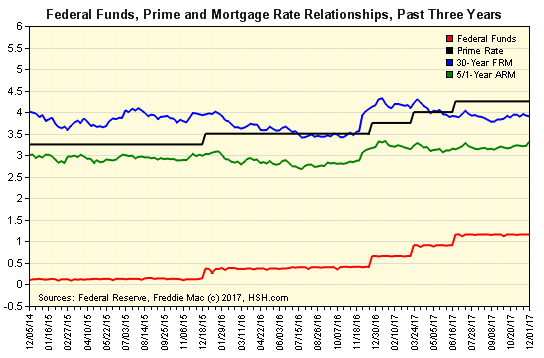
The FOMC does not directly set mortgage rates.  The rate they control is called the Federal Funds Rate and practically speaking has a very obscure function (it is the interest rate charged between banks to lend reserve balances for overnight depository requirements).

As the chart below shows there is no direct correlation between the Federal Funds Rate and mortgage rates.

As you can see from December of 2014 to December 2017 the Federal funds Rate increased from ~.25% to ~1.25% as a result of four separate rate hikes.  At the start of that time period conventional 30-year fixed rate mortgage rates were averaging 4.00% and now?  Still ~4.00%.

It’s important to note that the FOMC’s comments and actions can send ripple waves through the financial markets and can influence the direction of mortgage rates, for better or worse, but the Fed does not directly control the rates provided on home loans.


How words will impact mortgage rates this week

Mortgage rates essentially held steady last week despite the stock markets continued rally.  The Dow Jones Industrial Average has returned 23% year-to-date while the NASDAQ index is up 27%.  Despite those gains mortgage rates have held steady this year.  I expect they will likely increase by .50%-.75% in 2018.

The job’s report

Friday’s all important jobs report showed stronger than expected employment.

According to the survey 228,000 new jobs were created during the month of November, the unemployment rate remained at 4.1%, and average hourly earnings only ticked up by $.05 ($26.55).

Healthy economic growth with low inflationary pressure persists which is good news for the real estate market.

Central Banking

This week’s economic calendar is loaded with central bank meetings.

The US Federal Reserve board will meet starting on Tuesday and is widely expected to hike short-term interest rates by .25% with that announcement expected on Wednesday.

The Fed does not directly control home loan rates but their comments can cause volatility in the financial markets.  Furthermore, with short-term rates increasing and long-term rates unchanged the yield curve is flattening which may signal a recession is on the horizon (or higher longer-term rates).

On Thursday both the European Central Bank (ECB) and the Bank of England release monetary policy statements as well.  Both are expected to keep their target rates unchanged but economic growth in both regions has been positive and many onlookers believe the ECB will discontinue their bond-buying program in 2018.

If the ECB does roll back their quantitative easing program it would likely cause rates in Germany to increase which would likely pressure US interest rates higher as well.

Inflation?

Back in the US inflation measures have come in pretty close to the Fed’s 2% target this year.  On Tuesday we’ll get the latest reading on the Producer Price Index followed by the Consumer Price Index on Wednesday.  Inflation is the primary driver of mortgage rates so continued tameness will be a positive sign.

From a technical perspective mortgage backed bond prices have dropped below important technical support.  It will be hard for prices to reverse back above the multiple layers they have broken below.  I will recommend a locking bias.

Current Outlook: locking

Advancement of tax plan expected to pressure mortgage rates higher

If you’re looking for something to celebrate this week look no further.  On December 5, 1933 the 21st Amendment to the US Constitution was ratified effectively ending prohibition.  Fast forward to 2017, Oregon’s brewing industry contributes $4.49 billion to the state economy and directly/ indirectly employs over 30,000 people.  I can toast to that.

Republicans are toasting their advancement of tax overhaul legislation.  The Senate narrowly passed their version of the tax bill which will now be reconciled with the House version.

The Tax Plan:

The new tax plan is bad for mortgage rates on a couple levels.

First, passage of the new tax laws is expected to add ~$1.4 trillion to the Federal debt over the next ten years.  In order to fund the deficit the US Treasury will have to issue an equal amount of debt which will crowd out other borrowers and push yields higher.

Second, the new tax cuts are expected to promote economic growth which is good news for stocks.  The Dow Jones Industrial Average has increased by over 1,000 points in the past week and is trading at all time highs.  When stocks rally it tends to push interest rates up.

Jobs Week:

It’s the first week of a new month which means we’ll get a fresh all-important jobs report this Friday.  The markets are currently expecting ~+190,000 new jobs created during the month of November.  A figure significantly better than that would put upward pressure on mortgage rates and vice versa.

The Fed:

The next monetary policy meeting is scheduled for next week with an announcement set for December 8th.  There is currently a 90% probability that the Fed will hike short-term interest rates by +.25%.

In other words, the home loan rates you see today already assume a rate hike.  Please help consumers understand that mortgage rates will not automatically increase next week on account of this action (they could move higher for other reasons).  The Fed does not directly set home loan rates but their comments and actions can cause volatility.

Given the momentum of the tax plan I recommend locking in.

Current Outlook: locking

2018 Conforming Loan Limits Announced!

Fannie Mae & Freddie Mac issued a press release earlier today announcing changes to the conforming loan limits for 2018.  There is good news and bad news for the Portland, OR real estate market.  The bad news is that Multnomah, Clackamas, and Washington Counties are still not identified as “High Cost” areas which affords an even higher loan amount than the national standards.

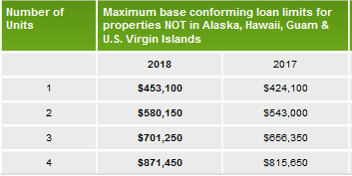
However, the great news is that the loan limits for a conventional-conforming 1-unit home is increasing from $424,100 (2017 limit) to $453,100!  Here is the chart which also shows the limits for two, three, and four unit homes.

Source: Freddie Mac

This change applies to loans which comply with Fannie Mae & Freddie Mac guidelines and does not apply to FHA, USDA, VA or other non-conforming loans (those programs will also likely update their loan limits).


This is not a commitment to lend. Not all applicants will qualify. Rates, terms and conditions of programs, products, and services are subject to change. All loans are subject to credit and property approval. Not all properties will benefit from appreciation. Appreciation can fluctuate based on market conditions. Please consult with your financial advisor to determine if investing in real estate is right for you. Mortgage Trust, Inc. is an Equal Housing Lender. NMLS 3250 | 4386 SW Macadam Ave., Suite 401 | Portland, OR 97239

Leave a Comment on 2018 Conforming Loan Limits Announced!

A busy economic calendar and potential vote to drive mortgage rates

Happy Birthday to John Burr Williams who would have turned 117 years old today!

In case you’re not familiar with that name (see HERE) he wrote a book called The Theory of Investment Value in 1938 which is widely regarded as the foundation of “Fundamental Analysis”.  His theories are critical to evaluating investments in real estate (and other assets).

Mortgage rates are essentially sideways from last week which is good news given the fact that US stocks traded at all-time highs.

Following a relatively quiet economic holiday week the calendar is jam packed for the next few days.

Housing in the news

Earlier today new home sales were reported and were much stronger than expected (+6%).  The pace of new home sales is currently at the highest level in 10 years!

Tomorrow we’ll get the latest S&P Case-Shiller Home Price Index and on Wednesday we’ll see pending home sales from the National Association of Realtors.

Inflation and the Fed

On Thursday the Personal Consumption Expenditure price index will be released which is the Fed’s favorite gauge of inflation.  Analysts do not expect a large uptick in inflation but if prices rose at a faster clip than is expected it would likely hurt home loan rates.

The Fed is widely expected to raise rates when they meet in a couple weeks.  Since the markets are already expecting this action that move will not impact mortgage rates (despite what the media coverage says).

Tax reform?

The big question is whether or not the Senate will vote on the tax overhaul bill.  Should legislation pass it is assumed that the stock market will benefit which would likely hurt mortgage rates.

From a technical perspective interest rates appear to be in a sideways pattern.  Unless it appears that tax legislation will be voted on and pass I will maintain a floating bias.

Current Outlook: cautiously floating

GOP Tax Plan still in focus for mortgage rates

I want to take a moment to wish you and your family a Happy Thanksgiving!  I am grateful for my audience that values professional and competent home loan advice.

Last week mortgage rates mostly held steady although pricing did worsen modestly.

This week’s economic calendar is relatively light with the highlights coming on Wednesday when we’ll see durable goods orders and the minutes from the last Fed meeting.

DON’T FEAR THE FED

We are now 23 days away from the next Fed meeting and the markets are currently assigning a 92% probability that the Fed will hike short-term interest rates by .25%.  I anticipate the media will pick up on this coverage after the Thanksgiving Holiday.  As a reminder, the Fed DOES NOT directly control mortgage rates.

GOP TAX OVERHAUL

I believe mortgage rates will sway with sentiment on the GOP tax overhaul plan.  If the House or Senate tax bill passes then the United States will experience higher deficit spending which is not good for mortgage rates.

Therefore, if it appears more likely that a bill will pass I expect home loan rates to worsen and vice versa.  I believe the road to passage will be difficult so will recommend floating.

Current Outlook: cautiously floating

I want to buy a rental, how much down payment is needed?

With real estate prices and rents booming across the Portland, Oregon metro region over the past few years, it is no wonder that so many people have become interested in purchasing investment property.  However, it seems that many would-be investors are not aware of the down payment requirements for buying a home that they intend to rent.

This post was written in November of 2017 and the facts below can change so it’s always best to check in with me to see if these requirements are still accurate.

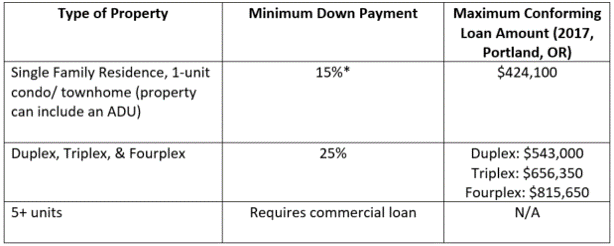
This post is focused on conventional conforming loans for home purchases (excludes refinances) where the buyer intends on renting out the property.  The minimum down payment required depends on the type of property an investor is purchasing:

table illustrating minimum down payment for investment property purchase

*Although one-unit investment property purchases only require a 15% down payment, a homebuyer will have to obtain private mortgage insurance with less than 20% down which can prove costly and upset the feasibility of the investment.

Also, it’s worth noting that an investment property purchaser who puts 25% down or more will obtain a fixed interest rate that is ~.375% better than if they put less than 25% down.  Therefore, stretching to 25% down can greatly improve the financial performance of the investment.

This post is written from the perspective of explaining the minimum down payment required to qualify for a loan.  Just because a lender says you qualify doesn’t mean the loan or investment is prudent.  Additional analysis should be completed to determine if the investment is suitable given your level of down payment (I can help with that but won’t take up that topic in this post).

Next, let’s outline what sources are acceptable forms of down payment capital.  The most common forms of down payment we see are personal checking/savings accounts, investments, mutual funds, inheritances, retirement account loans, and loans against equity in homes already owned.  Again, just because a source of capital is acceptable does not mean it is “suitable” and every applicant should consider the trade-offs associated with their transaction.  Gift funds are not an acceptable source of down payment when purchasing an investment property.

Underwriting requirements will also require that the applicant have left over capital “in reserve” when purchasing an investment property.  Those requirements will change applicant-to-applicant so it’s best to talk to us about the particulars of your situation.

There is no question that owning investment real estate can help families generate wealth in the long-term.  I’d love to help you determine if owning a rental property is right for you.  Please contact me if you’d like to learn more.

A flattening yield curve may signal higher rates in the future

Interest rates and US stocks got off to a good start last week but had a rough finish.  For the week mortgage rates worsened very modestly.

We are 30 days away from the next Fed meeting and according to CME group there is currently a ~97% probability that the Fed will hike short-term interest rates.  I am guessing media coverage will pick up on this topic after the Thanksgiving Holiday.

As a reminder the Fed does not directly control mortgage rates.  The Federal Funds Rate is charged on overnight loans between banks and a mortgage can last 30 years.

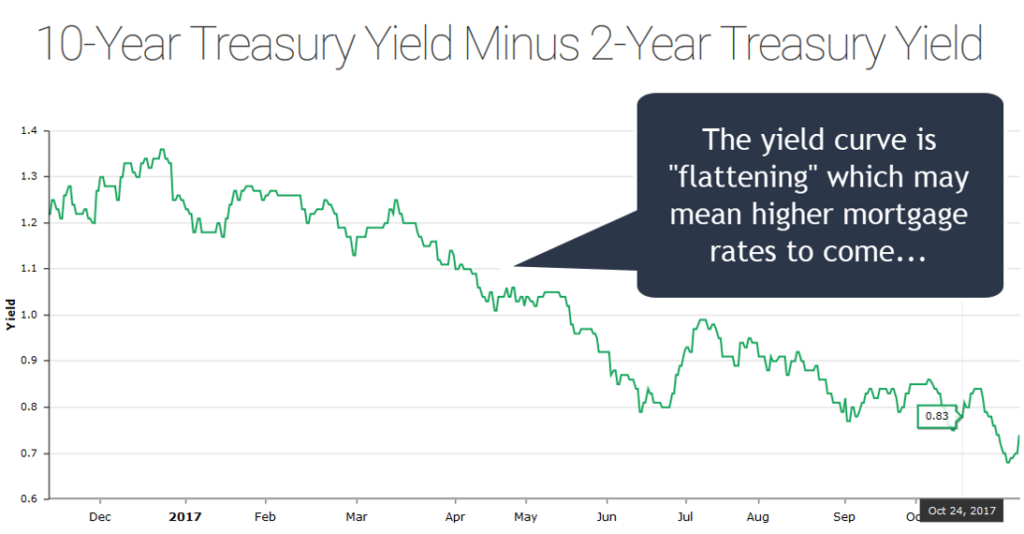
What’s interesting is that as the Fed has hiked short-term interest rates yields for shorter-term loans (i.e. less than three years) have increased yet longer-term durations have remained relatively low.  A look at he spread between the 2-year and 10-year treasury notes tell the story:

The yield curve is “flattening” which may mean long-term rates, including mortgages, will rise in the future or could also signal a recession.  Time will tell.

As I had written about last week (see HERE) sentiment regarding the tax overhaul is driving the direction of the financial markets. I expect much of the same this week.

The Senate version of the tax overhaul legislation, which was released on Thursday, will now be reconciled with the House version.  Given the vast differences investors now seem pessimistic that a compromise will be made.  Given that the tax overhaul is seen as inflationary this could actually help interest rates remain low……for now.

The economic calendar is busy this week.  Although we lost ground last week I will remain cautiously floating.

Current Outlook: cautiously floating

Sentiment on tax plan to guide mortgage rates

Do you ever wonder what the Federal Reserve talks about during their monetary policy meetings?  It’s nacho business.  Happy National Nacho Day!

It was announced earlier today that New York Federal Reserve President William Dudley will retire his position in February.  With Janet Yellen and Dudley leaving the Fed there is speculation that the philosophical tilt of the Fed could become less accommodative which is not friendly for interest rates.

What is friendly to interest rates is a weaker than expected jobs report and that is what was delivered on Friday.  The report showed only 261,000 new jobs were created in October and that wage growth was modest.  Analysts had expected 300,000 new jobs to be announced.

Mortgage rates improved moderately last week breaking a seven week trend of worsening.  Will they continue to improve?  Much will depend on the progress of the GOP tax plan which was unveiled last week.  The plan, which is not supported by the National Association of Realtors, relies heavily on deficit spending which means the US Treasury will need to issue more debt.  All else being equal a greater supply of debt means yields move higher.

Therefore, as sentient shifts in favor of the tax overhaul becoming law I expect home loan rates to worsen and vice versa.

Current Outlook: cautiously floating