Mortgage Rates at multi-month lows but expected to rise during 2019

Happy New Year!  77% of US citizens set financial goals for their new year’s resolutions.  Did you?  Unfortunately only 1 in 5 are able to see their resolutions through February.

I hope 2019 brings you good health and prosperity!

Mortgage Rates

Interest rates start off the new year at the best levels since the spring of 2018.  Weakness in the stock market helped mortgage rates improve during the final two months of 2018.

Trend line

A look at the chart of the US 10-year treasury note, which mortgage rates tend to follow, shows that yields fell from 3.22% at the beginning of November to 2.55% on January 2nd.  During that time home loan rates improved by .50%.
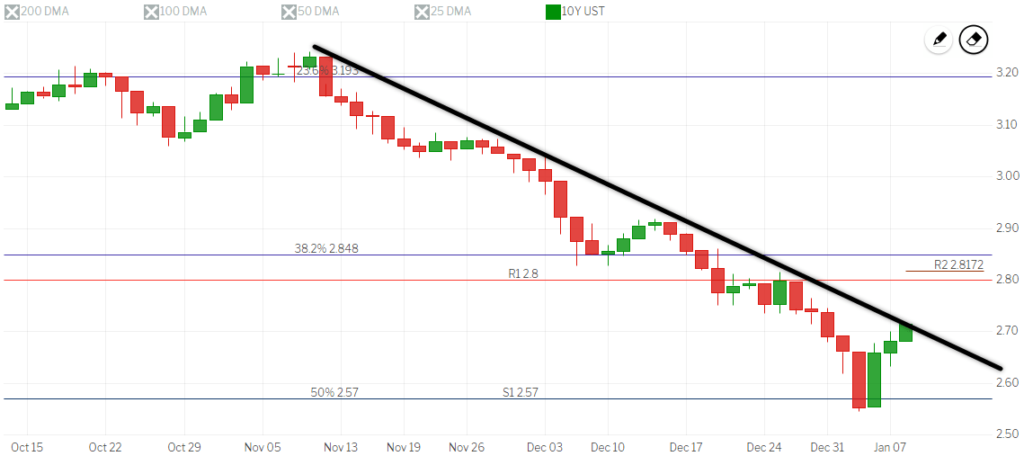
Currently the US 10-year treasury note is at 2.70% which is right up against the two month trend line.

Near-term Outlook

Should yields bounce lower off this trend line then mortgage rates are likely to improve by another .125%-.25%.  However, if the yield closes above 2.70% then I expect rates to move higher.

Longer-term Outlook

Most Wall Street Analysts believe that yields will increase by .50%-1.00% during 2019.  Therefore, I think the best buying opportunities will exist in the initial three to four months of the New Year!

 Current Outlook: locking bias
Credit Myth #5: All forms of debt are equal

After spending over 16 years in the mortgage lending industry I have identified seven myths that consumers commonly hold regarding their credit.  In this series of videos I am going to breakdown each myth and help you better understand how your credit scores are determined so that you can achieve a better outcome for your next loan application.

The fifth myth is that all forms of debt are looked at equally.  The credit scoring algorithms classify debt as either being an installment loan or revolving credit.  Watch this short video for more information on how to manage these forms of debt to enhance your credit.


Revolving Credit

An example of a revolving account is a credit card.  A lender approves a borrower to spend up to a credit limit.  It is then up to the borrower to determine how much they borrow relative to that limit and how much they pay back each month.

Generally speaking revolving credit is considered riskier than installment loans but when a borrower has a history of using their revolving credit conservatively this will improve their credit.

Installment Debt

An example of an installment loan is a fixed rate mortgage.  In this case the borrower receives a lump sum from the lender and agrees to repay the loan over a period of time with interest.  It is most important that a borrower make the payments in a timely fashion.  In general, an installment loan is considered less risky than revolving credit.

Ideally, a consumer will carry a mix of installment and revolving accounts and make their payments in a timely fashion.

Please contact me today to learn more!

Credit Myth #4: Your Job and Income Contribute to Your Credit Score

After spending over 16 years in the mortgage lending industry I have identified seven myths that consumers commonly hold regarding their credit score.  Over the course of the next few weeks I am going to breakdown each myth and help you better understand how your credit scores are determined so that you can achieve a better outcome for your next loan application.

The fourth myth is that a person’s job and level of income contribute to their credit score.  This is not true.  A person’s job and/ or income are not data points included in the algorithm that determines a credit score.  Certainly higher incomes allow households to better afford their payments and make it less likely they would incur adverse events.  But, at the end of the day a person’s credit score is entirely based on their previous credit behavior.

As THIS ARTILCE points out the information that contributes to a person’s credit score are……

  • How length of a person’s credit history
  • If they have repaid their loans as agreed
  • If they have any missed payments which were 30+ days delinquent
  • How they are currently using debt (is the overall level of debt increasing, decreasing, or remaining stable?)
  • The mix of different types of credit accounts
  • If they have any past derogatory events like bankruptcies, foreclosures, short sales, judgements, or collections.
  • If they have recently made other credit inquiries

Please contact me today to learn more about your home loan options.

As 2018 draws to an end home loan rates benefit from stock market weakness

Happy holidays from all of us at Swanson Home Loans!  This will be the last ‘rate update’ post of 2018 as the next two Tuesdays fall on a holiday.  The next ‘rate update’ will be posted on January 8th!  Have a safe and joyous season!

Stock Market

Home loan rates continue to benefit from weakness in the stock market.  The S&P 500 index is off 13% from the highs reached back in early October.

If you are a consistent reader of this post then you know we started expressing concerns over stock valuations all the way back in the beginning of the year so we are not surprised to see this correction.

The Fed

The Federal Reserve Open Market Committee begins its regularly scheduled two-day monetary policy meeting today.  Tomorrow they will announce their latest monetary policy decision.

According to CME Group there is currently a 73% probability that they will hike by another .25% tomorrow.  The Fed does not directly control mortgage rates so we’ll have to see how they react.

Should the Fed defy the odds and not hike I expect the stock market to rally which would likely hurt home loan rates.

Yield Curve

Should the Fed hike the Federal Funds rate tomorrow by .25%, as expected, it will be interesting to see how the yield curve responds.  The 2-year treasury note is currently yielding 2.66% and the 10-year treasury note is yielding 2.83% a difference of only .17%.

If the 2-year yield surpasses the yield on the 10-year treasury note it will be the first time that the yield curve has inverted since 2005-2007.  Every time in recent history the US yield curve has inverted an economic recession has followed.

Outlook

Unfortunately many analysts are growing pessimistic on their economic outlook which is partially why we’ve seen home loan rates improve in the past month.  As long as this viewpoint holds I will recommend floating.

Current Outlook: floating

Credit Myth #3: A high credit score can make up for a low credit score

After spending over 16 years in the mortgage lending industry I have identified seven myths that consumers commonly hold regarding their credit score.  Over the course of the next few weeks I am going to breakdown each myth and help you better understand how your credit scores are determined so that you can achieve a better outcome for your next loan application.

The third myth is that a high credit score in a joint loan application can make up for a low credit score.  The reality is, mortgage underwriters use the lower of the two applicants’ credit scores when evaluating a joint loan application.  It doesn’t matter if the higher credit score applicant has perfect credit or is only marginally higher.  The underwriter will use the lower of the two scores in determining if the application can be approved and in pricing the interest rate.

Sometimes it may be possible for the applicant with a higher credit score to qualify for a loan independent of the applicant with the lower credit score.  In that instance it may make sense to complete the loan application in the higher credit scorer’s name only.

Please contact me today to learn more about how your credit will impact your next home loan process.

As job growth slows mortgage rates improve

As you read this take a quick look around.  Do you see a few things that were ‘Made in China’?  On this day in 2001 China joined the World Trade Organization.  Currently President Trump is working to resolve trade tensions which are helping to contribute to lower mortgage rates.

Mortgage Rates

Home loan rates have benefited from recent weakness in the stock market.  One of the major factors contributing to stock market weakness has been the lack of progress on trade talks with China.

There are reports that progress is being made but for now key differences remain.  If and when the US and China reach a trade deal we may see the stock market rally which presumably would cause mortgage rates to rise.

Job growth declining

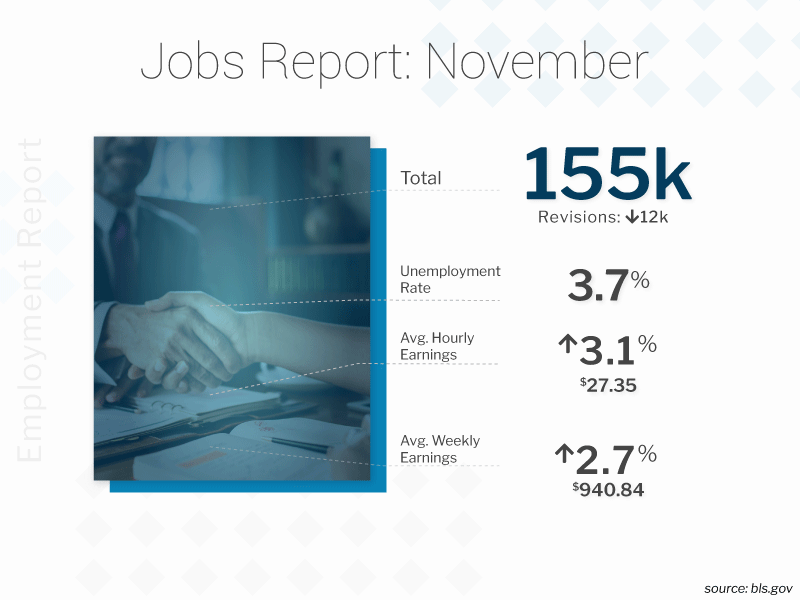
Last Friday’s all-important jobs report showed that 155,000 new jobs were created in the previous month.  This was less than the 190,000 that were expected.  The trailing three-month average has decreased to 170,000 which is the lowest of 2018.  Some economists are predicting an economic slowdown for 2019-2020.

Inflation Sensation

Ultimately inflation is the key driver of interest rates because if a lender forecasts that the purchasing power of money repaid in the future will be diminished they will charge a higher interest rate.

The Labor Department reported earlier today that prices at the wholesale level of the economy (Producer Price Index) increased by 2.7% last month when you strip away volatile food & energy.  This is a modest increase from last month.

Tomorrow the Consumer Price Index will be released.

Technical Signals

Mortgage rates are .375% better than they were a month ago.  It appears to me that the rally lower has lost steam.  I think the risks of mortgage rates reversing higher outweighs them improving so recommend locking.

 Current Outlook: locking

Credit Myth #2: Having your credit report pulled will ruin your scores

After spending over 16 years in the mortgage lending industry I have identified seven myths that consumers commonly hold regarding their credit score. Over the course of the next few weeks I am going to breakdown each myth and help you better understand how your credit scores are determined so that you can achieve a better outcome for your next loan application.

The second myth is that having a lender pull your credit report will ruin your credit score. It is true that credit inquires will reduce a consumers credit score. For each consumer the impact will be different, but for most the adverse effect is very small. In fact, according to THIS ARTCILE one credit inquiry will only reduce a person’s score by less than five points. Take a moment to watch this short video to learn about the special exception that applies to the mortgage industry pulling your credit:

Please contact me today to learn more about how your credit will impact your next home loan process.

Is a recession on the horizon? Fear drives mortgage rates to multi-month lows

I hope you took time to celebrate National Roof Over Your Head Day on December 3rd!  I showed up to work and helped people get a new roof over their heads so I’m feeling good about my contribution.  

Mortgage Rates

Mortgage rates continued to improve last week.  They are currently at multi-month lows.

Yield curve

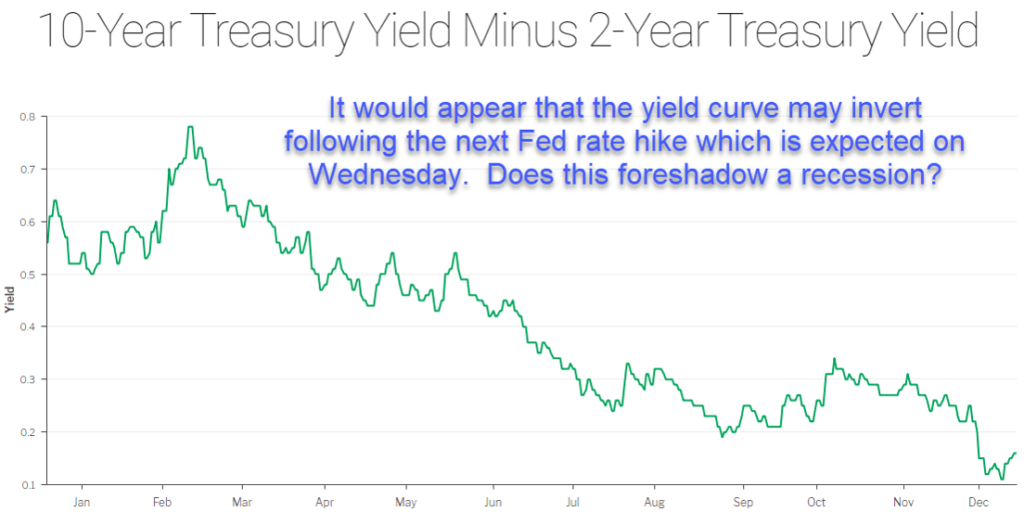
As long-term rates improve the short-end of the yield curve is basically unchanged.  The difference in yield between the US 2-year & 10-year treasury notes is only .015%!  It appears that the yield curve may invert in the coming months.

Going back many decades every time the US yield curve has inverted the economy has gone into recession shortly thereafter.

Housing Prices

Corelogic released its monthly Home Price Index today.  It showed that homes appreciated by +5.4% nationwide in the past year.  Oregon homes appreciated by +6.0% according to the report.  

Home prices are still increasing but at a slower pace.   

The Week Ahead

The financial markets will be closed on Wednesday this week in honor of President George Bush who passed away over the weekend.  On Friday we get the all-important jobs report which can definitely influence the markets.

Current Outlook: floating

Credit Myth #1: You have only one credit score

After spending over 16 years in the mortgage lending industry I have identified seven myths that consumers commonly hold regarding their credit score.  Over the course of the next few weeks I am going to breakdown each myth and help you better understand how your credit scores are determined so that you can achieve a better outcome for your next loan application.

The first myth is that we all only have one credit score.  In fact, consumers have over 40 different credits scores which are determined by various algorithms that specific industries subscribe to.  Please watch this short video to learn more:

Want to learn more?  I found THIS ARTICLE in Forbes online which goes into greater detail.

Please contact me today to learn more about how your credit will impact your next home loan process.

New Conforming Loan Limits announced for 2019

Christmas has come early to homeowners and prospective home-buyers in the Portland housing market!

Despite median home prices increasing by only +5.1% over the past twelve months the Federal Housing Finance Agency announced that the conforming loan limits in 2019 will increase by 6.9%.

The maximum conforming loan amount for 2019 will be $484,350 for a one-unit property, up from $453,100.

I still wish they would round the loan amount to an even $484,000 but hey, beggars can’t be choosers.

If you’re curious why this change is significant watch this short video where I explain the difference between a conforming and jumbo mortgage.

Here is a full list of the conforming amounts for 2019:

1-unit: $484,350 (up from $453,100)

2-units: $620,200 (up from $580,150)

3-units: $749,650 (up from $701,250)

4-units: $931,600 (up from $871,450)