Are mortgage rates likely to increase or decrease? Anyone? Anyone?

On this day in 1986 one of the greatest movies of all time was released. Does anyone know which movie? Anyone? Anyone? (see movie reference HERE).

Last week US stocks rallied and home loan rates moved which direction? Anyone? Anyone? They increased modestly.

The Week Ahead
The calendar is full of significant events this week. There won’t be anytime to take a day off (had to sneak in another movie reference).

Treasury auctions
The US Treasury has auctioned $32 billion of 3-year and $22 billion of 10-year notes already this morning. Tomorrow they will auction an additional $14 billion of 30-year bonds. The added supply of fresh debt will make it hard for home loan rates to improve this week.

Inflation
On Tuesday and Wednesday we’ll get fresh readings on the Consumer Price Index and Producer Price Index. Inflation has been trending higher and remains the primary driver of long-term interest rates including for mortgages.

The Fed
The Federal Open Market Committee meets Tuesday-Wednesday and is expected to announce a +.25% hike to the Federal Funds Rate mid-week. The Fed does not directly control mortgage rates but their comments and actions can influence them. If you have not locked in a rate don’t fret. The .25% rate hike is already baked into the rates you see today.

Technical trading patterns
Momentum is not on our side. Rates worsened modestly last week and have more room to worsen this week. I think we have more to lose than to gain so will maintain a locking outlook.

Current Outlook: locking
Might low unemployment signal a recession near?

On this day in 1896 the chief engineer of Edison Illuminating Company first test drove the “Quadricycle” he had developed.  That engineer’s name was Henry Ford and the “quadricycle” would eventually be commonly known as a car.  

The next stage of automobile evolution is expected to be the driverless car.  CLICK HERE to learn how they may impact real estate values.  

Jobs, Jobs, Jobs

Friday’s all-important employment report showed continued strength in the Labor Market.  According to the release the US economy added 223,000 new jobs, average hourly wages rose, and the unemployment rate decreased to 3.8%.  

Seemingly a healthy jobs market is a great indicator for the housing market.  However, there are two concerns that arise from the report.

#1: Inflation & Home Loan Rates

Job growth coupled with a low unemployment rate means employers will have to pay higher wages to attract workers.  This is great for employees but also can lead to wage-based inflation where producers are forced to charge higher prices.  

Since inflation is the primary driver of mortgage rates strong job growth becomes a double edged sword for housing demand.

#2: Recession near?

The US economy has been growing for more than eight years now making it one of the longest expansions in recent history.  Dating back to World War II recessions have always followed cyclical low points in the unemployment rate as the chart above shows (grey shadowing signals recessions).  

I subscribe to the belief that we are 12-24 months away from a recession.  Mortgage rates tend to drop during recessions so it might make sense for homebuyers to consider 5/1 & 7/1 ARM’s at this time.

The Week Ahead

This week’s economic calendar is relatively light.  The US Treasury will auction 10-year notes and 30-year bonds this Thursday.  The additional supply of longer-duration securities will make it difficult for rates to improve.  Furthermore, the political drama in Italy seems to be quieting down.  I will recommend a locking bias.  

Current Outlook: locking

Turmoil in Italy helps US mortgage rates improve

Have you seen the $170 paperclip from Prada (seriously-see HERE)?  I wonder how many will sell today given that it is National Paperclip Day.  I will be “celebrating” with a more modest version.

Italian political woes

US mortgage rates are benefitting from political turmoil in Italy.  Over the weekend the Italian President blocked the formation of a coalition government that would have given more power to the anti-European Union parties.  Remember what happened to US interest rates 3 years ago when Greece threatened the stability of the union?  (hint: they were lower.)

Interest rates in Italy and Spain spiked over the weekend which has prompted a flight to safety in the global financial markets.  Anytime uncertainty grows the US tends to benefit because it is considered a relatively safe place to invest capital.  As a result of heightened demand for US securities, including mortgage-backed bonds, mortgage rates have improved.

Housing Market

Earlier today the most recent version of the S&P Case-Shiller Home Price index was released.  The data showed continued gains in home prices across the nation. According to the report home prices in Portland increased by 6.7% over the past twelve months.  Seattle showed the highest appreciation at 13%.  

As long as the supply of homes for sale remains low I expect home prices to hold firm.

The Week Ahead

The economic calendar is full of significant releases.  On Wednesday we’ll get the Fed’s beige book and the ADP employment report.  On Thursday we’ll see personal income, core inflation, and pending home sales.  On Friday we get the all-important jobs report.  

The drama in Italy could overshadow these reports.  For now we’ll recommend floating as momentum is on our side.  However, I don’t expect the longer-term trend of rates worsening to change.

Current Outlook: floating

US 10-year below 3.00%, might rates improve this week?

Monday mornings don’t seem like the ideal day for a bloody mary but I would be lying if I said the thought hadn’t crossed my mind.  Speaking of “Bloody Mary Mornings” today is Willie Nelson’s 85th birthday.  HERE IS A LINK to his famous song.

In an upward trending rate environment it feels like a win when I can report that mortgage rates did not increase last week.  They also didn’t go down.

10-year treasury below 3.00%

After spending most of last week above 3.00% the US 10-year treasury note is currently trading at 2.94%.  I am hopeful that the 3.00% level will act as a strong technical ceiling.  If so, we may see mortgage rates improve by .125% or so.

Inflation

Higher prices are the primary driver of mortgage rates.  That is because when inflation rises it reduces the purchasing power of dollars used to repay debt.  Therefore, when inflation rises lenders charge higher rates of interest to compensate.

Earlier today the Fed’s favorite gauge of inflation, called the Personal Consumption Expenditure price index (PCE), was released.  It showed that on a year-over-year basis prices rose by 2.00% which is the Fed’s target.  This was moderately below expectations.

However, if we strip out volatile food and energy prices the “core” PCE increased by 1.9% which is an increase from last month when prices rose by 1.6%.  The large increase is alarming and may be a signal of higher inflation in the future (and thereby higher home loan rates).

The Week Ahead

On Tuesday the latest version of the Case-Shiller Home Price Index will be released.  We’ll also see new home sales and consumer confidence data.

On Friday we’ll get the all-important jobs report and gross domestic product.  That will be a big day for interest rates.

I am cautiously optimistic that rates could improve assuming the yield on the US 10-year treasury note remains below 3.00%.

Current Outlook: cautiously floating.

A busy week for housing, for home loan rates 2.91% is key

One of my favorite days of the year took place on Saturday when Berkshire-Hathaway released its annual shareholder letter.  If you have never partaken in Warren Buffett’s simple, humorous, and sage advice I encourage you to dive in HERE.  Have kids?  This is all the financial education you need to give them.

Mortgage Rates

Mortgage rates held steady last week and even improved modestly for 30-year fixed rate amortizations.  I had written about the significance of the US 10-year treasury note yielding 2.91%.  Fortunately that technical level did hold and today it is trading at 2.86%.  As long as it trades below 2.91% I expect mortgage rates to hold steady (and possibly improve?).

Housing Data

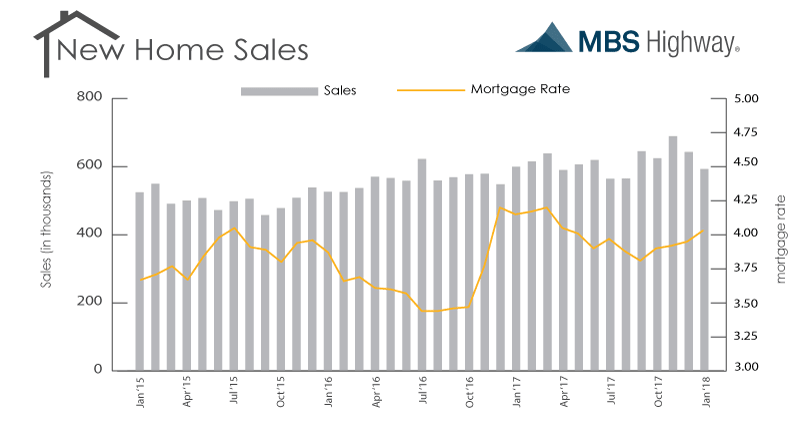
This week’s economic calendar will tell us a lot about housing.  Earlier today new home sales were reported below economists’ expectations.  However, they are coming off record highs reported in November of 2017.

On Tuesday we’ll see the most current home price index reports from Case-Shiller and the FHFA.  On Wednesday the National Association of Realtors will release the latest pending home sale report.

The Fed

New Fed Chairman Jerome Powell will address lawmakers on Capitol Hill for the first time on Tuesday and Thursday.  Larger projected government spending deficits have increased speculation that inflation pressures will rise.  Inflation is the primary driver of home loan rates so we will be listening closely to his comments.

The Outlook

As long as the yield on the US 10-year treasury note remains at or below 2.91% I feel comfortable floating.  However, longer-term trends are still concerning so my advice is use caution this week.

Current Outlook: cautiously floating

Government Shutdown Pauses Mortgage Rate Momentum

After two days of the government being shutdown it looks like congress has reached an agreement to fund Federal operations.  Just wondering, if this happens again can we ask Canada to govern us?

According to estimates a government shutdown costs the US economy $1 billion per day.  Bad news for the economy is often good news for mortgage rates.

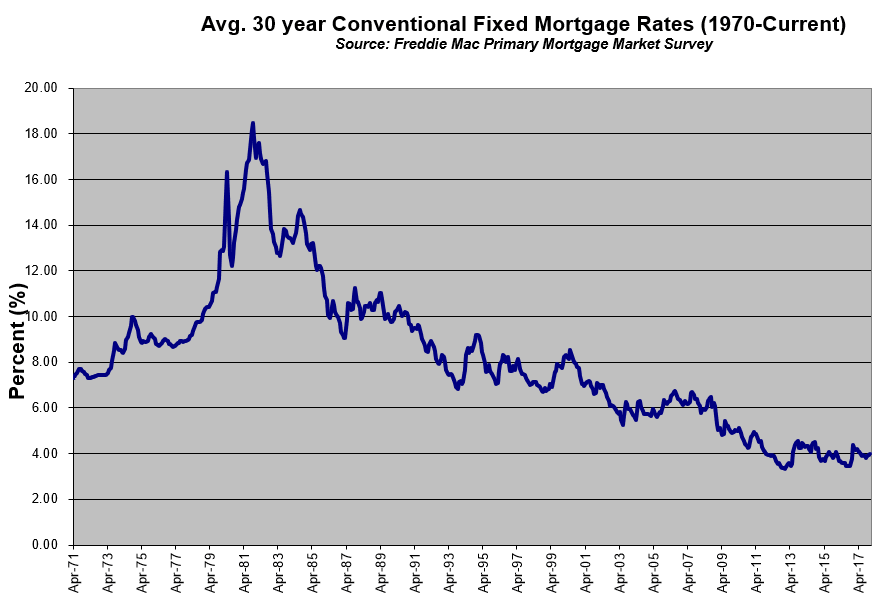
Home loan rates need the help because last week they continued to march higher.  Interest rates in the US are currently at the highest level since July of 2014.  Let’s not lose perspective though, mortgage rates are still historically low.

Furthermore, most experts predicted that mortgage rates would rise in 2018 so this should come as no big surprise.

This week’s economic calendar is relatively light (aside from the government shutdown).  On Wednesday we get existing home sales and the FHFA house price index.  I expect the latter to reflect continued appreciation due to lack of supply.  On Thursday we get the latest reading on new home sales and on Friday durable goods orders.

Assuming that the government funding agreement comes together today I am going to maintain a locking bias.  Momentum is not on our side.

If not the uncertainty of the shutdown could help mortgage rates improve in the near-term.

Current Outlook: locking

A flattening yield curve may signal higher rates in the future

Interest rates and US stocks got off to a good start last week but had a rough finish.  For the week mortgage rates worsened very modestly.

We are 30 days away from the next Fed meeting and according to CME group there is currently a ~97% probability that the Fed will hike short-term interest rates.  I am guessing media coverage will pick up on this topic after the Thanksgiving Holiday.

As a reminder the Fed does not directly control mortgage rates.  The Federal Funds Rate is charged on overnight loans between banks and a mortgage can last 30 years.

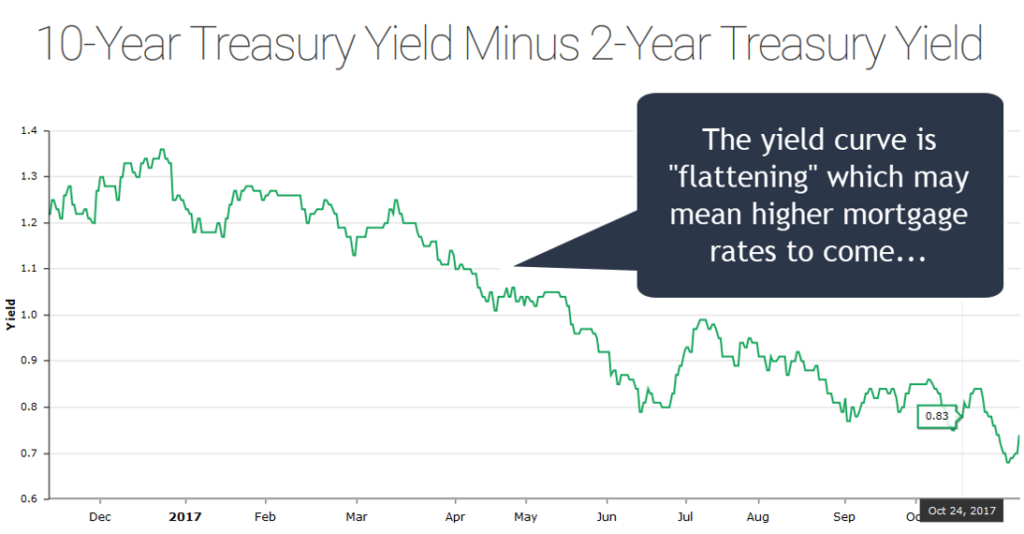
What’s interesting is that as the Fed has hiked short-term interest rates yields for shorter-term loans (i.e. less than three years) have increased yet longer-term durations have remained relatively low.  A look at he spread between the 2-year and 10-year treasury notes tell the story:

The yield curve is “flattening” which may mean long-term rates, including mortgages, will rise in the future or could also signal a recession.  Time will tell.

As I had written about last week (see HERE) sentiment regarding the tax overhaul is driving the direction of the financial markets. I expect much of the same this week.

The Senate version of the tax overhaul legislation, which was released on Thursday, will now be reconciled with the House version.  Given the vast differences investors now seem pessimistic that a compromise will be made.  Given that the tax overhaul is seen as inflationary this could actually help interest rates remain low……for now.

The economic calendar is busy this week.  Although we lost ground last week I will remain cautiously floating.

Current Outlook: cautiously floating

Sentiment on tax plan to guide mortgage rates

Do you ever wonder what the Federal Reserve talks about during their monetary policy meetings?  It’s nacho business.  Happy National Nacho Day!

It was announced earlier today that New York Federal Reserve President William Dudley will retire his position in February.  With Janet Yellen and Dudley leaving the Fed there is speculation that the philosophical tilt of the Fed could become less accommodative which is not friendly for interest rates.

What is friendly to interest rates is a weaker than expected jobs report and that is what was delivered on Friday.  The report showed only 261,000 new jobs were created in October and that wage growth was modest.  Analysts had expected 300,000 new jobs to be announced.

Mortgage rates improved moderately last week breaking a seven week trend of worsening.  Will they continue to improve?  Much will depend on the progress of the GOP tax plan which was unveiled last week.  The plan, which is not supported by the National Association of Realtors, relies heavily on deficit spending which means the US Treasury will need to issue more debt.  All else being equal a greater supply of debt means yields move higher.

Therefore, as sentient shifts in favor of the tax overhaul becoming law I expect home loan rates to worsen and vice versa.

Current Outlook: cautiously floating

Mortgage Rate Update October 30, 2017

My father-in-law once told me, “there is nothing more permanent than a temporary tax.”  Speaking of…. property tax statements for homes in the tri-county area are arriving in mailboxes as I type and most are increasing by greater than 3% this tax year.  I recommend reading THIS PIECE for an explanation.  If your customers have not pinged you yet on this topic I suspect some will soon.

As I wrote about last week mortgage rates have been on a brutal ride higher ever since the beginning of September.  Might we get a reversal this week?  So far so good.  Rates have stabilized this morning and pricing has improved since last Thursday.

It is an extremely busy week on the economic calendar.  Earlier today we got the latest reading of the Personal Consumption Expenditure price index.  It showed that core prices (“core” strips out volatile food & energy items) increased by only 1.3% from last year.  This is well below the Fed’s target of 2% and a friendly number for interest rates.

On Tuesday we’ll get the latest reading of consumer confidence and the Fed’s monetary policy meeting begins.  On Wednesday we’ll get the Fed’s statement (not expected to hike rates) and the ADP private payroll report.  On Thursday we get initial jobless claims and on Friday the all-important jobs report.

From a technical trading perspective mortgage rates are trading at important layers of support/ resistance.  They could break out either direction.

Current Outlook: cautiously floating

Mortgage Rate Update October 16, 2017

During an annual review an employee is astonished when their boss hands them a $10,000 check and says, “great job this year!”.  The employee is speechless.  The boss then says, “if you show me the same level of effort next year then bring that check back to your review and I’ll sign it.”  Today is National Boss’s Day so be sure to give yours a hard time.

Mortgage rates improved modestly last week despite the stock market gaining for the fifth consecutive week.  The cyclically adjusted price to earnings ratio for the S&P 500 remains above 30 which historically has been a signal that stocks are overvalued.  Third quarter earnings reports will be issued over the next couple weeks so we’ll see if profits can justify these lofty valuations.  In general when stocks do well mortgage rates suffer.

Last week tamer than expected core inflation numbers played a role in helping yields improve.  However, oil prices are starting this week higher on news that tensions are flaring between the Iraqi central government and the Kurdish region.  If oil prices continue to rise it will likely stoke fears of higher inflation in the future which would hurt mortgage rates.

This week’s economic calendar is heavy with housing data.  On Tuesday we get the home builders’ index, on Wednesday we’ll see housing starts/ building permits, and on Friday existing home sales.

From a technical perspective mortgage rates are trending in the right direction but will face significant resistance this week.

Current Outlook: neutral