What the heck are ‘technical trading patterns’?

If you’ve been an avid reader of ‘rate update‘ then you know that I often refer to ‘technical trading patterns’ (TTPs) as a factor that can have a major influence mortgage rates.  Typically TTPs have the most impact when the markets lack new economic data and/ or significant stock market momentum.

However, very few people are familiar with the concept of TTPs and how they impact mortgage rates.  In this post I will attempt to explain what TTPs are and how they impact our advice to “lock” or “float” interest rates.

To preface this explanation it’s first critical that you know that mortgage rates are 100% determined by the price of mortgage-backed bonds (MBS’s)When the price of MBS’s increase, mortgage rates decline.  When the price of MBS’s decrease, mortgage rates increase.

TTPs are essentially derived from the discipline of technical analysis.  Believers in technical analysis claim that previous price data for a specific financial security can be used to predict the future movements of that price.

In this case, TTPs offer a way for us to assess patterns in the price history of MBS’s and determine how future prices will react.

Specifically, in evaluating TTPs we look for where the current price level for MBS’s are relative to the average price levels over a 10, 25, 40, 50, 100, and 200 day time frame.  These averages are called “moving averages” and are calculated by averaging the price level of MBS’s over a specified time frame.

For example, the “10-day moving average” is calculated simply by averaging the price of MBS’s over the previous 10 days.  Likewise, the “200-day moving average” is calculated by averaging the price level of the previous 200 days.

What makes identifying TTPs possible is that MBS prices often react in a consistent manner when they approach these “moving averages”.  Therefore, we often see very predictable patterns of price changes when MBS’s approach these levels.  Because mortgage rates react inversely to the price of movements of MBS’s once we can accurately predict price movements we can also predict mortgage rate movements.

For example, in the chart below look at the first circle near the top left hand corner.  At this point MBS prices are falling and approaching the 200-day moving average (blue line).  We know that when MBS prices approach this level they tend to react in one of two ways.
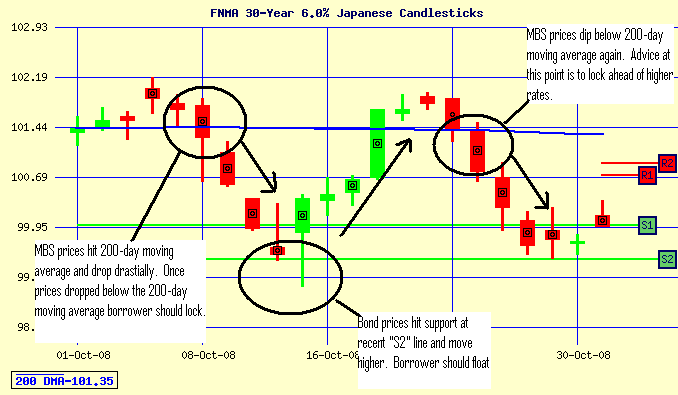
One reaction is for them to “bounce” higher off the 200-day moving average which causes MBS prices to rise and rates to drop.  However, in this instance MBS prices reacted in the opposite manner.  They dip below the 200-day moving average and rates rise as a result.

At times like this we would advise or clients to float as long as MBS prices remain at or above the 200-day moving average.  As soon as they close below the 200-day moving average we know rates will get worse before they get better.  Therefore, we advise a “locking” position as soon as MBS prices dip below the 200-day moving average.

The second circle near the bottom of the chart shows MBS prices getting support at the “S2 line” (green line) which is not a moving average but likely a low-point in recent trading history.  At this level MBS prices are able to find a bottom and begin rallying.  At this time mortgage rates are likely .25%-.375% higher compared to only a few days earlier (when MBS prices were up near the 200-day moving average). Because MBS prices appear to have bottomed we would recommend a “floating” position at this point as mortgage rates show signs of improvement.

Indeed, off this floor MBS prices rally for 5 days and rates drop back down by .25%-.375%.  Once they approach the 200-day moving average the rally loses steam and  in the third circle show signs of weakness.

Much like our approach at the first circle we would recommend a “floating” position so long as MBS prices remain at or above the 200-day moving average.  As soon as prices dip below this level we know that prices are likely to decline pushing rates higher by .25%-.375% once again.

This is just one example of how we would use technical analysis to identify TTPs that will impact mortgage rates.  This concept is somewhat complicated and takes time to learn.  If you have questions about TTPs or would like to make a comment please do so below.

Why margin calls are currently causing mortgage rates to rise

In a more normal financial environment we expect that when stocks trade lower mortgage rates benefit.  This is because when money flows out of stocks it typically finds its way into the bond market which helps drive yields lower.

However, on many occasions over the past two weeks we’ve seen both stocks and bonds sell-off together causing mortgage rates to rise.  Why has this dynamic changed?

The reason is that many investors, hedge funds, and institutions are having to sell assets because of “margin calls“.

To understand what a margin call it is first important to understand that many investors borrow money in order to purchase financial securities.  By employing leverage they are able to increase their return on equity (when the value of these securities rise).

The lenders who lend money on margin require that investors keep a certain proportion of equity relative to leverage (much like loan-to-value ratio on a home).  For example, if a bank is to lend an investor $1.0 million on margin they may require that the value of the account maintain a level of at least $2.0 million.

When the value of the securities decrease below this level, the lender issues a “margin call”.  This call forces the investor to sell assets and raise cash to pay back the loan.

If enough investors are forced to do this concurrently, as they are in today’s environment, then the financial markets are flooded with securities and values of all asset classes decrease together.

This is why in today’s market, we are seeing the stock market decline AND mortgage rates increasing.

Mortgage Rates headed higher?

This cnnmoney.com article predicts that mortgage rates will be moving higher over the course of the next 6 months.  The reasons?

-Increased supply of US treasury bills to pay for the financial bailout plan.  When the supply of treasury’s increase it pushed yields higher for all fixed income securities including mortgage-backed bonds.

FDIC’s plan to cover unsecured bank debt.  As a part of the financial rescue plan the FDIC now has authority to effectively sell bonds to pay for bank deposit insurance.  This represents a further supply in government issued bonds which could also contribute to higher interest rates.

-However, Mark Zandi correctly points out near the end of the article that spreads between 30-year treasury bonds and mortgage-backed bonds are close to 2% right now.  Historically the spread is closer to 1.5% so a convergance in yields could help mortgage rates.

Will bailout lead to weaker US Dollar?

Vitaliy Katsenelson wrote a good article for Forbes today about the impact that a $700 billion bailout would have on confidence in the US dollar.

Excerpt:

In the past, we did not really have to worry about the financial strength of the U.S. government. Today, that financial strength has been tested. I doubt it will happen but I would not be surprised if Microsoft’s new AAA-rated bonds will have a lower yield than US Treasuries.

In other words, if the US government commits to a $700 billion bailout plan investors know that they will have to effectively print money to foot the bill.  Increasing the money supply would lead to higher inflation and therefore higher interest rates.

Although unlikely could you imagine if US debt carried higher rates of interest than AAA corporate debt?

However, he goes on to mention:

On the bright side, the bailout may or may not end up being a bailout. If the government were to buy loans for 30 cents on the dollar that are worth at least 30 cents, then the government is providing liquidity–the cost to taxpayers is zero. Not necessarily a bailout.

Hopefully the latter is the case.

Rate Update September 24, 2008

Rates remain unchanged this morning after being pushed slightly higher yesterday afternoon.
What does Warren Buffet have to do with mortgage rates? The greatest investor of all time (in my opinion) gave a huge vote of confidence to the financial system yesterday when it was announced that he had reached a deal with Goldman Sachs to purchase $5 billion in preferred stock.

Current Outlook: near-term locking, long-term floating

Derivative market failure could lead to higher rates

MSN Money writer Jim Jubak wrote a great article today about the importance of the derivative market.  Little is known about derivatives outside of Wall Street but he makes a compelling case for government intervention because of the role that these financial instruments play in encouraging foreign investors to invest in US based financial securities.

Put simply, derivatives are insurance contracts that an investor can purchase from a “counter-party” which would require the counter-party to pay the investor a sum of money should a specific event occur.  For example, a sovereign wealth fund who was purchasing a large pool of US mortgage-backed bonds could purchase a derivative contract from a financial institution which would pay out a sum of money should defaults on mortgage increase past a certain level (say 5%).

These derivatives then act as hedges for the sovereign wealth fund should this pool of mortgages go bad.  In essence, they reduce the risk involved for foreign investors in making investments into an economy they may not be familiar with.

Without derivatives foreign investors who we rely on to buy up mortgage-backed bonds and other US financial securities would be far less likely to invest in the US.  Without their demand for our securities we would sit back and watch mortgage rates and other interest rates rise.

Rate Update September 19, 2008

Rates are unchanged from yesterday’s levels.

Mortgage rates do not know what to do after the government announced “bold” plans to shore up the financial system.  This announcement leaked yesterday afternoon which is why the stock market has rallied over the past 24 hours.

Treasury Secretary Henry Paulson announced this morning that the government would work over the weekend to create legislation designed to restore confidence in financial institutions.

The main points behind the program can be seen at this link.

At this point we are going to shift our outlook to neutral until we get more details about the plan.

Current Outlook: neutral

Rate Update September 17, 2008

Rates are sharply higher this morning following a steep sell-off in mortgage-backed bonds yesterday afternoon.

The major piece of news this morning is that the government has stepped in to bailout the nation’s largest insurance business AIG. This is not a huge surprise because of the extent that AIG is intertwined into the broader financial system. Had the government not stepped in the consequences would have been drastic.

The implication of this announcement on mortgage rates is that volatility has picked up. You’ll notice that mortgage rates are sharply higher this morning. Both the stock market and bond market have made acute movements in the past couple days as investors try to interpret these unprecedented events.

For those of you who may have insurance through AIG the research I’ve done tells me that you should be fine. Here is a link to a great article on CNNmoney which provides simple answers.

We remain optimistic that in the next few weeks mortgage rates will come down further. However, it is clear that day to day we may see volatile changes to rates.

Current Outlook: long-term floating, near-term neutral

Rate Update September 16, 2008

Rates are effectively unchanged this morning.

There is A LOT to talk about this morning as crisis in the financial markets persists. Here is a summary of the major stories we’re falling that are likely to impact the direction of mortgage rates:

→ AIG: The nation’s largest insurer is close to insolvency. Analysts are suggesting that the troubled insurer needs to raise $75 billion in fresh capital to stay afloat. The failure of this firm would be unprecedented because of it’s vast reach & volume of obligations. AIG operates in 130 countries and is a major player in the credit default & life insurance sector. AIG’s failure would likely cause a major disruption in the financial markets which could drag other firms down with it. Although rates may benefit from this news in the near term, in the long run this would be a disaster.

→ Federal Funds Rate: The Fed is scheduled to announce their interest rate policy decision this afternoon. Last week at this time there was a 0% chance that the Fed would alter rates. However, analysts now assume a cut of at least .25% and possibly even .50%. Remember that in and of itself the Fed cutting rates will not directly impact mortgage rates. However, what they say following their announcement can.

→ Consumer Price Index: Finally, the Labor Department released the monthly CPI report. The report came in line with expectations reflecting a 5.4% increase year-over-year. When stripping out volatile food and energy prices year-over-year inflation rose by 2.5%. Although these figures are relatively high compared to the past couple years the announcement did not surprise the markets.

Current Outlook: floating

Kudos to Barron’s part II

After reading and blogging about one article in Barron’s this weekend I came to another outstading one.  Here is a link.  Nice work Barron’s.

Among the points that I found interesting:

* If Fannie Mae [ticker: FNM] and Freddie Mac [FRE] stopped all of their activity — for a moment, forget about shutting them down and being insolvent — in order to sell off mortgages as normal loans without this guarantee, the interest rate would have to be around 9% or 10%.

* Q: What other negatives do you see?

A: Inflation risk down the line. [The federal government is] going to probably overstimulate and over support in an attempt to stem these deflationary forces. We are looking at a longer-term inflationary force that is pretty substantial. This has been my view for a long time. Interest rates went into a very long decline from the late ’70s and early ’80s until earlier this decade, when first we saw rates bottom out. Then rates went up a couple of times.

Basically, we are getting back down toward those low levels again. The multiyear bottom in interest rates that started around 2002 will probably last into 2009. Then we are going to see the inflationary aftermath of these government policies, and you might be surprised at how high interest rates go.

* Q: How much more pain are we going to feel in the housing market before things start to stabilize?

A: I think we are about half way through. There is high momentum in terms of home-price declines, so it is pretty clear they are going lower. It always looks a lot like the hills on a roller coaster. It starts out with a flattish period. Then it starts to go down, and then it really starts to drop, and we are clearly in that period. That period is going to be with us for about another year before it flattens out and bumps along in 2010.

The S&P/Case-Shiller Index is down a little more than 15% from its peak in 2006, and I’ve believed for some time that the index will have dropped 30% from its peak. That means some markets are going to drop by 50%. That includes Miami, Las Vegas and Phoenix, all of which were fueled by subprime lending. The foreclosure overhang is so big in those areas.