Mortgage Rate Update January 28, 2016

Mortgage rates are unchanged from Monday.

Yesterday the Fed concluded their latest monetary policy meeting and delivered the highly anticipated statement.  As we expected (see HERE) the Fed did come slightly more “dovish” in their outlook for hiking short-term interest rates in 2016.  As a reminder the Fed does not directly control mortgage rates.

Following the December meeting the Fed had led the markets to believe that they would hike 4 times during 2016 for a total increase of 1.00%.  Since then the US stock market has declined by ~10% and equity markets in Japan, China, and France are down even more.  In their statement the Fed acknowledged the shift in the economic outlook and said they’d be “…closely monitoring global economic and financial developments…”.  At this point the markets a placing a very low probability on a rate hike at the next meeting scheduled for March.

According to the most recent S&P Case-Shiller Home Price Index report Portland led the nation in annual home price appreciation for the year ending in November 2015.

In housing news the S&P Case-Shiller Home Price Index report was released on Tuesday.  The report covered home price changes for the month of November 2015.  In case you missed it Portland led the nation in annual home price appreciation at 11.1%.  That report coupled with the Pending Homes Sales report released by the National Association of Realtors today indicate a market where demand remains strong and supply is scarce.

From a technical perspective interest rates remain very attractive going back a couple years.  I am going to recommend a locking bias.

Current Outlook: locking bias
Mortgage Rate Update January 25, 2016

Mortgage rates are unchanged from last week and remain at multi-month lows.

It’s Fed week so I anticipate the financial markets will trade sideways until the monetary policy committee releases its statement on Wednesday at 11AM PST.  As a reminder, the Fed does not directly control mortgage rates but their comments and actions do impact the financial markets, including mortgage rates.

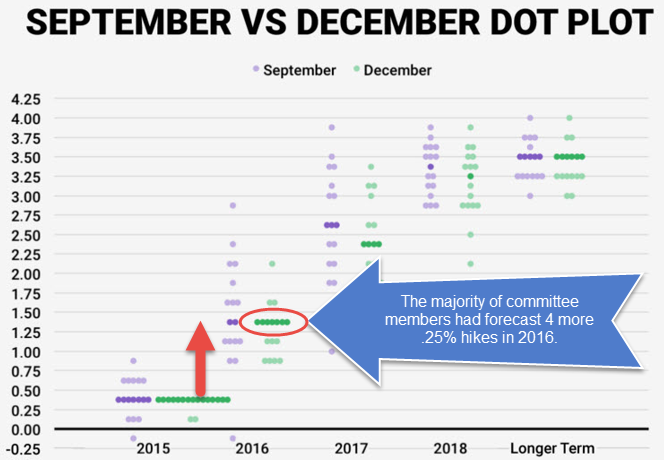
As we know the Fed embarked on a rate hiking cycle at the mid-December meeting.  In addition, the Fed released the chart below showing where the individual committee members forecast the Federal Funds rate to be in the future.

Source: The Federal Reserve

This chart shows that the majority of committee members had forecast 4 more +.25% hikes during 2016 (for a total +1.00%).  I use the term ‘had’ in the previous sentence because there is speculation that the Fed will back off this forecast given the recent turmoil in the financial markets.  Keep in mind, the US central bank is tightening monetary policy while its counterparts in Europe and Japan are all easing.

If the Fed does publish a less “hawkish” statement it could spark a rally in stocks which we know would not be favorable for mortgage rates.  Given that I think this is a real possibility I am going to recommend locking before Wednesday.

Current Outlook: locking before Wednesday

Mortgage Rate Update January 21, 2016

Mortgage rates are unchanged from the beginning of the week and remain at multi-month lows.  If you missed the window for refinancing in October 2015 now is your time to revisit your options.

As I wrote about on Tuesday weakness in the stock market continues to help mortgage rates improve.  Much of the media focus here in the US has been on our domestic equity markets which are off by approximately 10% in the past month.  Did you know Asia is faring much worse?

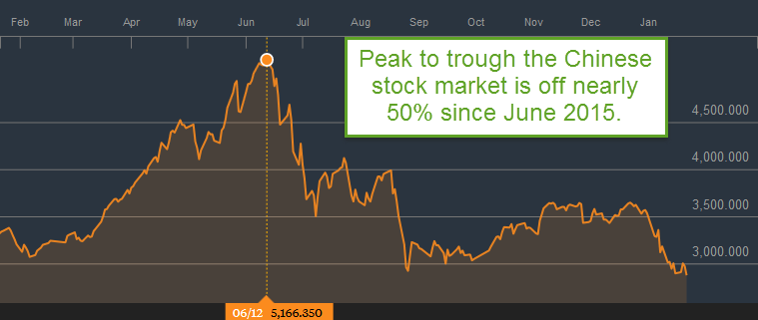
From the “it could be worse department” Japan’s Nikkei 225 stock index is off by approximately 20% since the beginning of December and China’s Shanghai Stock Index is off nearly 50% since June.

Source: Bloomberg.com

Global stock market volatility encourages investors to dump equity holdings and seek “safe-havens” for their capital.  This additional demand for US fixed income securities drives yields lower which is why mortgage rates have improved by .125%-.25% over the past month.

Will this trend continue?  It’s always difficult to know.  Many stock markets analysts have turned cautious.  I am going to recommend a floating bias since momentum is on our side.

Current Outlook: floating

Mortgage Rate Update January 19, 2016

Interest rates are extremely attractive.  They are currently at the best levels since October of last year.

I’ve written numerous times about how the stock market can impact mortgage rates.  All else being equal when stocks do poorly interest rates benefit as a result of a “flight-to-safety”.  Want to see a great example of this?

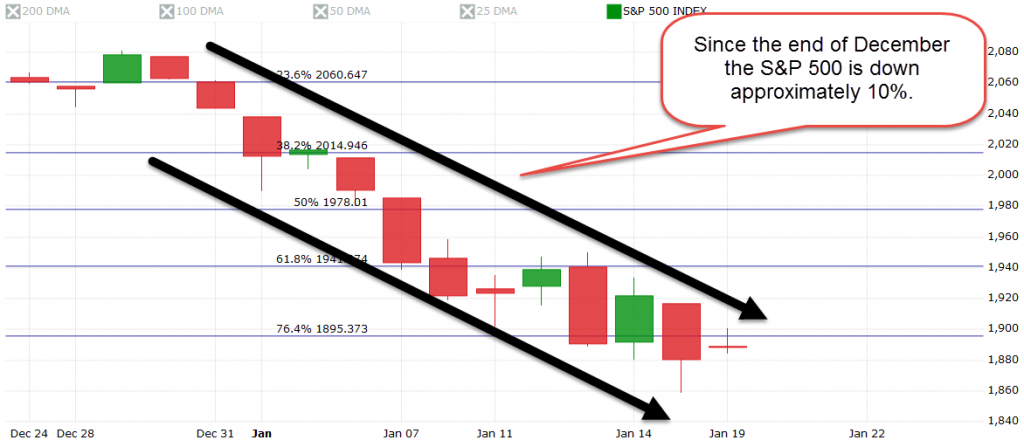
Over the past month the S&P 500 has fallen by approximately 10% (on a related note see HERE).

01-19SP500
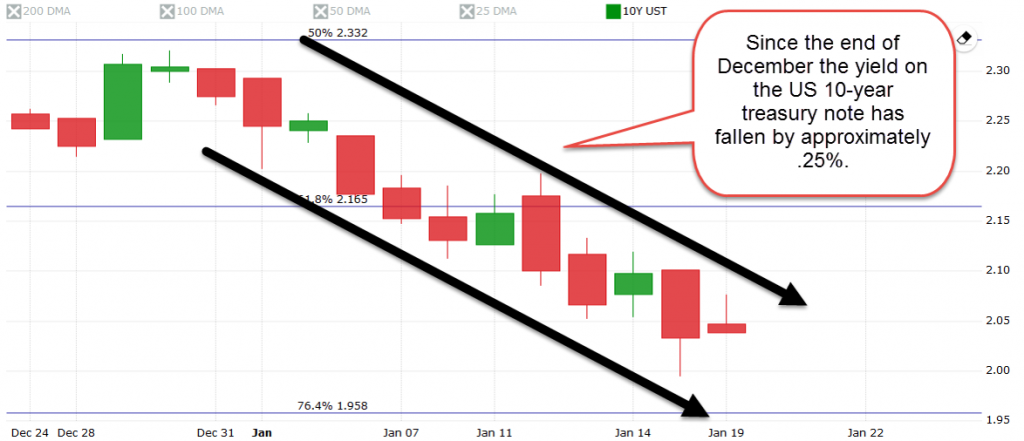
Over that same time period the yield on the US 10-year treasury note, which mortgage rates tend to track, have improved as well.

01-19-US 10yr treasury

The stock market will likely overshadow other factors in this holiday shortened week.  If stocks rebound then mortgage rates may reverse higher but if they continue to slump we could see rates move even lower.  If I knew with certainty what was going to happen you and I could make a lot of money.

Given that mortgage rates have improved by .125%-.25% in the past month I am going to recommend a locking bias even though I can see stocks continuing to struggle.

Current Outlook: locking bias
Mortgage Rate Update January 14, 2016

Mortgage rates are essentially unchanged from the beginning of the week and remain at 2-month lows.

As I have repeatedly written over the past few months the Fed does not directly control mortgage rates.  In mid-December the Fed increased short-term interest rates by +.25%.  Since then mortgage rates have improved by ~-.25%.  There you have it.

With an assist to Art Cashin, I want to take a moment to focus on the stock market.  As we know, when stocks do poorly mortgage rates tend to benefit and vice versa.  Below is a chart of the S&P 500 for the past 6 months.

01-14-SP500

As you can see the S&P 500 has experienced two 10% corrections in the past six months.  In the past 100 years this has only happened three other times.  The other three occurrences took place in 1929, 2000, and 2008.  Do you need a reminder on how those years turned out for the stock market?  Of course there is no guarantee that history will repeat itself but this is certainly a concerning prospect.

From a technical perspective mortgage rates appear ripe for reversal.  I am going to recommend a locking position.

Current Outlook: cautiously floating

Mortgage Rate Update January 11, 2015

Mortgage rates are improved from the beginning of last week.

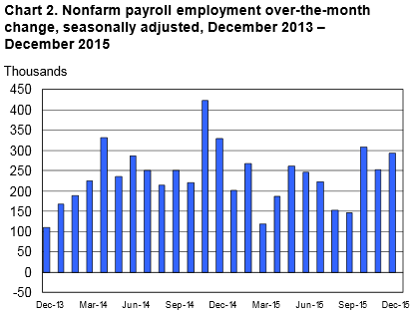
In case you missed it the headline numbers that accompanied the all-important jobs report were better than expected.  According to the report the US economy added 292,000 new jobs during the month of December, far more than the ~200,000 that was anticipated.

Source: Bureau of Labor Statistics

Normally, we’d expect mortgage rates to suffer in reaction to a stronger than expected jobs report.  However, when you dive into the report you realize that many of the gains were made by teenagers and many appear to be seasonal.  Therefore, mortgage rates did not react as we’d expect.

Looking ahead for this week the economic calendar is fairly quiet until Friday.  At the end of the week we’ll get readings on retails sales, manufacturing activity, and inflation (Producer Price Index).

In the meantime, I expect interest rates to react to global stock markets and technical trading patterns.  Globally, stock markets remain vulnerable as concerns regarding the outlook for the Chinese economy reverberate around the world.  When market sentiment is negative about the Chinese outlook is helps US interest rates because investor seek “safety” here.  The opposite is also true.

From a technical perspective the near-term outlook looks favorable.  I am going to recommend floating for now but that may change before I post Thursday’s ‘rate update’.

Current Outlook: cautiously floating

Mortgage Rate Update January 4, 2016

Mortgage rates are unchanged from last Monday.

Global influences are helping the outlook for mortgage rates.  Chinese officials had to put a halt to trading earlier today as the Chinese stock market fell 7% after a report showed a decline in factory activity there.

THE CHINESE STOCK MARKET TRADED SHARPLY LOWER TODAY WHICH IS HELPING US MORTGAGE RATES.

Geopolitical tensions are rising in the middle east following the execution of 47 individuals by Saudi Arabia over the weekend.  Saudi Arabia announced that they would cut diplomatic ties with Iran.  The financial markets are concerned about this event spiraling into an armed conflict.  When geopolitical tensions rise, US interest rates benefit.

In response US stocks are trading sharply lower to start the new year.  The Dow Jones Industrial Average is currently off 422 points (-2.4%).  When US stocks trade lower mortgage rates tend to improve.

The economic calendar is fairly quiet this week until we get to the all-important jobs report on Friday.  I will focus on that in this Thursday’s update.

Current Outlook: floating

Mortgage Rate Update December 28, 2015

I hope you had a great holiday weekend!  Mortgage rates are slightly worse as compared to last Monday.

As you might imagine the economic calendar is fairly light this week.  The highlights include the Case Shiller Home Price index (Tuesday), Consumer Confidence (Tuesday), and Pending Home Sales (Wednesday).  The bond market will be open for a half day on Thursday and closed Friday.

I don’t expect mortgage rates to move significantly one way or the other.  Have a fantastic New Year holiday!

Current Outlook: floating

Mortgage Rate Update December 21, 2015

Mortgage rates are unchanged from last Thursday’s update.  The bond market will close early on Thursday and be closed on Friday so this update will be the only one for the week.

I hope you have  a fantastic holiday season and Happy New Year!

HAPPY HOLIDAYS!
HAPPY HOLIDAYS!

Although it is a holiday shortened week the economic calendar is relatively full.  The highlights include the FHFA housing price index (Tuesday), existing home sales (Tuesday), durable goods orders (Wednesday), personal consumption expenditure price index (Wednesday), and new home sales (Wednesday).  Given that trading desks are lightly populated this week we could see some volatility since there will be fewer buyers and sellers in the marketplace.

From a technical perspective mortgage-backed bonds are trading in a relatively tight trading range between support and resistance.  The US 10-year treasury yield has improved by ~.125% following the Fed’s rate hike last Wednesday.  At ~2.19% the yield has a stiff floor of resistance that will make it hard for rates to move lower.

Current Outlook: locking

Mortgage Rate Update December 17, 2015

Mortgage rates worsened slightly Monday & Tuesday this week but have since rebounded so that we’re currently unchanged on the week.

Unless you live under a rock you are well aware that, as expected, the Fed did raise short-term interest rates by .25% yesterday.  The move will increase the borrowing costs on loans based on the Prime Index such as credit cards and home equity lines of credit but does not directly impact mortgage rates.

In conjunction with announcing the increase the Fed said they were likely to continue to bump short-term interest rates higher at a “gradual” pace.  What does that mean?

December Fed Dots12-17-2015

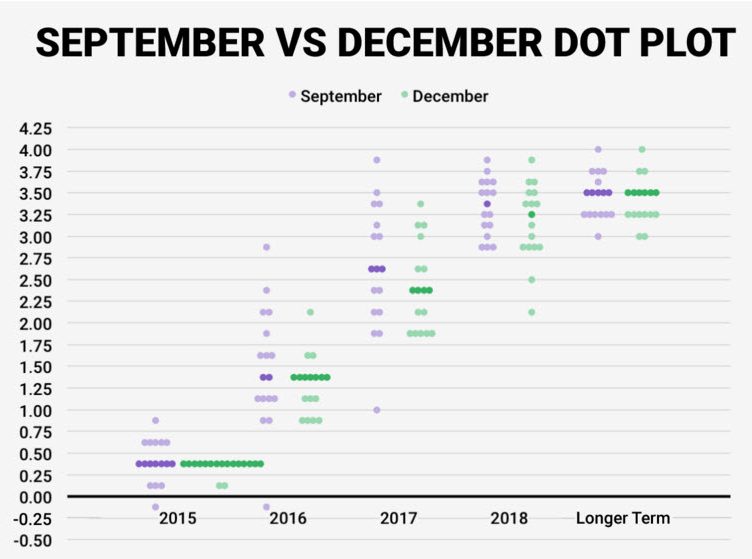
A look at the “dot chart”, which is a graphical representation of the various Fed members’ forecasts for future rates, the markets currently believe the Fed will bump rates by .25% 4 times in 2016 and 2017.

From a technical perspective mortgage rates are trading within a fairly tight range which leads me to believe that rates will likely trade sideways.  That said, next week is a holiday shortened week and it’s likely that trading desks will sparsely occupied so starting Monday we run the risk of seeing some volatility.  I would recommend locking before the week is out.

Current Outlook: locking before the week is out