Deflation string-article #2

This past Sunday I blogged about Nouriel Roubini’s prediction that the US economy would face deflation in the next 6 months.

Today, cnnmomney.com has also published this article in which they report that deflation is becoming more and more of a concern for central bankers.

In terms of economic health deflation is a bad sign.  In terms of mortgage rates the expectation of deflation could help mortgage rates get very low.  That’s why I am hoping that expectations for deflation grow so rates can move lower but that we never actually reach that point.

Central Banks & short-term rates

If you like to “geek out” on economics like I do then you may also find this article interesting in today’s Washington Post.  In the article Chris Rugaber explains what impact short-terms rates has on the economy and why different central banks around the globe hold their short-term lending rates at different levels even though many of them face the same challenges.

Exceprt:

Q: What effect do central banks have on me?

A: The Federal Reserve is the U.S. central bank. When it cuts (or raises) its benchmark short-term interest rate, most major banks follow suit by cutting (or raising) the interest rate they charge on credit cards, home equity lines of credit and other consumer loans.

The Fed has cut rates twice this month, potentially helping U.S. borrowers. Unfortunately, today’s steep cut by the Bank of England won’t reduce your car payment or mortgage, unless you’re reading this from England.

Deflationary environment would lower mortgage rates

You’ve probably never heard of Nouriel Roubini but you may want to start paying attention.  Along with Peter Schiff he basically called the subprime mortgage crisis before the term even existed.  He is getting a lot of attention lately in the media.

In this article published on Forbes.com he lays down the argument that the US economy will experience deflation in the next 6 months.  Although there are many scary macro-economic implications of such an event there is a silver lining for mortgage rates.

Since we know that higher inflation causes mortgage rates to increase, it can also be said that deflation causes mortgage rates to decrease.  In fact, much of the credit for low interest rates following 9/11 has been appointed to concerns of deflation.

Mortgage rates should benefit from Bernanke’s comments

On Friday Fed Chairman Ben Bernanke announced that he endorses the concept of the federal government guarantying mortgage-backed securities (MBS’s) issued by Fannie Mae and Freddie Mac.  These comments should help mortgage rates move lower.

The reason that a government guarantee helps mortgage rates move lower is because it reduces the risk of default on MBS’s for investors and therefore they are willing to accept a lower yield.

To learn more click these links-

Washington Post article

Wall Street Journal article

Blog posting on the role that Fannie & Freddie play in mortgage market

What the heck are ‘technical trading patterns’?

If you’ve been an avid reader of ‘rate update‘ then you know that I often refer to ‘technical trading patterns’ (TTPs) as a factor that can have a major influence mortgage rates.  Typically TTPs have the most impact when the markets lack new economic data and/ or significant stock market momentum.

However, very few people are familiar with the concept of TTPs and how they impact mortgage rates.  In this post I will attempt to explain what TTPs are and how they impact our advice to “lock” or “float” interest rates.

To preface this explanation it’s first critical that you know that mortgage rates are 100% determined by the price of mortgage-backed bonds (MBS’s)When the price of MBS’s increase, mortgage rates decline.  When the price of MBS’s decrease, mortgage rates increase.

TTPs are essentially derived from the discipline of technical analysis.  Believers in technical analysis claim that previous price data for a specific financial security can be used to predict the future movements of that price.

In this case, TTPs offer a way for us to assess patterns in the price history of MBS’s and determine how future prices will react.

Specifically, in evaluating TTPs we look for where the current price level for MBS’s are relative to the average price levels over a 10, 25, 40, 50, 100, and 200 day time frame.  These averages are called “moving averages” and are calculated by averaging the price level of MBS’s over a specified time frame.

For example, the “10-day moving average” is calculated simply by averaging the price of MBS’s over the previous 10 days.  Likewise, the “200-day moving average” is calculated by averaging the price level of the previous 200 days.

What makes identifying TTPs possible is that MBS prices often react in a consistent manner when they approach these “moving averages”.  Therefore, we often see very predictable patterns of price changes when MBS’s approach these levels.  Because mortgage rates react inversely to the price of movements of MBS’s once we can accurately predict price movements we can also predict mortgage rate movements.

For example, in the chart below look at the first circle near the top left hand corner.  At this point MBS prices are falling and approaching the 200-day moving average (blue line).  We know that when MBS prices approach this level they tend to react in one of two ways.
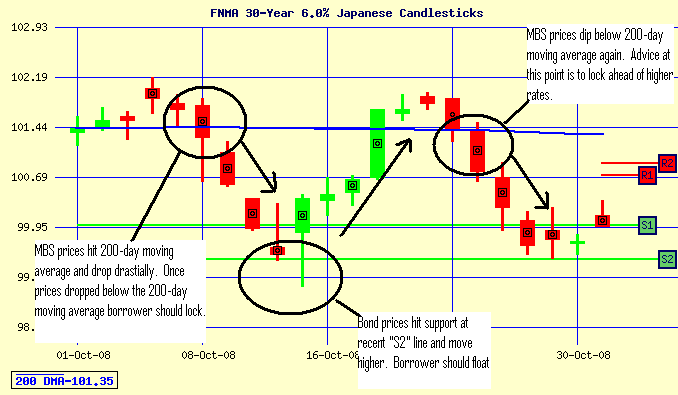
One reaction is for them to “bounce” higher off the 200-day moving average which causes MBS prices to rise and rates to drop.  However, in this instance MBS prices reacted in the opposite manner.  They dip below the 200-day moving average and rates rise as a result.

At times like this we would advise or clients to float as long as MBS prices remain at or above the 200-day moving average.  As soon as they close below the 200-day moving average we know rates will get worse before they get better.  Therefore, we advise a “locking” position as soon as MBS prices dip below the 200-day moving average.

The second circle near the bottom of the chart shows MBS prices getting support at the “S2 line” (green line) which is not a moving average but likely a low-point in recent trading history.  At this level MBS prices are able to find a bottom and begin rallying.  At this time mortgage rates are likely .25%-.375% higher compared to only a few days earlier (when MBS prices were up near the 200-day moving average). Because MBS prices appear to have bottomed we would recommend a “floating” position at this point as mortgage rates show signs of improvement.

Indeed, off this floor MBS prices rally for 5 days and rates drop back down by .25%-.375%.  Once they approach the 200-day moving average the rally loses steam and  in the third circle show signs of weakness.

Much like our approach at the first circle we would recommend a “floating” position so long as MBS prices remain at or above the 200-day moving average.  As soon as prices dip below this level we know that prices are likely to decline pushing rates higher by .25%-.375% once again.

This is just one example of how we would use technical analysis to identify TTPs that will impact mortgage rates.  This concept is somewhat complicated and takes time to learn.  If you have questions about TTPs or would like to make a comment please do so below.
Why margin calls are currently causing mortgage rates to rise

In a more normal financial environment we expect that when stocks trade lower mortgage rates benefit.  This is because when money flows out of stocks it typically finds its way into the bond market which helps drive yields lower.

However, on many occasions over the past two weeks we’ve seen both stocks and bonds sell-off together causing mortgage rates to rise.  Why has this dynamic changed?

The reason is that many investors, hedge funds, and institutions are having to sell assets because of “margin calls“.

To understand what a margin call it is first important to understand that many investors borrow money in order to purchase financial securities.  By employing leverage they are able to increase their return on equity (when the value of these securities rise).

The lenders who lend money on margin require that investors keep a certain proportion of equity relative to leverage (much like loan-to-value ratio on a home).  For example, if a bank is to lend an investor $1.0 million on margin they may require that the value of the account maintain a level of at least $2.0 million.

When the value of the securities decrease below this level, the lender issues a “margin call”.  This call forces the investor to sell assets and raise cash to pay back the loan.

If enough investors are forced to do this concurrently, as they are in today’s environment, then the financial markets are flooded with securities and values of all asset classes decrease together.

This is why in today’s market, we are seeing the stock market decline AND mortgage rates increasing.

Will bailout lead to weaker US Dollar?

Vitaliy Katsenelson wrote a good article for Forbes today about the impact that a $700 billion bailout would have on confidence in the US dollar.

Excerpt:

In the past, we did not really have to worry about the financial strength of the U.S. government. Today, that financial strength has been tested. I doubt it will happen but I would not be surprised if Microsoft’s new AAA-rated bonds will have a lower yield than US Treasuries.

In other words, if the US government commits to a $700 billion bailout plan investors know that they will have to effectively print money to foot the bill.  Increasing the money supply would lead to higher inflation and therefore higher interest rates.

Although unlikely could you imagine if US debt carried higher rates of interest than AAA corporate debt?

However, he goes on to mention:

On the bright side, the bailout may or may not end up being a bailout. If the government were to buy loans for 30 cents on the dollar that are worth at least 30 cents, then the government is providing liquidity–the cost to taxpayers is zero. Not necessarily a bailout.

Hopefully the latter is the case.

Derivative market failure could lead to higher rates

MSN Money writer Jim Jubak wrote a great article today about the importance of the derivative market.  Little is known about derivatives outside of Wall Street but he makes a compelling case for government intervention because of the role that these financial instruments play in encouraging foreign investors to invest in US based financial securities.

Put simply, derivatives are insurance contracts that an investor can purchase from a “counter-party” which would require the counter-party to pay the investor a sum of money should a specific event occur.  For example, a sovereign wealth fund who was purchasing a large pool of US mortgage-backed bonds could purchase a derivative contract from a financial institution which would pay out a sum of money should defaults on mortgage increase past a certain level (say 5%).

These derivatives then act as hedges for the sovereign wealth fund should this pool of mortgages go bad.  In essence, they reduce the risk involved for foreign investors in making investments into an economy they may not be familiar with.

Without derivatives foreign investors who we rely on to buy up mortgage-backed bonds and other US financial securities would be far less likely to invest in the US.  Without their demand for our securities we would sit back and watch mortgage rates and other interest rates rise.

Short-term treasuries move to negative return

In probably the most telling sign that the financial markets are a mess yields on short-term treasuries actually turned negative yesterday.  WSJ.com reported on this phenomenon in this article.

* “The desperation was especially striking in the market for U.S. government debt, long considered the safest of investments. At one point during the day, investors were willing to pay more for one-month Treasurys than they could expect to get back when the bonds matured. Some investors, in essence, had decided that a small but known loss was better than the uncertainty connected to any other type of investment.

That’s never happened before. In a special government auction on Wednesday, demand ran so high that the Treasury Department sold $40 billion in bills, far beyond what it needed to cover the government’s obligations.”

WSJ.com-Worst crisis since Great Depression

WSJ.com featured a great article summarizing the problems we find ourselves in.  You may access the article by clicking this link.

Among the points that I found interesting-

* “This has been the worst financial crisis since the Great Depression. There is no question about it,” said Mark Gertler, a New York University economist who worked with fellow academic Ben Bernanke, now the Federal Reserve chairman, to explain how financial turmoil can infect the overall economy. “But at the same time we have the policy mechanisms in place fighting it, which is something we didn’t have during the Great Depression.”

* Fed and Treasury officials have identified the disease. It’s called deleveraging, or the unwinding of debt. During the credit boom, financial institutions and American households took on too much debt. Between 2002 and 2006, household borrowing grew at an average annual rate of 11%, far outpacing overall economic growth. Borrowing by financial institutions grew by a 10% annualized rate. Now many of those borrowers can’t pay back the loans, a problem that is exacerbated by the collapse in housing prices. They need to reduce their dependence on borrowed money, a painful and drawn-out process that can choke off credit and economic growth.

* At least three things need to happen to bring the deleveraging process to an end, and they’re hard to do at once. Financial institutions and others need to fess up to their mistakes by selling or writing down the value of distressed assets they bought with borrowed money. They need to pay off debt. Finally, they need to rebuild their capital cushions, which have been eroded by losses on those distressed assets.

* Today, Mr. Bernanke is taking out his playbook, said NYU economist Mr. Gertler, “and rewriting it as we go.”

* The latest trouble spot is an area called credit-default swaps, which are private contracts that let firms trade bets on whether a borrower is going to default. When a default occurs, one party pays off the other. The value of the swaps rise and fall as the market reassesses the risk that a company won’t be able to honor its obligations. Firms use these instruments both as insurance — to hedge their exposures to risk — and to wager on the health of other companies. There are now credit-default swaps on more than $62 trillion in debt, up from about $144 billion a decade ago.