Mortgage Rate Update July 6, 2015

Mortgage rates are improved to start the week.

In case you missed it Greek voters chose to reject additional austerity measures over the weekend which takes Greece and the Euro Zone into uncharted territory.  From here there is uncertainty regarding how this gets handled.  Can a deal still be struck between Greece and its creditors?  Or will Greece be forced to abandon the Euro?  Uncertainty is bad for the stock market and tends to be good news for US interest rates.  I expect the Greek story to continue to be a very fluid situation which means potential volatility for rates.

Greek voters flexed their muscle over the weekend.  Now we wait for the consequences to unravel.
Greek voters flexed their muscle over the weekend. Now we wait for the consequences to unravel.

The economic calendar is relatively light this week.  The highlights include minutes from the last Fed meeting (Wednesday), a US 10-year treasury note auction (Wednesday), and a speaking engagement for Janet Yellen (Friday).  In the meantime I expect US interest rates to take direction from the Greek situation.  Greater uncertainty and fear should help pressure mortgage rates lower and vice versa.

For now we can begin the week by floating.

Current Outlook: floating
Mortgage Rate Update July 2, 2015

Mortgage rates are effectively unchanged from Monday.

Normally during jobs week I am writing the Thursday ‘rate update’ about the expectations for the all-important jobs report and how the release may impact mortgage rates the following day.  That is because the jobs report is normally released on Friday.

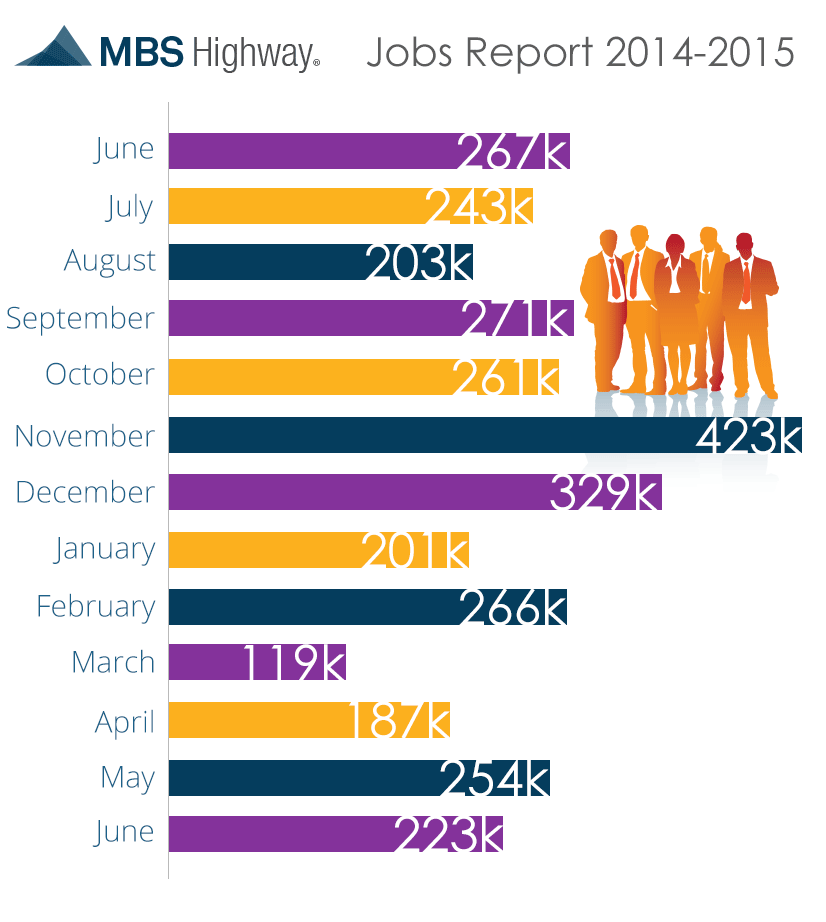
However, given that this week is a holiday shortened week the report was released today so we get to examine the results in this update.  The report showed that 223,000 new jobs were created in June.  This was slightly lower than analysts’ expectations.  Furthermore, the previously released results for May and April were revised downward.  Bad news for the jobs market is often good news for mortgage rates.

jobs-report-7-2-15

The unemployment rate ticked down to 5.3% from 5.4%.  Job creation only deserves partial credit as 432,000 Americans left the labor force last month (the unemployment rate measures the number of people not working of those who would like to work).

Lastly, wages were flat month-to-month and only up 2% year-over-year.  The Fed has a close eye on wages.  Although we’ve had strong job creation over the past year we haven’t seen real wages grow for most Americans.  As a result employers have not had to increase their payroll expense which has allowed inflation to remain low.  Low wage growth gives room for the Fed to keep short-term rates low.

The next big event is Greece’s referendum on Sunday.  Greeks will vote to accept further austerity measures in exchange for additional bailout funds or not.  Should the referendum carry it could put further pressure on rates Monday morning.

Current Outlook: locking bias

Mortgage Rate Update June 29, 2015

Although mortgage note rates are unchanged from last Thursday pricing has improved so in fact the overall rate environment is better to start the week.

Greece is back in focus for the financial markets today.  Although Greece is not yet technically in “default” they are teetering on the edge.  Negotiations between Greece and its creditors have broken down just 24 hours before the ailing country is scheduled to make a 1.6€ billion payment.

Greece has implemented strict capital controls in order to keep its financial system from crashing.  The Greek stock market is closed, bank branches are closed, and ATM’s are open but Greek citizens are limited to withdrawing 60 euros per day (~$67).

Euros are a little more scarce in Greece today....and US mortgage rates are benefiting.
Euros are a little more scarce in Greece today….and US mortgage rates are benefiting.

The chaos in Greece has ignited a “flight-to-safety” in the financial markets.  As I explain HERE this is a good sign for US mortgage rates.

For the time being mortgage rates will likely respond to developments in the Greek saga.  However, it is a very busy compressed economic calendar this week (the financial markets are closed on Friday).

In housing news the National Association of Realtors reported that pending home sales hit a 9-year high last month.  Tomorrow S&P will release the latest reading on the Case-Shiller Home Price Index.

It’s jobs week so we’ll get the ADP, initial claims, and the all-important jobs report later in the week.  We will be keeping a close eye on wage growth in this Thursday’s jobs report as that is the missing piece of the inflation puzzle which will force the Fed’s hand in raising rates.

Current Outlook: floating

Mortgage Rate Update June 25, 2015

Mortgage rates are mostly unchanged from the beginning of the week.

Interest rates have been choppy this week.  On Monday it appeared that mortgage rates were headed higher on news that Greece was close to reaching a deal with their creditors.  However, news emerged yesterday that its creditors would not accept the proposal.  Therefore, rates improved.  And today rates appear headed higher on better than expected economic news.Inflation concept.

This morning’s read on inflation came from the Personal Consumption Expenditure price index (PCE).  It showed that on a year-over-year basis consumer prices rose by only 1.2% here in the US.  This is well below the Fed’s target of 2% and will make it hard for the Fed to raise rates.

What is interesting is the Consumer Price Index, a separate measure of inflation, is currently reporting a +1.8% year-over-year increase so the disconnect may make it hard for the Fed to really know what price pressures exist in the economy.

In a separate release weekly jobless claims were shown to remain near historic lows.  The employment picture in the US remains strong but inflation is tame.  Inflation will come and when it does it will pressure interest rates higher.

Current Outlook: locking

Mortgage Rate Update June 22, 2015

Mortgage rates are unchanged from last week but are trending in the wrong direction this morning.  Last week mortgage rates caught a break from their upward trend that had been established a few weeks ago.  The break was as a result of renewed fears over the Greek financial crisis.

Those fears are unwinding this morning as reports out of Europe suggest that Greece and its creditors may be close to a deal that would prevent a default.  This is a very fluid situation so sentiment can change in a heartbeat but for now it appears that mortgage rates may firm up due to reduced fear surrounding the Greek situation.

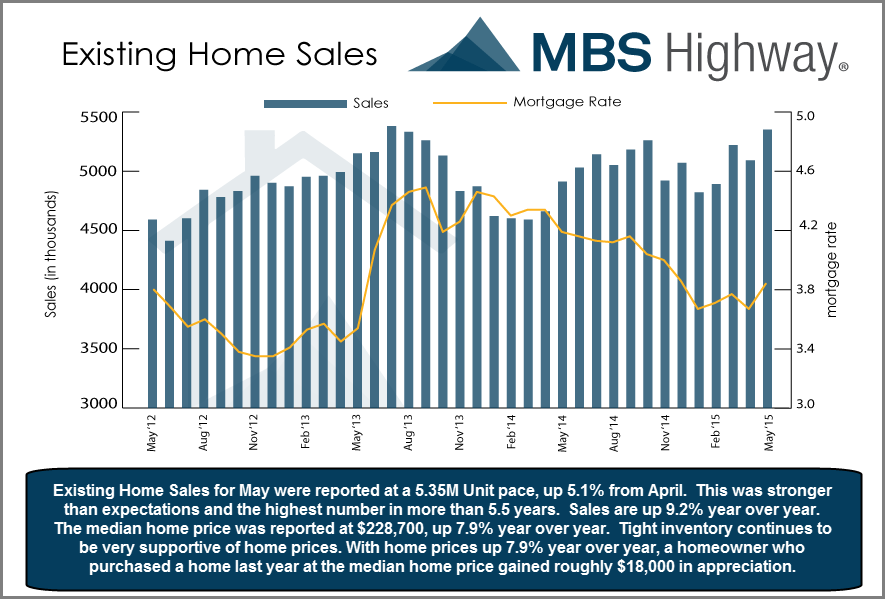
There was a great housing report from the National Association of Realtors (NAR) released earlier today.  The report showed that the number of existing home sales in the US increased by 9.2% from last year (+9.0% in the west).  The number of home sales has now increased for eight consecutive months.  In the west the median home price rose by 10.2% from last year.

existing-home-sales-6-22-15

Looking ahead, on Tuesday we’ll get figures on new homes sales, on Wednesday we’ll get a report on US Gross Domestic Product, and on Thursday we’ll get the Fed’s favorite gauge of inflation (Personal Consumption Expenditure price index).

Last thing, in case you missed it the Consumer Financial Protection Bureau announced a two month delay on the implementation of their new mortgage disclosure regime known as “TRID” (TILA-RESPA Integrated Disclosure).  The new disclosures were scheduled to begin with new loan applications started on August 1st and now it will be October 1st.

Current Outlook: locking

Mortgage Rate Update June 18, 2015

Mortgage rates are unchanged from Monday.

In case you missed the Fed’s statement following their monetary policy meeting yesterday they indicated that they would raise rates on a gradual basis.  This means that the market now thinks that Fed will increase interest rates on a slower pace than previously expected.  At first glance this may seem like good news….but in fact this is not favorable for mortgage rates.  Why?

It’s been a while so I will reiterate that inflation is the primary enemy of mortgage rates.  When a lender makes a loan and will be repaid in the future they have to take into account the projected purchasing power of that future repayment in setting a rate of interest to charge a borrower.

Rate hikes may be coming slower than we all thought....and that is not good for mortgage rates.
Rate hikes may be coming slower than we all thought….and that is not good for mortgage rates.

Since the great recession inflation has consistently been below the Fed’s target of 2% which is part of the reason why mortgage rates have remained near historically low levels.  In fact, the Consumer Price Index was reported today and it showed prices continuing to rise by less than 2% on a year-over-year basis.

However, the interest rate markets are forecasting that inflation will be picking up in the near future.  This is evident in mortgage rates increasing by .25%-.50% over the past month.

When the Fed increases short-term interest rates is helps to curb inflationary pressure.  Therefore, by the Fed taking a slower approach to raising rates than previously thought it is more likely that they could get behind the curve in fighting inflation.  This is why yesterday’s announcement was actually unhelpful to rates moving forward.

I am going to shift to a locking bias given this new information.

Current Outlook: locking

Mortgage Rate Update June 15, 2015

Mortgage rates are unchanged from last Monday.

The financial travails in Greece are back in the headlines this morning.  Over the weekend talks between Greece and its creditors broke down.  Greece is supposed to pay the International Monetary Fund a 1.6 billion euro payment by the end of June.  There is growing speculation that they will not meet that obligation which could throw Greece’s financial system into chaos.  The fear is that contagion will spread to other European Union countries such as Portugal, Italy, and Spain.  That fear contributes to a “flight-to-quality” that helps US interest rates.

Greece's financial system may crumble next....
Greece’s financial system may crumble next….

International markets are helping US interest rates remain low but the domestic picture is less certain.  We know that the recent employment numbers have been fairly robust and that wages are rising in the US.  Assuming this trend continues the Fed will need to raise short-term interest rates in order to curb inflationary pressure.  That said, there is growing skepticism regarding the outlook for the economy.

This morning’s report on manufacturing and capacity utilization showed continued weakness in the manufacturing sector of the economy.  This is likely a consequence of a stronger US dollar and lower exports.

Later this week we’ll get the Fed’s latest monetary policy statement (Wednesday).  The Fed is not expected to raise short term interest rates this week but they may provide clarity on when they intend on starting that exercise.  On Thursday we’ll get the Consumer Price Index from the Labor Department which will reveal whether inflationary pressure is growing.

We’ll begin the week by floating to see if there is any follow through regarding the Greece storyline.

Current Outlook: floating

Mortgage Rate Update June 8, 2015

Mortgage rates had a tough run last week.  They have increased by ~.25% in the past week and a half.  Yields on US government bonds suffered the worst sell-off in over two years during the same timeline.

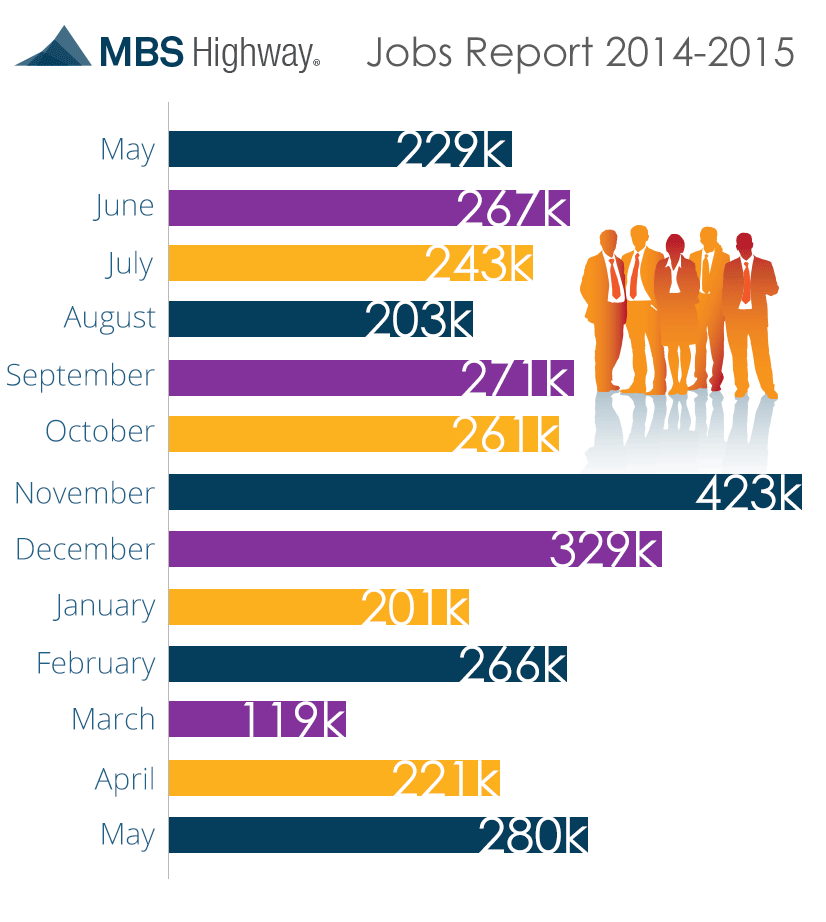
In case you missed it Friday’s all-important jobs report showed that the US economy created 280,000 new jobs during the month of May.  This was better than expectations and the highest reading since December of last year.  With the exception of March the US economy has added at least 200,000 new jobs each month for the past year.

jobs-report-6-5-15

Also embedded in the jobs report is information about average hourly earnings.  This part of the report showed that wages increased by more than expected last month which is an unwelcome sign for inflation and therefore interest rates.  With another healthy month of job growth analysts think it is more likely that the Fed will begin to raise rates later this year (versus early next year).

The economic calendar for the week gets busy in the latter half.  We’ll get retail sales on Thursday along with initial jobless claims.  On Friday we’ll get the latest reading on the producer price index.  Inflation is the missing piece of the puzzle for the Fed to begin raising rates.  It will be interesting to see if the PPI shows any signs of accelerating.

From a technical perspective mortgage-backed bonds are trying to rebound after a very tough ride.  We’ll float for now to see if we can recoup some ground.

Current Outlook: floating

Mortgage Rate Update June 4, 2015

Mortgage rates are at the highest levels since November of 2014.  Interest rates around the globe have moved higher during the first half of this week.

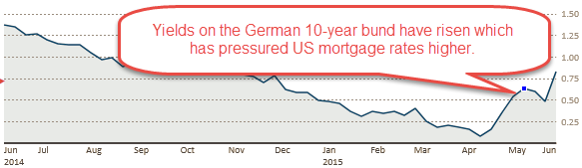
As we know changes in US mortgage rates tend to correlate to changes in yields on the US 10-year treasury note.  Lately, changes in the US 10-year treasury yield have correlated to changes in the yield on the German 10-year bund.  Therefore, changes to mortgage rates are closely correlated to changes in German interest rates.

6-4-10yr

As recently as April the yield on the German 10-year bund was ~.10%.  Yesterday it touched as high as .99%.  Over that time mortgage rates have increased by roughly .375%.

Yesterday the president of the European Central Bank stated that “the markets should get used to volatility.”  His comments caused interest rates around the globe to surge higher.

Let’s not forget that it’s jobs week and momentum can change with the single release of the all-important monthly report.  The markets are currently expecting 235,000 new jobs created in May.  Wednesday’s ADP private employer results showed 201,000 new jobs.  Typically speaking a number south of the expectation bodes well for rates and vice versa.

Given that rates have increased so sharply in the past three days I am going to recommend floating to see if we see a brief reprieve heading into next week.

Current Outlook: floating

Mortgage Rate Update June 1, 2015

Mortgage rates are unchanged from late last week.

The technical pattern for mortgage-backed bonds (MBS’s) which I identified as a positive sign for mortgage rates last Thursday is breaking down this morning.  MBS prices are drifting below the supportive trend line which does not bode well for mortgage rates.

US Consumers remain hesitant to spend their extra dough.

What is putting pressure on interest rates?  Greece announced earlier today that they would be on time with their next interest payment due to the International Monetary Fund.  The ailing country is scheduled to repay €1.6 billion over the next couple weeks.  Assuming they make all payments it would likely put upward pressure on mortgage rates.

The economic calendar is jam packed with significant information this week.   Earlier today the Commerce Department released its monthly personal spending report.  It showed that despite lower gasoline prices US consumers remain cautious.  This is not terribly surprising given that we got soft consumer confidence figures last week.

Also embedded in the report is the Fed’s favorite gauge of inflation known as the Personal Consumption Expenditure Price Index.  It showed that inflation continues to be below 2% which will prevent the Fed from hiking short-term rates soon.  Later this week we get the latest jobs report.

Given that the positive technical trading patterns have broken down I am inclined to recommend locking.

Current Outlook: locking