Mortgage Rate Update August 10, 2015

Mortgage rates are effectively unchanged from last Thursday.

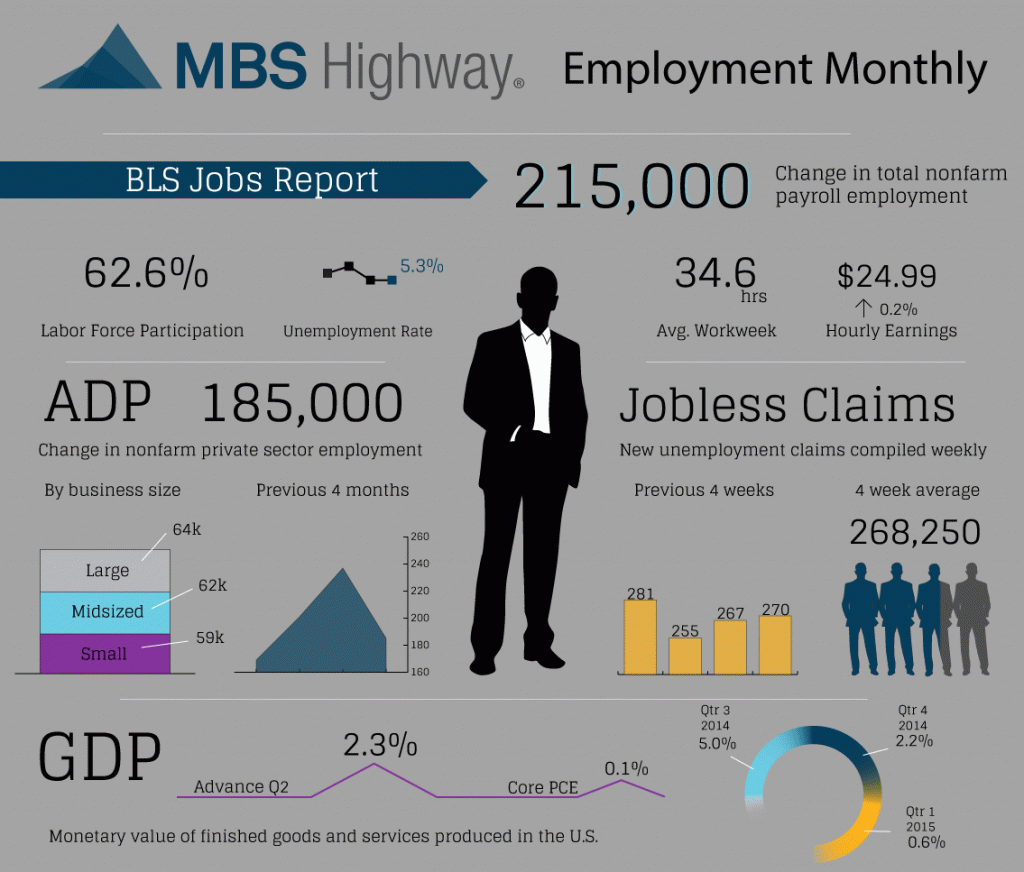
In case you missed it the all-important jobs report released on Friday was essentially inline with market expectations.  The report showed 215,000 new jobs created and the unemployment rate at 5.3%.  Average hourly earnings were up slightly but not enough to stoke fears of wage-based inflation.  The market reaction was fairly muted.
employment-monthly-8-10-15

This morning interest rates are modestly worse thanks to a rally in the stock market.  US stocks are higher on news that Warren Buffett’s Berkshire Hathaway will buy Oregon-based Precision Castparts for $32 billion.  When stocks do well interest rates tend to suffer.

Looking ahead for the week the economic calendar is fairly light.  There are various Fed officials slated to speak throughout the week.  As the markets struggle to better understand their game plan for raising short-term rates their comments could cause some volatility.

I will remain in a locking position.

Current Outlook: locking

Mortgage Rate Update August 6, 2015

I shifted to a ‘locking bias” last Thursday and that has proven to be a good call as rates have increased by ~.125% from the beginning of this week.

All attention is focused on tomorrow’s all-important monthly jobs report.  I think mortgage rates are in a lose-lose situation and therefore am going to maintain my locking bias.

Traditionally speaking, a weaker than expected jobs report is beneficial for mortgage rates and vice versa.  However, a weaker than expected jobs report this time around could actually hurt mortgage rates because of how the Fed may respond.

The Fed has indicated that they intend on raising short-term interest rates later this year.  Analysts are debating on whether they will begin this process in September, October, or December.  The longer they wait the more likely it is that inflationary pressure builds in our economy.  Inflation is the enemy of interest rates.

Should tomorrow’s jobs report come in below expectations then it would likely influence the Fed to hold off on raising short-rates.  Long-term rates may react negatively to this.

If tomorrow’s report comes in stronger than expected then it could influence the Fed to raise rates sooner.  But, it could also signal higher wage pressure which is not interest rate friendly.  I recommend locking in ahead of the report.

Current Outlook: locking bias

Mortgage Rate Update August 3, 2015

Mortgage rates have improved since last Thursday’s ‘rate update’.

On Friday the Bureau of Labor Statistics released it’s latest reading of the Employment Cost Index (ECI).  I haven’t covered the ECI much in the past and that is because it hasn’t been much of a driver in the interest rate markets.  As analysts continue to speculate on when the Fed will begin to raise short-term interest rates wage pressure is getting a lot of attention because it is viewed as being the missing component for inflationary pressure.  Friday’s reading of the ECI was lower than expectations which is interest rate friendly.

Weak wage growth continues to dampen inflationary pressure.

Speaking of inflation, earlier today the Commerce Department released it’s personal consumption and savings report.  It showed that inflation, according to the Fed’s favorite gauge, remains low at +1.3% year-over-year.  This is well below the Fed’s target of 2.0% and leaves the door open for the Fed to delay rate increases for now.

Looking ahead, it is jobs week so we’ll get the ADP report on Wednesday followed by weekly jobless claims on Thursday and the all-important monthly jobs report on Friday.

From a technical perspective interest rates look vulnerable to a reversal.  I am going to continue recommending a locking position.

Current Outlook: locking bias
Mortgage Rate Update July 30, 2015

Mortgage rates are unchanged from the beginning of the week.

There is a lot of economic news to cover this morning.  First off, the Fed’s monetary policy statement released yesterday offered little clarity on when the Fed plans to start raising short-term interest rates.  They have scheduled meetings in September, October, and December and at this point the markets believe October is the most likely scenario for rates to begin increasing.  As I wrote on Monday a Fed rate hike could actually help mortgage rates move lower in the near term.

Next up, The Commerce Department’s first reading of Q2 gross domestic product (GDP) showed the US economy grew at a 2.3% annualized clip from March-June.  This was slightly below expectations but still a solid number.  Q1 GDP, which had previously been reported at -.2%, was revised higher to +.6%.

With regard to inflation, the core Personal Consumption Expenditure (PCE) price index was up 1.8% year-over-year which is much higher than +1.0% reported last month.  As I’ve been reporting on ‘rate update’ a lack of inflation has been the missing piece for the Fed to justify rate increases.  With the PCE increasing closer to their target of 2% the door has been opened for rate increases later this year.

claims-7-30-15

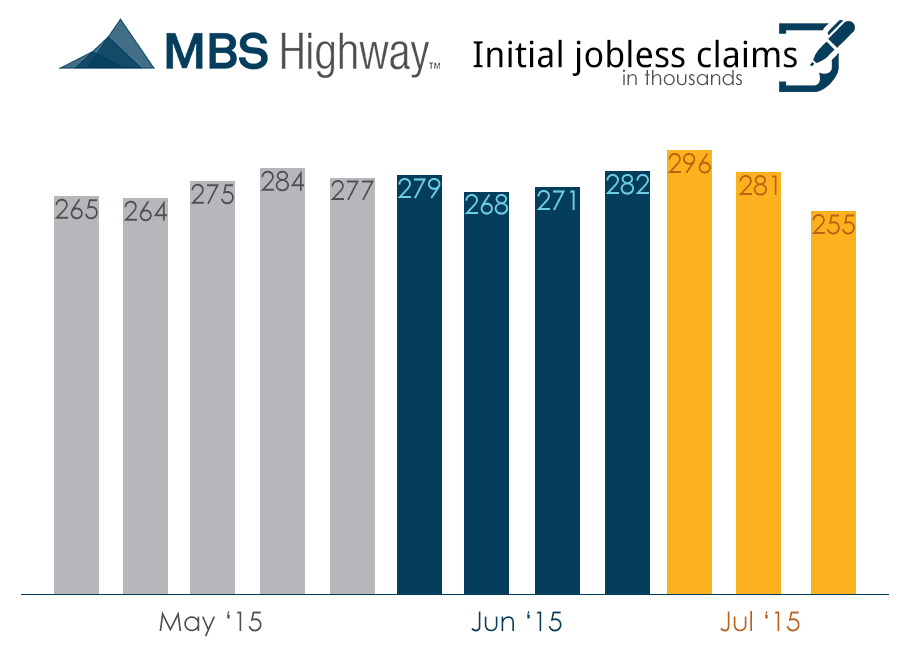
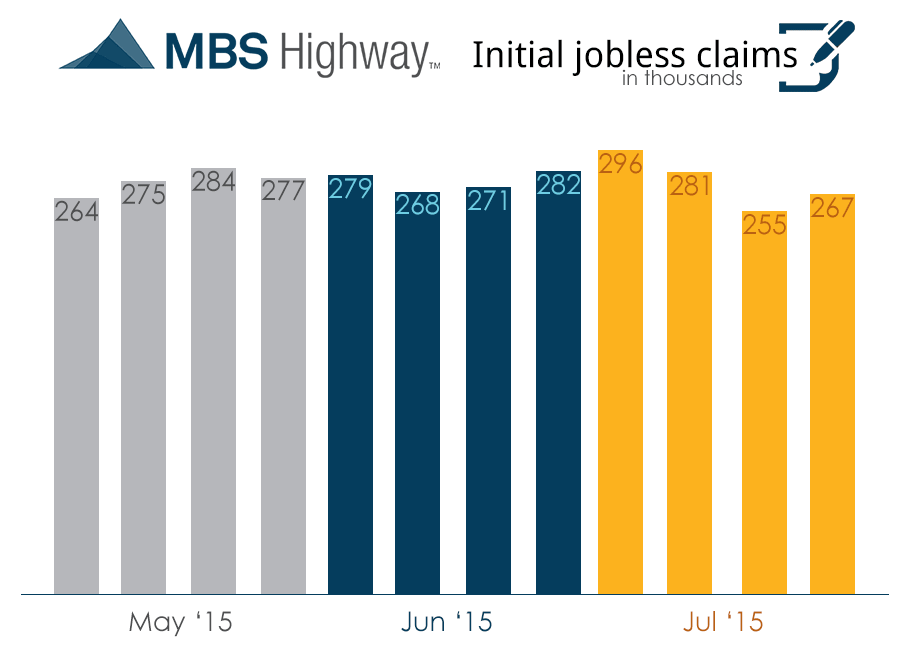
The other piece of the puzzle for the Fed is jobs.  Earlier today weekly jobless claims were reported at 267,000 which is a very strong number.  If you’ll remember back to last week this same report showed the strongest results in 42 years.  The labor market continues to show strength.

Despite all this good economic news mortgage rates remain very attractive relative to the past few weeks.  I suggest borrowers take advantage and lock in.

Current Outlook: locking bias

Mortgage Rate Update July 27, 2015

For the most part mortgage note rates are unchanged from Thursday but the accompanying closing costs are slightly less so in fact the rate environment has improved.  We switched to a ‘floating’ position last Monday and since then mortgage rates have improved by roughly .125%.

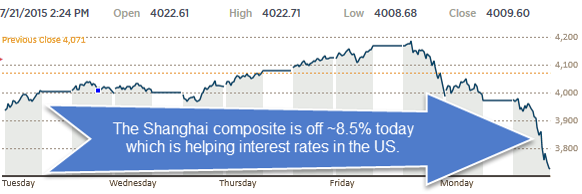
China’s stock market has taken a sharp turn lower this morning.  The Shanghai index is off nearly 8.5% on concerns that the Chinese government will curb efforts to prop up stock market prices.  To put this drop in perspective the Dow would have to fall by over 1500 points to lose 8.5% of its value.  US stocks are also trading lower which is good for mortgage rates.

Shanghai 07-2015

Looking at the remainder of the week there are multiple data points that we’ll be monitoring.  Tomorrow S&P will release the Case-Shiller home price index, on Wednesday we’ll get pending home sales from NAR, and a monetary policy statement from the Fed.

The Fed will not be raising short-term interest rates at this meeting but they may change their wording of the statement to provide clarity on when they plan on starting to raise rates.  Believe or not we could actually see mortgage rates improve if the Fed indicates that they will raise rates sooner rather than later.  Why?

When the Fed raises short-term rates it curbs inflationary pressure in the economy.  Long-term interest rates like it when inflation is low.

Current Outlook: floating

Mortgage Rate Update July 23, 2015

Mortgage rates are unchanged from Monday.

Interest rates have been very quiet this week which is in stark contrast to the volatility we saw when Greece was in the throes of negotiating a(nother) bailout.

As I stated on Monday it has been a fairly quiet economic news week so mortgage rates have responded to the equity markets.  Stocks opened higher this morning but have reversed after disappointing earnings reports from American Express, 3M, and Caterpillar.

Earlier today the Labor Department reported that weekly initial jobless claims hit the lowest level since 1973.  However, analysts are taking the report with a grain of salt because it is assumed seasonal adjustments are distorting the numbers.

Last time claims were this low Nixon was our President.

The National Association of Realtors reported that existing home sales increased again in June.  They have now increased for nine consecutive months and have matched the pace seen in February 2007.  Nationwide the median sales price surpassed its housing peak in 2006 and is currently at an all-time high.

I am hopeful that lower commodity prices will ease inflationary concerns and push rates lower.  I will continue to recommend floating.

Current Outlook: floating

Mortgage Rate Update July 20, 2015

Mortgage rates are mostly unchanged from Thursday.

With the Greek storyline in the rear-view mirror (for now) and a very light economic calendar this week I expect mortgage rates to respond to the stock market and technical trading patterns.

The US stock market is expected to respond to 2nd quarter earnings reports from various large companies scheduled for release this week (see earnings calendar HERE).  If earnings are reported stronger than expected one would expect capital to flow out of the bond market which would pressure mortgage rates higher (and vice versa).

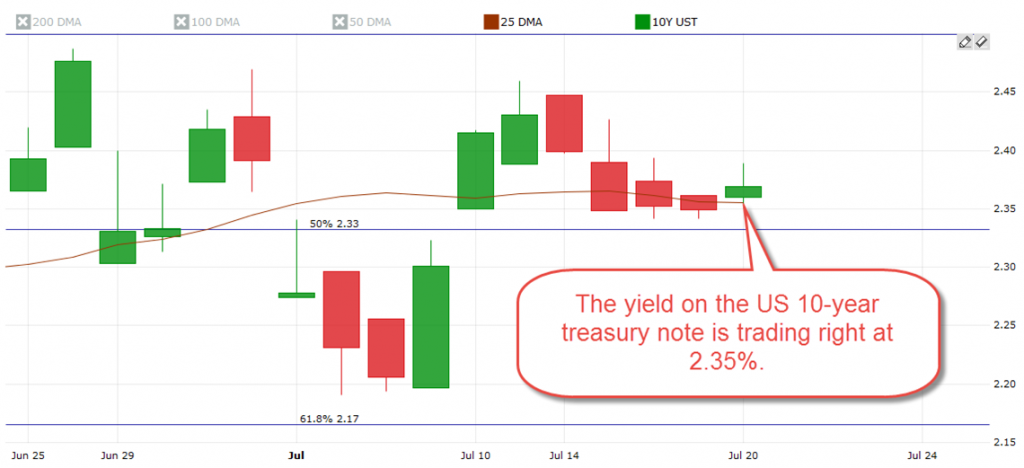
From a technical perspective the yield on the US 10-year treasury yield, which mortgage rates generally follow, is trading right above the 25-day moving average at ~2.35%.  If the yield can dip below this level it would be a great sign for mortgage rates.  However, if they bounce higher we’ll need to shift to a locking bias.

10 yr 7-20-15

Although the economic calendar is light this week there is significant housing news.  On Wednesday we’ll get existing home sales and the FHFA housing price index.  On Friday we get a reading of new home sales.

Current Outlook: floating

Mortgage Rate Update July 16, 2015

Mortgage rates are slightly better today than they were on Monday.  Effectively rates are back in line with where they were right before the Greek bailout deal was announced.

Speaking of Greece, worries over Greece exiting the Eurozone in a disorderly fashion are all but erased for now.  Eurozone creditors are in the process of extending financing to Greek banks and the Greek Parliament has agreed to adopt stiff austerity measures in exchange for further funding.

The interest rate markets will now shift focus back on the domestic economy and the Federal Reserve.  In prepared testimony to congress Fed Chairwoman Janet Yellen told lawmakers that should the economy continue to grow as expected then they would plan to raise short-term rates later this year.  She has been very careful to also state that the pace of increases will be gradual.

The number of Americans filing for unemployment benefits continues to decline.  Data out today showed only 281,000 new claims were filed.  The labor market continues to show strength.

From a technical perspective mortgage rates look ripe to move higher.  I am going to recommend a locking bias.

Current Outlook: locking

Mortgage Rate Update July 13, 2015

Mortgage rates are slightly higher across the board this morning on news that Greece and its creditors have reached a bailout agreement.

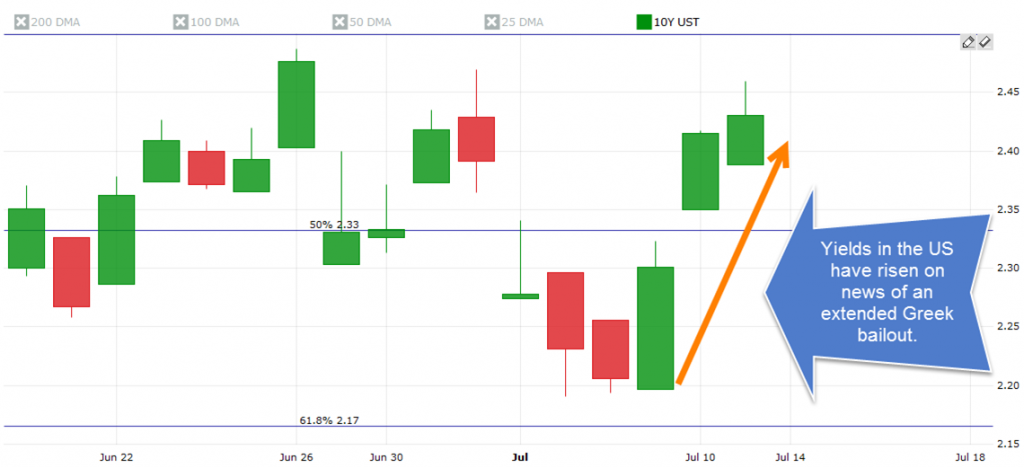
Earlier today it was announced that Greece has agreed to terms for an €86 billion bailout.  Greece will have to implement a series of austerity measures which will be tricky given that last Sunday Greek citizens voted down a referendum with similar terms.  For now, interest rates in the US have risen on the news given that there is less fear and uncertainty surrounding the situation.

The yield on the US 10-year treasury note has risen to ~2.45%, up from only ~2.2% at the beginning of last week.  Mortgage rates tend to change along with the US 10-year treasury note.

07-13-15US 10yr

The economic calendar is very busy this week.  The highlights include Retail Sales (Tuesday), Producer Price Index (Wednesday), Consumer Price Index (Friday), and congressional testimony from Fed Chairwoman Janet Yellen.

From a technical perspective interest rates are presently at the higher end of the trading range they’ve been bound in for the past month or so.  Assuming these technical levels hold we would recommend floating.  However, with a Greek bailout deal in place we run the risk of rates moving higher.

Current Outlook: cautiously floating

Mortgage Rate Update July 9, 2015

Mortgage rates are mostly unchanged from the beginning of the week but we have gotten slight improvements on some loan programs.

The interest rate markets continue to respond to global influences including the ongoing Greek saga and China’s stock market.

Greek officials have sent a rehashed 3-year bailout proposal to creditors.  Apparently the deal does include austerity measures and economic reforms absent from previous negotiations.  There is also talk of a “Super” summit this Sunday.  Should a deal be reached I would expect US mortgage rates to increase by ~.125%.  As we know this situation is very fluid and sentiment can shift quickly making it hard to handicap.

In China the stock market has seesawed in the past few days.  After falling for 8 out of the past 10 trading days the Chinese stock market had its biggest daily gain in 6 years today.  For months analysts have been warning that Chinese stocks were overvalued and that the market was overdue for a correction.  Things began to unwind a couple weeks ago and the Chinese Government has had to intervene (51% of all stocks on the Shanghai and Shenzen markets remain suspended from trading).

When uncertainty prevails investors seek safety.  This typically helps US rates move lower.
When uncertainty prevails investors seek safety. This typically helps US rates move lower.

The bottom line is when there is fear and uncertainty around the globe it prompts investors to seek “safe-havens” for their capital.  Typically this helps US interest rates move incrementally lower.

From a technical perspective conditions look promising for rates to improve in the coming days.  However, should a bailout deal be reached by Greece and its creditors it would likely pressure rates higher.  Tough call so I will go neutral.

Current Outlook: neutral