Stocks slide on trade fears helping mortgage rates

How does a team go undefeated in the World Cup and not win the whole thing?  Easy, not qualify. For those US soccer fans there is reason to celebrate today.  On this day in 1950 the US men’s soccer team beat England in a major upset.  

Mortgage rates traded sideways last week.

US Stocks

The US stock market is not celebrating the trade threats that continue to escalate between the US and China.  Over the weekend the Trump Administration announced rules which will limit Chinese companies from investing in US technology companies.  

US stocks opened sharply lower this morning. Bad news for the economy tends to be good news for home loan rates.

Housing

Last week the National Association of Realtors announced that the pace of existing home sales had slowed in May.  However, the median home price continued to climb on tight supply.  The median home price in the US has increased for 75 straight months.

Earlier today the Commerce Department announced that the number of contracts for the purchase of newly constructed homes increases substantially year-over-year.  This is welcome news given that there continues to be a shortage of housing.

Technical Trading Patterns

The yield on the US 10-year treasury note has broken below an important technical layer.  If it can close below 2.88% then it may be a signal of lower rates on the horizon.  Fingers crossed.

The Week Ahead

This week’s economic calendar kicks off tomorrow with the Case-Shiller Home Price Index.  On Wednesday we’ll see durable goods and pending home sales. On Friday we’ll get personal income and the Fed’s favorite gauge of inflation.  

I recommend floating as long as the US 10-year treasury note is at or below 2.90%.  If it reverses higher then we’ll need to lock in.

Current Outlook: floating
Fed flattens yield curve

On this day in 2006 the Oregon State Beavers baseball team lost its opening game in the College World Series.  They would come back to win five of its next six games to claim the national championship. We’ll see if the 2018 team can follow the same pattern!  

Mortgage rates improved modestly last week.

The Fed

As expected the Fed did hike short-term interest rates on Wednesday of last week.  As a reminder the Fed does not directly set mortgage rates.  They also set the expectation that they would hike two more times in 2018 and two to three more times in 2019.  

Yield Curve

The yield curve has flattened over the past three years with rates at the short-end of the curve increasing by ~1.5% while rates at the long-end have increased less.  

Some economists believe that a flat yield curve is an indicator for a recession.  This coupled with low unemployment (see HERE) have me feeling more and more like we will see an economic slowdown in the next 12-24 months.

US Stocks

The US stock market was trading lower on Monday in response to tariff threats between the US and China.  Late last week President Trump approved 25% tariffs on approximately $50 billion of Chinese exports.  China countered over the weekend with penalties on US products sold in China. Although tariffs will help some industries most economists agree it will not be favorable for the economy as a whole.

Bad news for the economy tends to be good news for home loan rates.

The Week Ahead

This week’s economic calendar is relatively light.  There are significant housing related reports such as housing starts & building permits (Tuesday), existing home sales (Wednesday), and leading economic indicators (Thursday).  

Current Outlook: cautiously floating

How the Fed does and does not influence mortgage rates

Video Transcript:

The Federal Open Market Committee led by current Chairperson, Jay Powell, is scheduled to meet this week as they do every six weeks. What makes this week unique is the Fed is expected to hike short-term interest rates by one quarter of one percent (.25%).

The Fed controls an interest rate called the Federal Funds Rate, and pragmatically speaking, it actually plays a very obscure role in our economy. The Federal Funds Rate dictates the rate of interest at which banks charge each other when they lend money to each other to meet overnight reserve requirements.

I won’t bore you with those details, but the bottom line is, the Fed does not directly control mortgage rates. When you see that the Fed hikes rates this Wednesday by one quarter of one percent, don’t worry that if you call us the next day that your mortgage rate on a 30 year fixed rate loan will automatically be one quarter of one point higher.

The Feds comments and actions can certainly influence mortgage rates for better or worse, but just because the Fed hikes short term interest rates doesn’t mean that mortgage rates will automatically go higher.

Are you looking for a mortgage professional that is competent and is going to help you navigate this complicated landscape? We’d love to be a resource. Contact us today. Thanks for watching.

Are mortgage rates likely to increase or decrease? Anyone? Anyone?

On this day in 1986 one of the greatest movies of all time was released. Does anyone know which movie? Anyone? Anyone? (see movie reference HERE).

Last week US stocks rallied and home loan rates moved which direction? Anyone? Anyone? They increased modestly.

The Week Ahead
The calendar is full of significant events this week. There won’t be anytime to take a day off (had to sneak in another movie reference).

Treasury auctions
The US Treasury has auctioned $32 billion of 3-year and $22 billion of 10-year notes already this morning. Tomorrow they will auction an additional $14 billion of 30-year bonds. The added supply of fresh debt will make it hard for home loan rates to improve this week.

Inflation
On Tuesday and Wednesday we’ll get fresh readings on the Consumer Price Index and Producer Price Index. Inflation has been trending higher and remains the primary driver of long-term interest rates including for mortgages.

The Fed
The Federal Open Market Committee meets Tuesday-Wednesday and is expected to announce a +.25% hike to the Federal Funds Rate mid-week. The Fed does not directly control mortgage rates but their comments and actions can influence them. If you have not locked in a rate don’t fret. The .25% rate hike is already baked into the rates you see today.

Technical trading patterns
Momentum is not on our side. Rates worsened modestly last week and have more room to worsen this week. I think we have more to lose than to gain so will maintain a locking outlook.

Current Outlook: locking

Might low unemployment signal a recession near?

On this day in 1896 the chief engineer of Edison Illuminating Company first test drove the “Quadricycle” he had developed.  That engineer’s name was Henry Ford and the “quadricycle” would eventually be commonly known as a car.  

The next stage of automobile evolution is expected to be the driverless car.  CLICK HERE to learn how they may impact real estate values.  

Jobs, Jobs, Jobs

Friday’s all-important employment report showed continued strength in the Labor Market.  According to the release the US economy added 223,000 new jobs, average hourly wages rose, and the unemployment rate decreased to 3.8%.  

Seemingly a healthy jobs market is a great indicator for the housing market.  However, there are two concerns that arise from the report.

#1: Inflation & Home Loan Rates

Job growth coupled with a low unemployment rate means employers will have to pay higher wages to attract workers.  This is great for employees but also can lead to wage-based inflation where producers are forced to charge higher prices.  

Since inflation is the primary driver of mortgage rates strong job growth becomes a double edged sword for housing demand.

#2: Recession near?

The US economy has been growing for more than eight years now making it one of the longest expansions in recent history.  Dating back to World War II recessions have always followed cyclical low points in the unemployment rate as the chart above shows (grey shadowing signals recessions).  

I subscribe to the belief that we are 12-24 months away from a recession.  Mortgage rates tend to drop during recessions so it might make sense for homebuyers to consider 5/1 & 7/1 ARM’s at this time.

The Week Ahead

This week’s economic calendar is relatively light.  The US Treasury will auction 10-year notes and 30-year bonds this Thursday.  The additional supply of longer-duration securities will make it difficult for rates to improve.  Furthermore, the political drama in Italy seems to be quieting down.  I will recommend a locking bias.  

Current Outlook: locking

Turmoil in Italy helps US mortgage rates improve

Have you seen the $170 paperclip from Prada (seriously-see HERE)?  I wonder how many will sell today given that it is National Paperclip Day.  I will be “celebrating” with a more modest version.

Italian political woes

US mortgage rates are benefitting from political turmoil in Italy.  Over the weekend the Italian President blocked the formation of a coalition government that would have given more power to the anti-European Union parties.  Remember what happened to US interest rates 3 years ago when Greece threatened the stability of the union?  (hint: they were lower.)

Interest rates in Italy and Spain spiked over the weekend which has prompted a flight to safety in the global financial markets.  Anytime uncertainty grows the US tends to benefit because it is considered a relatively safe place to invest capital.  As a result of heightened demand for US securities, including mortgage-backed bonds, mortgage rates have improved.

Housing Market

Earlier today the most recent version of the S&P Case-Shiller Home Price index was released.  The data showed continued gains in home prices across the nation. According to the report home prices in Portland increased by 6.7% over the past twelve months.  Seattle showed the highest appreciation at 13%.  

As long as the supply of homes for sale remains low I expect home prices to hold firm.

The Week Ahead

The economic calendar is full of significant releases.  On Wednesday we’ll get the Fed’s beige book and the ADP employment report.  On Thursday we’ll see personal income, core inflation, and pending home sales.  On Friday we get the all-important jobs report.  

The drama in Italy could overshadow these reports.  For now we’ll recommend floating as momentum is on our side.  However, I don’t expect the longer-term trend of rates worsening to change.

Current Outlook: floating

Mortgage rates enter new range

Although it is illegal to sell a body part in the United States thousands of people do it every day.  On this day in 1881 the American Red Cross was founded.  Since then people have been selling pints of blood for a cup of juice and a cookie nearly every day.  

Mortgage Rates  

Mortgage rates worsened modestly last week.  The US 10-year treasury note, which home loan rates tend to track, is now yielding over 3.00%.  It is at the highest level since 2011.

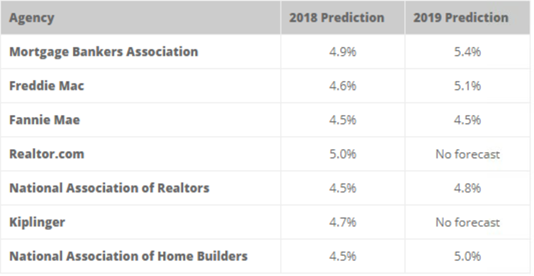
Most every analyst’s interest rate prediction for 2018 has been surpassed including my own.  I thought mortgage rates would increase to 4.625%-4.875%. Here is what others thought:

Source: mortgagereports.com

US Stocks

The Dow Jones Industrial Average reacted positively to comments made by US Treasury secretary Steve Mnuchin earlier today.  He stated that the trade dispute between the US And China was “on hold”. The Dow spiked 350 points at the opening bell.

When stocks rally it tends to hurt mortgage rates.

The Week Ahead

This week’s economic calendar is fairly light.  On Wednesday we’ll get minutes from the May 2nd Fed meeting which can always move the markets.  Aside from that I’ll be watching New Home Sales (Wednesday), Existing Home Sales (Thursday), and the FHFA Home Price Index (Thursday).

Outlook

It appears that rates have entered into a new trading range.  I expect the current level of rates to be at the lower end of the range with room for them to be .25% higher than current levels.  I recommend locking.

Current Outlook: locking

Higher oil prices pressure home loan rates higher

They say that weddings are getting more and more expensive.  In fact, the average cost of one surpassed $30,000 in 2017.  That is enough to put 5% down and pay closing costs for a median priced home in Portland, OR..   

As I type there are four days, six hours, and 27 minutes until the royal wedding for Prince Harry and Meghan Markle.  That ceremony is estimated to cost $2.8 million which could be used to put 5% down on THIS HOME.

Mortgage Rates  

Unfortunately mortgage rates worsened modestly last week as US stocks rallied.  The US stock market registered its best week in over two months which put upward pressure on home loan rates.

Oil prices

Geopolitical tension in the middle east coupled with uncertainty around Iran economic sanctions further supported oil prices last week which are now at three and a half year highs.

Higher oil prices are problematic for interest rates because they tend to be inflationary and inflation is the primary driver of mortgage rates.  

The Week Ahead

This week’s economic calendar is relatively light.  It features a slew Fed officials speaking around the country.  The Fed does not directly control mortgage rates but their comments can certainly influence them.  

According to CME Group there is currently a 95% probability that the Fed will hike short-term interest rates at the next meeting on June 13th.  There is a 50% probability that the Fed will hike short-term rates three more times in 2018.

Outlook

Due to momentum and the longer-term trend for interest rates I favor a locking position this week.

Current Outlook: locking

Higher oil prices threaten mortgage rates

President Woodrow Wilson proclaimed the first Mother’s Day holiday this week in 1914.  For the past 104 years we have celebrated those special women in our society who desperately need a break yet do not want to miss a single minute.  Thank you moms!

Mortgage Rates  

Interest rates improved modestly last week but not enough to get excited about.  For most applicants their note rate is unchanged but the accompanying closing costs are lower.

Oil prices

Oil prices have been on the rise which does not bode well for mortgage rates.  In the past month they have increased by 10% reaching the highest levels since 2014.  

When oil prices rise it tends to cause inflationary pressure in the economy.  Inflation is the primary driver of long-term interest rates.  

The Week Ahead

Speaking of inflation we’ll get the latest reading on the Producer Price Index this Wednesday and the Consumer Price Index on Thursday.  If those reports come in hotter than expected I would expect rates to worsen.

Also on Wednesday the US Treasury is scheduled to auction $25 billion of 10-year treasury notes.  The added supply could make it hard for mortgage rates to improve for the second week in a row.  

From a technical perspective the yield on the US 10-year treasury note is currently at ~2.95%.  Fortunately the 3.00% level has acted as resistance so if we test that level again I am hopeful it will hold.  

Outlook

I am less optimistic than I was last week but still feel like rates will not move meaningfully higher in the near-term.  I will shift to a neutral position.

Current Outlook: neutral

US 10-year below 3.00%, might rates improve this week?

Monday mornings don’t seem like the ideal day for a bloody mary but I would be lying if I said the thought hadn’t crossed my mind.  Speaking of “Bloody Mary Mornings” today is Willie Nelson’s 85th birthday.  HERE IS A LINK to his famous song.

In an upward trending rate environment it feels like a win when I can report that mortgage rates did not increase last week.  They also didn’t go down.

10-year treasury below 3.00%

After spending most of last week above 3.00% the US 10-year treasury note is currently trading at 2.94%.  I am hopeful that the 3.00% level will act as a strong technical ceiling.  If so, we may see mortgage rates improve by .125% or so.

Inflation

Higher prices are the primary driver of mortgage rates.  That is because when inflation rises it reduces the purchasing power of dollars used to repay debt.  Therefore, when inflation rises lenders charge higher rates of interest to compensate.

Earlier today the Fed’s favorite gauge of inflation, called the Personal Consumption Expenditure price index (PCE), was released.  It showed that on a year-over-year basis prices rose by 2.00% which is the Fed’s target.  This was moderately below expectations.

However, if we strip out volatile food and energy prices the “core” PCE increased by 1.9% which is an increase from last month when prices rose by 1.6%.  The large increase is alarming and may be a signal of higher inflation in the future (and thereby higher home loan rates).

The Week Ahead

On Tuesday the latest version of the Case-Shiller Home Price Index will be released.  We’ll also see new home sales and consumer confidence data.

On Friday we’ll get the all-important jobs report and gross domestic product.  That will be a big day for interest rates.

I am cautiously optimistic that rates could improve assuming the yield on the US 10-year treasury note remains below 3.00%.

Current Outlook: cautiously floating.