Mortgage Rate Update November 14, 2016

Mortgage rates have increased substantially following the surprise election win by President-elect Donald Trump.

Below is a chart showing the yield on the US 10-year treasury yield.  As you can see yields jumped from ~1.80% prior to the election to ~2.20% today.  Mortgage rates have increased by .375% during that time.
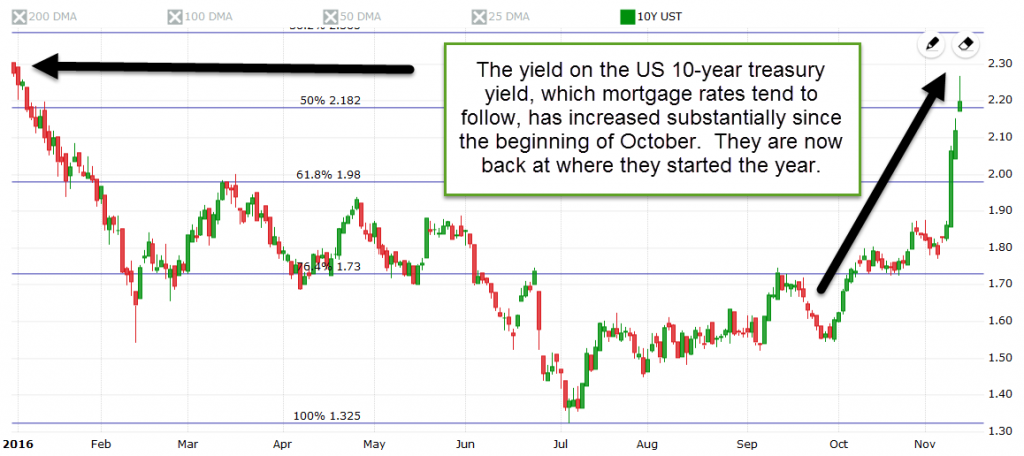
portland-mortgage-rates-nov-14-2016-10yr

Why are rates increasing in reaction to Trump’s election?  At this point analysts are speculating that his economic policies will be inflationary and inflation is a nemesis for mortgage rates.

Speaking of inflation the economic calendar for this week includes a report on import prices (Tuesday), Producer Price Index (Wednesday), and the Consumer Price Index (Thursday).  In addition we’ll get retail sales (Tuesday) and housing starts (Thursday).

From a technical perspective the current outlook is difficult to handicap.  On one hand, markets tend to overreact to major events such as last week’s election.  Therefore, I wouldn’t be surprised to see rates rebound and improve a little.  That said, momentum is firmly against us.  So waiting any longer to lock could mean accepting a higher rate than what is available today.

Current Outlook: locking bias
Mortgage Rate Update November 7, 2016

Mortgage rates are unchanged from last week.

Election day is only 24 hours away.  The stock market is rallying this morning following the FBI’s announcement over the weekend that they would not pursue charges against Hillary Clinton based on a new batch of emails.

Purely looking at the election from the stock market’s perspective the ideal outcome is for Clinton to win the presidential election while the House of Representatives and Senate remain in Republican control.  Since this outcome is optimal for the stock market we can deduct that it is also probably the worst case scenario for mortgage rates (when stocks do well mortgage rates tend to suffer).

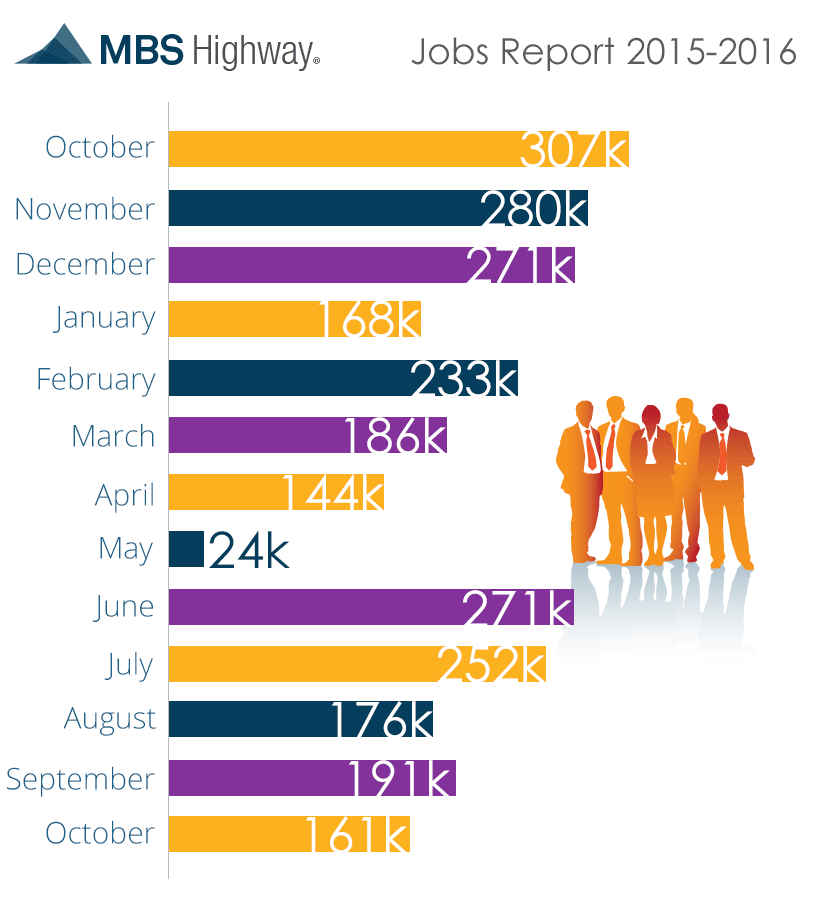
In case you missed it Friday’s all-important jobs report showed the US economy created ~161,000 new jobs in October.  In addition, the Labor Department revised the two previously released numbers for August & September higher.  The jobs market remains solid which generally is bad news for mortgage rates.

portland-mortgage-rates-jobs-nov-2016

What was interesting about the jobs report was that average hourly earnings increased by 2.8% from a year earlier.  This represents the largest increase since 2009 and ignites concerns regarding wage-based inflation.

All in all I am not excited about the momentum in the market.  I am going to maintain a locking bias.

Current Outlook: locking bias
Mortgage Rate Update October 31, 2016

Mortgage rates are unchanged from the latter half of last week.

Inflation remains top of mind for market analysts.  Inflation is important because it is the primary driver of long-term interest rates, including mortgages.

Earlier today the Fed’s preferred measure of inflation, called the Personal Consumption Expenditure price index, was released.  Core inflation, which excludes volatile food and energy prices, was up 1.7% from a year earlier.  This is the firmest inflation has been in the last couple years.

Jack O' Lantern

The economic calendar is busy this week.  On Wednesday the Fed will deliver its monetary policy statement.  It is not expected that they will hike rates at this meeting but their comments always have the ability to shape the markets.  On Friday we get the all-important jobs report.  The markets currently expect +175,000 new jobs.

From a technical perspective momentum is not our side.  Although rates have stabilized from my last ‘rate update’ it still feels we’re seeing upward pressure.

Have a safe and happy halloween!

Current Outlook: locking bias

Mortgage Rate Update October 27, 2016

Across the globe long-term interest rates, including those for US mortgages, have worsened this week.  A peak at the chart below shows that the yield on the US 10-year treasury note, which mortgage rates tend to track, has risen by ~.50% from the beginning of July until today.

portland-mortgage-broker-oct-27-2016

Why the increase?

First, let’s remember that the “Brexit” vote took place at the end of June.  Mortgage rates immediately fell sharply as uncertainty spread across the global financial markets and investors sought safe havens for capital.

That uncertainty has dissolved and there is greater confidence in economic growth.  As a result, many of the investors who re-positioned investments into the US have reversed those trades which has put upward pressure on interest rates.

Second, inflation expectations are rising across the globe.  This is partially related to oil prices increasing.  Since February oil prices have risen by nearly 50%.  Inflation is the primary driver of long-term interest rates, including mortgages, because it reduces the value of a lender’s future return.

From a technical perspective mortgage rates continue to look vulnerable so I will maintain a locking bias.

Current Outlook: locking bias

Mortgage Rate Update October 24, 2016

Mortgage rates are mostly unchanged from last week.

As we enter the final full week of October it’s hard to believe there are only 10 weeks left in 2016.  Mortgage rates were pretty quiet last week and I would not be surprised if they are quiet again this week.  It seems like investors are sitting quietly waiting for the election to wrap up.

This week’s economic calendar is heavy with fresh housing data.  Tomorrow we get the S&P Case Shiller house price index, new home sales on Wednesday, and pending home sales on Thursday.  Anecdotally it feels like demand has softened slightly so it will be interesting to see if this is evident in the data.

This week brings plenty of fresh housing data.

From a technical perspective interest rates look vulnerable.  The yield on the US 10-year treasury note is 1.76% which is right above strong support.  I am going to recommend a locking bias.

Current Outlook: locking bias

Mortgage Rate Update October 17, 2016

Although mortgage rates remain at historically attractive levels October has been a rough month for interest rates.

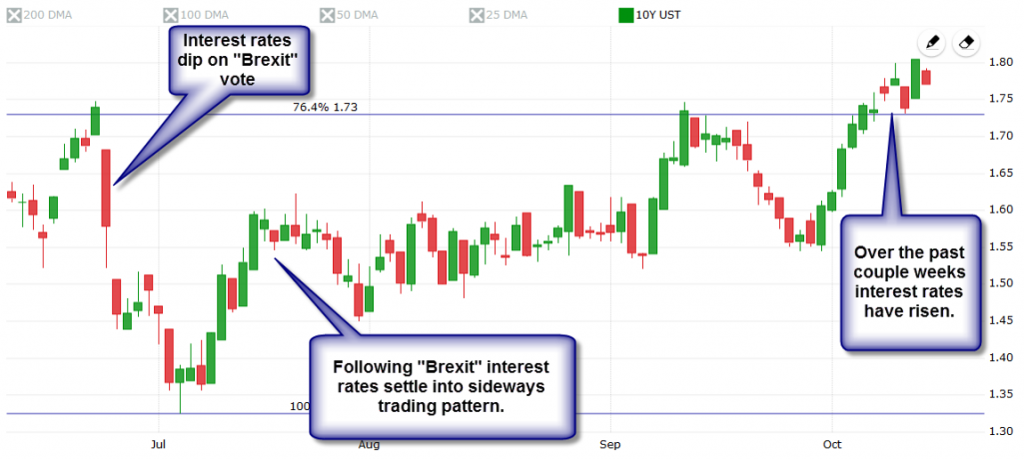
Looking back to June 23rd which is when Britain voted to exit the European Union interest rates slipped as investors sought safe haven for their capital.  By mid-July interest rates had given up half of the gains.  From mid-July to late September interest rates traded sideways for most of the time.

portland-mortgage-rates-1017-16-10yr

Over the past couple weeks interest rates have begun to creep higher.  Why?  There is a growing belief that the Fed, and other central banks around the world, may become less combative against inflationary pressure.  Inflation is the primary driver of mortgage rates.

Furthermore, there is growing recognition that large scale quantitative easing measures are also likely coming to an end.  These policies drive interest rates lower because it involves central banks buying massive amounts of bonds.

From a technical perspective interest rates are trending higher and now have support levels below current levels.  The picture is not conducive to lower rates.

Current Outlook: locking bias

Mortgage Rate Update October 13, 2016

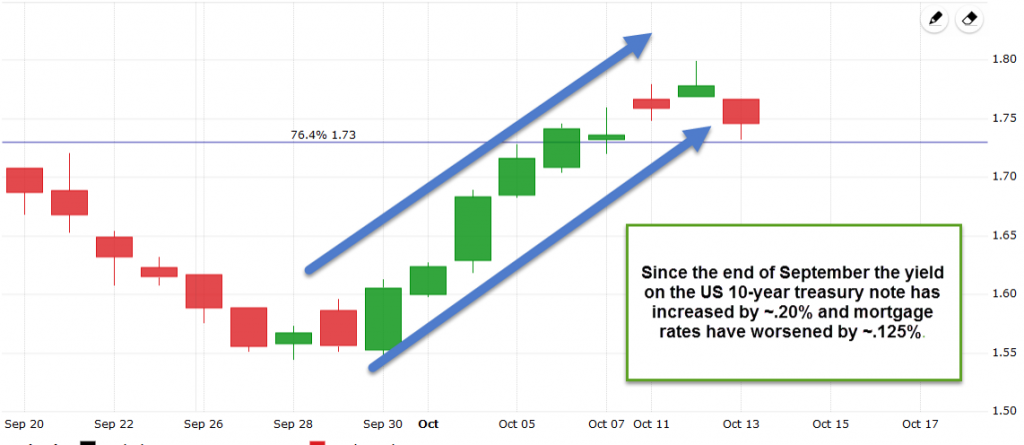
Mortgage rates have worsened modestly this week.  A look at the yield on the US 10-year treasury shows an increase from ~1.55% in late September to ~1.75% today.  During that time mortgage rates have increased by ~.125%.

portland-mortgage-rates-us-10yr-10-13
This morning interest rates have stabilized and are trying to reverse lower as stocks slide.  US stocks are trading lower on news that Chinese exports declined 10% year-over-year.  Mortgage rates tend to benefit when stocks falter.

In September 2015 the Fed was widely expected to raise short-term interest rates but ended up delaying the action after China released weaker than expected economic data.  Might today’s release cause the Fed to delay again?  At this point I think not but we’ll have to see how the markets respond in the coming weeks.

From a technical perspective the pattern shown in the chart above leads me to believe we could see yields continue to decline.  I am going to recommend a floating stance.

Current Outlook: floating

Mortgage Rate Update October 10, 2016

Mortgage rates are unchanged from last week.  The financial markets were closed yesterday for Columbus Day.

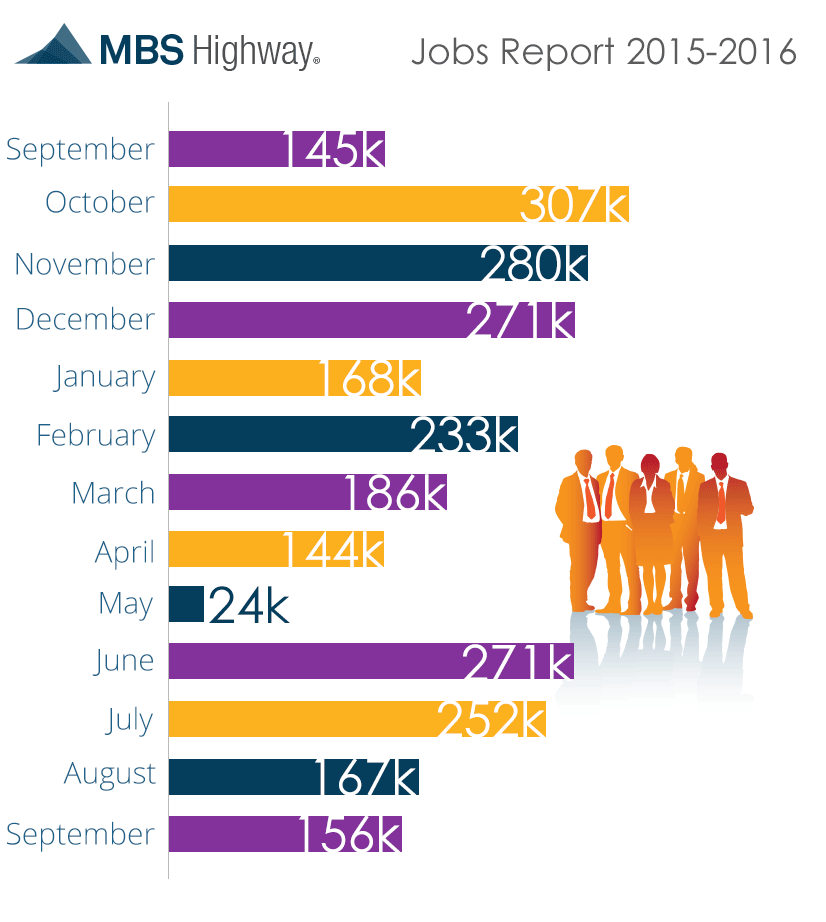
Friday’s all-important jobs report came in at +156,000 new jobs which was just shy of expectations.  Also embedded in the jobs report was data that showed year-over-year average hourly wages increasing by 2.6% which is nearly the highest increase in seven years.

portland-mortgage-broker-jobs-report-10-7-2016

Why is this important?  If companies have to continually raise workers’ wages at some point they will need to raise the price of the good or service they are selling to compensate.  Higher prices leads to inflation which is the nemesis of mortgage rates.

Decent job growth coupled with strong wage gains leads me to believe the Fed will hike rates at the December meeting.  The Fed does not directly set mortgage rates and the last time the Fed hiked rates mortgage rates feel afterwards.  Will history repeat itself?  It could.

If the markets think that additional interest rate hikes could threaten the economic expansion and/ or suppress inflationary pressure we could see mortgage rates fall even as the Fed hikes short-term interest rates.

Current Outlook: neutral

Mortgage Rate Update October 3, 2016

Mortgage note rates are unchanged today but pricing at these levels is modestly worse.

It’s a relatively quiet day in the financial markets.  Earlier today a report was released that showed US manufacturing activity slightly stronger than anticipated.  Good news for the economy tends to be bad news for mortgage rates.

It’s a new month which means a fresh jobs report due out this Friday.  The markets are currently expecting ~170,000 new jobs created.  Last month only ~150,000 new jobs were created but the prior two months showed 200,000+.  In general a strong jobs report will pressure mortgage rates higher and vice versa.

Normally mortgage rates react poorly to a strong jobs report but this month might be different.

That said, this month’s jobs report could react differently.  If the jobs number on Friday comes in well below expectations then it will become less likely that the Fed will hike rates this December.  The stock market would likely react positively which would hurt mortgage rates.  If the jobs number comes in stronger than expected then it would likely solidify a fed rate hike in December.  Since rate hikes are anti-inflationary we could see rates improve.

The technical signals do not look favorable so I will maintain a locking bias.

Current Outlook: locking bias

Mortgage Rate Update September 29, 2016

Mortgage rates are unchanged today.

Earlier this morning the Commerce Department released figures for 2nd quarter Gross Domestic Product (GDP).  The report showed the US economy grew at a 1.4% annual clip which was higher than the .8% growth during the first quarter but slower than the ~2% average we’ve experienced during this economic expansion.

The Wall Street Journal reported yesterday that members of OPEC have agreed in principle to a future cut in oil production.  If a significant agreement is reached and oil prices rise that would promote inflationary pressure which would not be good for mortgage rates.  That said, OPEC’s record on reaching agreement amongst all its members is questionable.

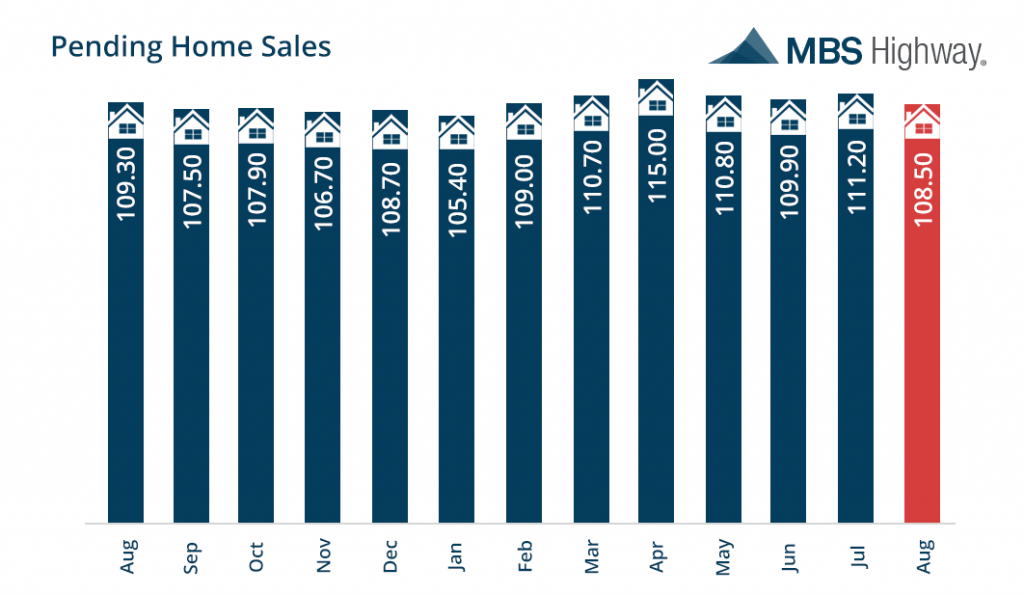
The National Association of Realtors reported that pending home sales declined by 2.4% in August.  Low inventory continues to impact the housing market.

09-29-portland-mortgage-pending-home-sales9-29-2016

The technical outlook for interest rates is neutral.  I am going to recommend a locking bias as it feels like momentum may be shifting.

Current Outlook: locking bias