Decreasing demand and increasing supply causes mortgage rates to rise

Congratulations to the Philadelphia Eagles who won their very first Super Bowl Championship yesterday.  As for the Patriots, do you know the difference between a New England fan and a carp?  Answer: One is a bottom-feeding, scum sucker, and the other is a fish.

Mortgage rates continue to march higher.  I know this may seem repetitive but it’s not like we didn’t see this coming (see HERE, HERE, and HERE).

Supply & Demand

The basic concept of supply and demand can explain why we’re witnessing home loan rates rising.  Rates are effectively determined by the price of mortgage-backed bonds (MBS’s).  When the price of bonds fall then mortgage rates rise and vice versa.

The Federal Reserve

Starting in 2017 the Fed began to unwind the balance sheet which they accrued during the aftermath of the housing crash.  The Fed had been investing billions of dollars per month into the fixed income market including MBS’s.  In the absence of the Fed’s investment demand for MBS’s has declined pushing prices down and yields up.

European Central Bank

The US central bank was not the only entity dumping money into quantitative easing (QE) measures following the recession.  The European Central Bank followed the US’s lead and became a major investor in the European fixed income market.  They recently discontinued their QE and that has also drawn demand away from the US further pressuring prices down and yields up.

Higher deficits

Not only is demand for fixed income securities declining but the US government will be increasing the supply of US Treasury notes and bonds in the coming years in order to fund the recently passed tax cuts.  Should congress and the president also sign an infrastructure bill into law we could expect to see higher deficits and a greater supply of fixed income securities competing with MBS’s.

The bottom line is that we are in an environment where the demand for MBS’s has declined and the supply of competing debt securities is increasing.  As a result yields are rising.

I expect this trend to continue in the immediate term.  I think mortgage rates will worsen by another .125%-.25% before stabilizing.

Current Outlook: locking
State of the Union speech may pressure mortgage rates higher

On Tuesday President Trump will deliver the annual State of the Union Address to Congress.  Some people think that Congress should work towards increasing the Federal minimum wage.  If anyone knows about doing the minimum for their wage it seems like a great place to start.

What legislative priorities will the President focus on in his speech? Any emphasis on infrastructure spending could add fuel to the fire in terms of mortgage rates increasing.

The tax reform law which passed in December has already added $1.5 trillion in deficit spending over the next decade.  Additional infrastructure investment without means to pay for it would put further pressure on interest rates to move higher (CLICK HERE to learn how).

Interest rates are currently at the highest levels since April of 2014.  There are a variety of factors contributing to higher home loan rates.

Notably the Fed has been hiking short-term interest rates for the past couple years and the longer end of the yield curve has remained flat.  It appears longer durations are following suit.

In addition, although inflation measures remain tepid the economy is growing and unemployment is near historic lows.  Speaking of employment we’ll get a new all-important jobs report this Friday.  The markets are currently expecting ~190,000 new jobs.

On Tuesday the latest S&P Corelogic Case-Shiller Home Price Index will be released as well as Consumer Confidence.

This column has been recommending a locking position ever since the US 10-year treasury note eclipsed 2.50% back on January 10th.  Since then mortgage rates have increased by .25%-.375%.  I continue to recommend a locking stance.

Current Outlook: locking

Government Shutdown Pauses Mortgage Rate Momentum

After two days of the government being shutdown it looks like congress has reached an agreement to fund Federal operations.  Just wondering, if this happens again can we ask Canada to govern us?

According to estimates a government shutdown costs the US economy $1 billion per day.  Bad news for the economy is often good news for mortgage rates.

Home loan rates need the help because last week they continued to march higher.  Interest rates in the US are currently at the highest level since July of 2014.  Let’s not lose perspective though, mortgage rates are still historically low.

Furthermore, most experts predicted that mortgage rates would rise in 2018 so this should come as no big surprise.

This week’s economic calendar is relatively light (aside from the government shutdown).  On Wednesday we get existing home sales and the FHFA house price index.  I expect the latter to reflect continued appreciation due to lack of supply.  On Thursday we get the latest reading on new home sales and on Friday durable goods orders.

Assuming that the government funding agreement comes together today I am going to maintain a locking bias.  Momentum is not on our side.

If not the uncertainty of the shutdown could help mortgage rates improve in the near-term.

Current Outlook: locking

The stock market rally is not helping home loan rates

On this day in 1803 President Thomas Jefferson requested funding from Congress for the Lewis and Clark expedition.  The funding package was for $2,500 in 1803 dollars which equates to $52,252 in today’s dollars.  Any guesses as to whether or not our current government could accomplish the same feat as cheaply?

Government expeditions aren’t the only thing that have become more expensive.  Just take a look at the stock market.  Earlier today the Dow Jones Industrial Average (DJIA) eclipsed 26,000 for the first time.

Only seven trading sessions have passed from when the DJIA eclipsed 25,0000.  Should it close above 26,000 later today it would be the first time in the market’s 120-year history that it has increased by 1,000 points this quickly.

Typically, when stocks rally it hurts mortgage rates because it encourages money to flow out of the bond market and into equities.  As we know mortgage rates have increased by ~.25% over the past few weeks and the stock market has had an influence.

Momentum in the stock market suggests that home loan rates will have a difficult time moving lower in the near-term.  I think the best we can hope for this week is for them to remain constant and I won’t be surprised to see them edge higher.

In my personal opinion US stocks are currently overvalued as compared to long-run valuation comparisons (see HERE) but that doesn’t mean we’ll see a near-term correction.

For now I recommend locking.

Current Outlook: locking

US 10-year treasury breaks 2.50%, mortgage rates at risk of moving higher

I warned in yesterday’s post (see HERE) that, “if the yield on the US 10-year treasury note breaks through 2.50% then watch out. I would expect mortgage rates to worsen by another .125%-.25%.

This morning yields have broken above 2.50% which is not a favorable sign for home loan rates.

There are a variety of factors contributing to the move higher in rates including an expectation for less monetary stimulus in Japan and Europe, growing inflationary pressure, and economic optimism.

It is possible that yields reverse and move back below 2.50% but if that does not happen today and the market closes above this threshold then it will be more difficult for that take place in the near-term.

At this point I would recommend loan applicants lock their rates (if they are able) if they haven’t already.

US 10-year treasury note holds key to mortgage rates this week

On this day in 1947 a mother walked into a hardware store in Tupelo, Mississippi and purchased a guitar for her 11-year old son’s birthday.  It was his first guitar and the $6.95 investment turned out to be a pretty good one.

In 2004, the son’s estate sold for ~$100 million which equates to a 33.5% annualized return.  The power of compound interest brought to you by Elvis Presley.

Mortgage banks only wish they could earn a return of 33.5% on their loans.  Rates did tick up last week (modestly) but at today’s 30-year fixed rates it would take 401 years for a $6.95 investment to turn into $100 million.  Who’s got time for that?

This week’s economic calendar is relatively light.  The highlights include a 10-year treasury note auction on Wednesday, jobless claims on Thursday, and the Consumer Price Index (CPI) on Friday.

Inflation is the primary driver of mortgage rates so any signal that price pressure is increasing in the CPI would not be favorable.

From a technical perspective I am keeping a close eye on the US 10-year treasury note (which home loan rates tend to track).  It is currently yielding 2.48%.  It has not traded above 2.50% in nearly a year. Recent attempts to break through 2.50% have resulted in lower interest rates.

If the yield on the US 10-year treasury note breaks through 2.50% then watch out.  I would expect mortgage rates to worsen by another .125%-.25%.

However, if they can hit 2.50% and bounce lower then we may see mortgage rates improve by .125% or better.

Current Outlook: floating as long as the US 10-year treasury note yields less than 2.50%.  

A look ahead to 2018, will rates and home prices move higher?

Happy New Year!  Welcome to 2018.  Want to feel old?  Students in the class of 2018 that graduate from high school this year were born in 2000-2001.  They’ve never known Star Wars to be a trilogy or “rolled down a window”.

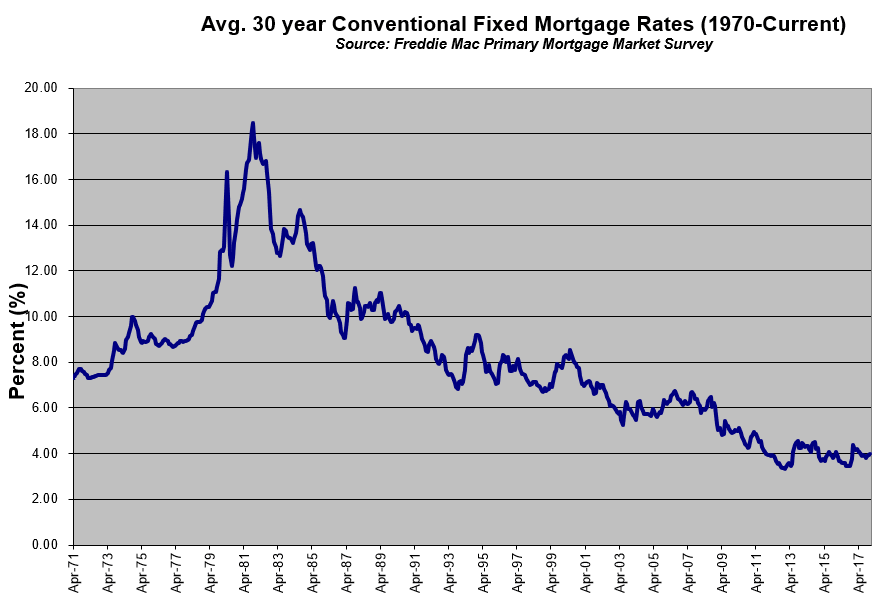
Assuming home ownership rates remain similar then approximately 63% of them will purchase a home in the future.  What interest rates will they lock on their loans?  If you believe in “reversion to the mean” then this chart above may offer a clue.

I believe mortgage rates are likely to increase in 2018.  Why do I think this?

Yield Curve

The yield curve flattened during 2017 as the Fed hiked short-term interest rates while yields at the long end of the curve remain more or less unchanged.

This is evident in the fact that the difference between the yield on a US 10-year treasury note and 2-year note fell last year.  A flat yield curve typically predicts an economic recession, which does not seem likely in the near-term, or higher long-term rates in the future.  I think the latter is more likely.

I do not have a crystal ball but am forecasting 30-year fixed rate mortgage rates to increase by .50%-.75% during 2018.

Home Prices

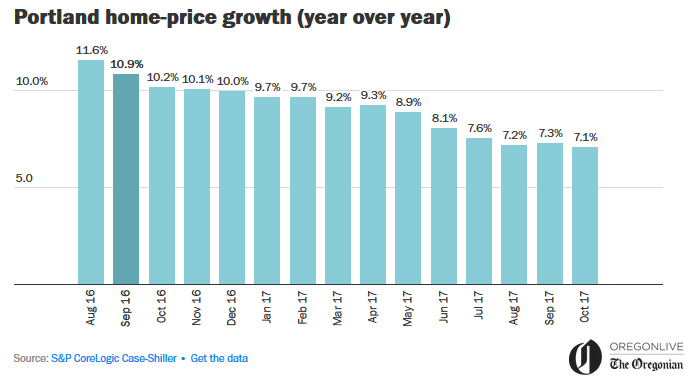
Home price appreciation for Portland has been on a steady decline since the summer of 2016 but remains above historical averages.  In Portland home prices are increasing at a ~7% annualized rate according to the Case-Shiller Home Price Index report.

Given that demand is expected to remain strong as people continue to move here and supply of housing remains constrained I think it will be more of the same in 2018.  I am forecasting home prices in Portland to increase by 6.0% over the next 12 months.

How do you see 2018 playing out?  Feel free to leave comments here.

Current Outlook: locking

The Fed does not set mortgage rates

Later today the Federal Reserve Bank Open Market Committee (FOMC) is widely expected to hike short-term interest rates.  Contrary to popular belief a Fed rate hike could actually help mortgage rates improve.

To understand why one must consider the reason why the Fed is hiking rates in the first place.

The Fed has a dual mandate which is to maintain:

  1. maximum employment
  2. stable prices and moderate long-term interest rates

Interest rate hikes are a tool the FOMC uses to help stabilize prices (AKA curb inflationary pressure).  Inflation is the primary enemy of mortgage rates because it erodes the purchasing power of the money used to repay the loan.

Consider if you were planning on lending someone money today and deciding on what rate of interest to charge.  If you were informed that the value of the money repaid to you in the future would have less purchasing power due to inflation you would be prudent to add that additional cost into the interest rate.

As the Fed hikes short-term interest rates it should theoretically prevent future inflationary pressure which is good for home loan rates.

The FOMC does not directly set mortgage rates.  The rate they control is called the Federal Funds Rate and practically speaking has a very obscure function (it is the interest rate charged between banks to lend reserve balances for overnight depository requirements).

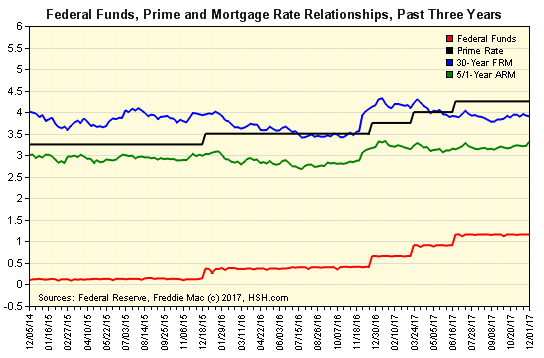
As the chart below shows there is no direct correlation between the Federal Funds Rate and mortgage rates.

As you can see from December of 2014 to December 2017 the Federal funds Rate increased from ~.25% to ~1.25% as a result of four separate rate hikes.  At the start of that time period conventional 30-year fixed rate mortgage rates were averaging 4.00% and now?  Still ~4.00%.

It’s important to note that the FOMC’s comments and actions can send ripple waves through the financial markets and can influence the direction of mortgage rates, for better or worse, but the Fed does not directly control the rates provided on home loans.


How words will impact mortgage rates this week

Mortgage rates essentially held steady last week despite the stock markets continued rally.  The Dow Jones Industrial Average has returned 23% year-to-date while the NASDAQ index is up 27%.  Despite those gains mortgage rates have held steady this year.  I expect they will likely increase by .50%-.75% in 2018.

The job’s report

Friday’s all important jobs report showed stronger than expected employment.

According to the survey 228,000 new jobs were created during the month of November, the unemployment rate remained at 4.1%, and average hourly earnings only ticked up by $.05 ($26.55).

Healthy economic growth with low inflationary pressure persists which is good news for the real estate market.

Central Banking

This week’s economic calendar is loaded with central bank meetings.

The US Federal Reserve board will meet starting on Tuesday and is widely expected to hike short-term interest rates by .25% with that announcement expected on Wednesday.

The Fed does not directly control home loan rates but their comments can cause volatility in the financial markets.  Furthermore, with short-term rates increasing and long-term rates unchanged the yield curve is flattening which may signal a recession is on the horizon (or higher longer-term rates).

On Thursday both the European Central Bank (ECB) and the Bank of England release monetary policy statements as well.  Both are expected to keep their target rates unchanged but economic growth in both regions has been positive and many onlookers believe the ECB will discontinue their bond-buying program in 2018.

If the ECB does roll back their quantitative easing program it would likely cause rates in Germany to increase which would likely pressure US interest rates higher as well.

Inflation?

Back in the US inflation measures have come in pretty close to the Fed’s 2% target this year.  On Tuesday we’ll get the latest reading on the Producer Price Index followed by the Consumer Price Index on Wednesday.  Inflation is the primary driver of mortgage rates so continued tameness will be a positive sign.

From a technical perspective mortgage backed bond prices have dropped below important technical support.  It will be hard for prices to reverse back above the multiple layers they have broken below.  I will recommend a locking bias.

Current Outlook: locking

Advancement of tax plan expected to pressure mortgage rates higher

If you’re looking for something to celebrate this week look no further.  On December 5, 1933 the 21st Amendment to the US Constitution was ratified effectively ending prohibition.  Fast forward to 2017, Oregon’s brewing industry contributes $4.49 billion to the state economy and directly/ indirectly employs over 30,000 people.  I can toast to that.

Republicans are toasting their advancement of tax overhaul legislation.  The Senate narrowly passed their version of the tax bill which will now be reconciled with the House version.

The Tax Plan:

The new tax plan is bad for mortgage rates on a couple levels.

First, passage of the new tax laws is expected to add ~$1.4 trillion to the Federal debt over the next ten years.  In order to fund the deficit the US Treasury will have to issue an equal amount of debt which will crowd out other borrowers and push yields higher.

Second, the new tax cuts are expected to promote economic growth which is good news for stocks.  The Dow Jones Industrial Average has increased by over 1,000 points in the past week and is trading at all time highs.  When stocks rally it tends to push interest rates up.

Jobs Week:

It’s the first week of a new month which means we’ll get a fresh all-important jobs report this Friday.  The markets are currently expecting ~+190,000 new jobs created during the month of November.  A figure significantly better than that would put upward pressure on mortgage rates and vice versa.

The Fed:

The next monetary policy meeting is scheduled for next week with an announcement set for December 8th.  There is currently a 90% probability that the Fed will hike short-term interest rates by +.25%.

In other words, the home loan rates you see today already assume a rate hike.  Please help consumers understand that mortgage rates will not automatically increase next week on account of this action (they could move higher for other reasons).  The Fed does not directly set home loan rates but their comments and actions can cause volatility.

Given the momentum of the tax plan I recommend locking in.

Current Outlook: locking