Uncertainty keeps mortgage rates at low levels

Think “fake news” is a new phenomenon?

Back in 1935 an organization called the Clark Foundation based in Cooperstown, NY publicized a false story claiming that US Civil War hero Abner Doubleday invented the game of baseball in that town 100 years earlier.

Despite the story being inaccurate it helped the organization raise money to build the baseball hall of fame which inducted its first members on this day in 1936.

Every year around this time baseball fans eagerly await the election results to see which former players will be inducted in that year’s class.

Brexit uncertainty

The financial markets are eagerly awaiting a vote in the British Parliament today which will set the stage for Brexit which is currently scheduled to take place on March 29th.

Britain still does not have an approved trade agreement with the European Union and if Brexit takes place in the absence of one it is likely Britain will fall into recession.

Many analysts are predicting Brexit will get delayed so an agreement can be reached but there is still much uncertainty.

…more uncertainty

Political uncertainty is not contained to Britain.  Here in the US we recently reopened the Federal government after the longest shutdown in history.  The threat of another shutdown looms three weeks away and it is not a clear that a longer funding bill will get passed in time.

Furthermore, US and Chinese trade negotiators continue to meet periodically but by all accounts are still far from a comprehensive trade deal.

Political and economic uncertainty helps US mortgage rates remain low.  Should these issues get resolved I would expect mortgage rates to move higher by .25%-.50%.

Home prices still rising

The Case-Shiller Home Price index report was issued earlier today and showed that home prices nationwide increased by 5.2% from a year earlier.  Here in Portland home prices only increased by 4.4% from last year.  Many in the media are painting a doomsday scenario.

However, for a customer who puts 5% down on a $400,000 home ($20,000) and sees their home value increase by 4% in the first year (+$16,000) that is better than they could expect from the stock market.

Outlook

Still to come this week is the Fed monetary policy decision (no rate hike expected) and the all-important jobs report due out on Friday.  For now we can continue to float but I am concerned rates may have hit a bottom at current levels.

 Current Outlook: floating
Credit Myth #7- Qualifying for a home loan without a credit score

After spending over 16 years in the mortgage lending industry I have identified seven myths that consumers commonly hold regarding their credit.  In this series of videos I am going to breakdown each myth and help you better understand how your credit scores are determined so that you can achieve a better outcome for your next loan application.

The seventh myth is that an applicant without a credit score cannot qualify for a mortgage.  Please watch this short video to learn the truth:

It is possible for people without a credit score to obtain a home loan.  They have to be able to demonstrate that they have made on-time payments for other recurring payments such as rent, utilities, insurance or other similar bills.  This is known as a “non-traditional credit reference”.  This approach may not be used for an application with a credit score that is too low to qualify.

If you would like to learn if this loan program would work for you please contact me today!

A short outlook for housing in 2019

Have you made it a goal to buy a home in 2019?  If so then knowing when to buy can offer real savings.  In this short video I explain why I think home buyers that take action at the beginning of the year will likely be better off than those who wait.

As explained in the video, many experts are predicting that home prices and interest rates will rise throughout the year.  Given that mortgage rates are currently at multi-month lows, I am encouraging those who want to buy a home to look sooner rather than later.

If you would like a no obligation review of your options please contact me today to get started.  Thanks!


The shutdown’s impact on mortgage rates

The government shutdown is now the longest running shutdown in our history.  Over 800,000 federal workers remain without a paycheck.  Meanwhile, the government is accruing back wages to the tune of $2,000 per second.

How is the shutdown impacting home loans?

Mortgage Rates

The government shutdown has helped contribute to lower mortgage rates.  How?

First off, political uncertainty encourages investors to be less risky with their capital.  When investors seek safety mortgage-backed securities attract greater demand which drives yields lower.

Second, lower government spending has a slowing effect on the economy which is bad for the stock market.  As we know the US stock market has traded lower for the past two months which also helps interest rates improve.

Mortgage Processing

Most borrowers will not experience any delays as a result of the shutdown.  However, some applications require that the tax returns provided with the application be verified through the IRS.  They are not currently providing this service so those applications are likely to be delayed.

Furthermore, the VA and FHA are currently understaffed.  For applications which require specific underwriting guideline questions lenders are left to either proceed with the application without clarity from the VA/ FHA, deny the loan, or delay it.

Economic Data

The federal government issues most of the economic reports that analysts rely on to make forecasts.  Some reports are being issued on schedule but others are not (see a list of reports HERE).

The all-important jobs report is scheduled for release on February 1st (for now) but the financial markets may not react to the report because the reliability of the results will be called into question.

Given that there does not appear to be a compromise in sight we will maintain a floating bias BUT borrowers should be warned that we expect home loan rates to rise once the shutdown is over.

 Current Outlook: floating

Credit Myth #6: It takes a great credit score to qualify for a home loan (not true)

After spending over 16 years in the mortgage lending industry I have identified seven myths that consumers commonly hold regarding their credit.  In this series of videos I am going to breakdown each myth and help you better understand how your credit scores are determined so that you can achieve a better outcome for your next loan application.

The sixth myth is that an applicant must have a good credit score to qualify for a home loan.  Please watch this short video to learn the truth:

If you would like to learn about your options for buying a home with a below average credit score please contact us today to get the process started!

Mortgage Rates at multi-month lows but expected to rise during 2019

Happy New Year!  77% of US citizens set financial goals for their new year’s resolutions.  Did you?  Unfortunately only 1 in 5 are able to see their resolutions through February.

I hope 2019 brings you good health and prosperity!

Mortgage Rates

Interest rates start off the new year at the best levels since the spring of 2018.  Weakness in the stock market helped mortgage rates improve during the final two months of 2018.

Trend line

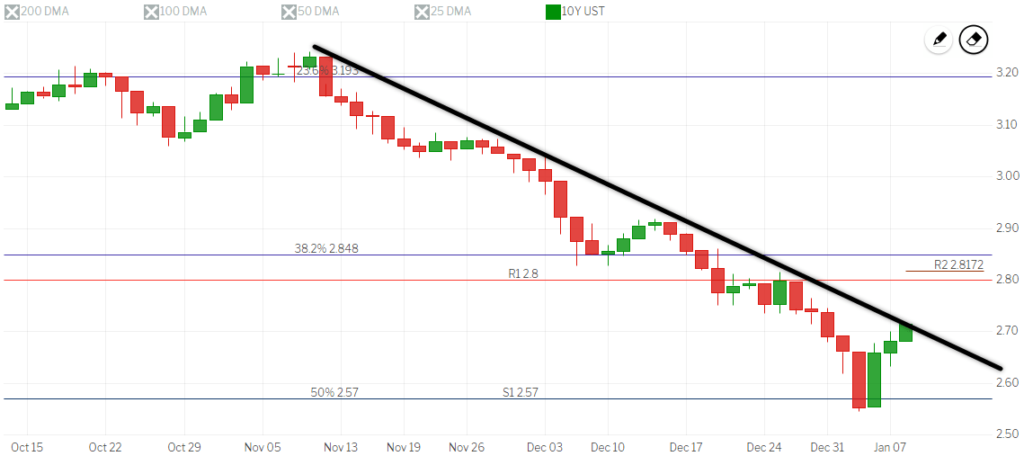
A look at the chart of the US 10-year treasury note, which mortgage rates tend to follow, shows that yields fell from 3.22% at the beginning of November to 2.55% on January 2nd.  During that time home loan rates improved by .50%.

Currently the US 10-year treasury note is at 2.70% which is right up against the two month trend line.

Near-term Outlook

Should yields bounce lower off this trend line then mortgage rates are likely to improve by another .125%-.25%.  However, if the yield closes above 2.70% then I expect rates to move higher.

Longer-term Outlook

Most Wall Street Analysts believe that yields will increase by .50%-1.00% during 2019.  Therefore, I think the best buying opportunities will exist in the initial three to four months of the New Year!

 Current Outlook: locking bias

Credit Myth #5: All forms of debt are equal

After spending over 16 years in the mortgage lending industry I have identified seven myths that consumers commonly hold regarding their credit.  In this series of videos I am going to breakdown each myth and help you better understand how your credit scores are determined so that you can achieve a better outcome for your next loan application.

The fifth myth is that all forms of debt are looked at equally.  The credit scoring algorithms classify debt as either being an installment loan or revolving credit.  Watch this short video for more information on how to manage these forms of debt to enhance your credit.


Revolving Credit

An example of a revolving account is a credit card.  A lender approves a borrower to spend up to a credit limit.  It is then up to the borrower to determine how much they borrow relative to that limit and how much they pay back each month.

Generally speaking revolving credit is considered riskier than installment loans but when a borrower has a history of using their revolving credit conservatively this will improve their credit.

Installment Debt

An example of an installment loan is a fixed rate mortgage.  In this case the borrower receives a lump sum from the lender and agrees to repay the loan over a period of time with interest.  It is most important that a borrower make the payments in a timely fashion.  In general, an installment loan is considered less risky than revolving credit.

Ideally, a consumer will carry a mix of installment and revolving accounts and make their payments in a timely fashion.

Please contact me today to learn more!

Credit Myth #4: Your Job and Income Contribute to Your Credit Score

After spending over 16 years in the mortgage lending industry I have identified seven myths that consumers commonly hold regarding their credit score.  Over the course of the next few weeks I am going to breakdown each myth and help you better understand how your credit scores are determined so that you can achieve a better outcome for your next loan application.

The fourth myth is that a person’s job and level of income contribute to their credit score.  This is not true.  A person’s job and/ or income are not data points included in the algorithm that determines a credit score.  Certainly higher incomes allow households to better afford their payments and make it less likely they would incur adverse events.  But, at the end of the day a person’s credit score is entirely based on their previous credit behavior.

As THIS ARTILCE points out the information that contributes to a person’s credit score are……

  • How length of a person’s credit history
  • If they have repaid their loans as agreed
  • If they have any missed payments which were 30+ days delinquent
  • How they are currently using debt (is the overall level of debt increasing, decreasing, or remaining stable?)
  • The mix of different types of credit accounts
  • If they have any past derogatory events like bankruptcies, foreclosures, short sales, judgements, or collections.
  • If they have recently made other credit inquiries

Please contact me today to learn more about your home loan options.

As 2018 draws to an end home loan rates benefit from stock market weakness

Happy holidays from all of us at Swanson Home Loans!  This will be the last ‘rate update’ post of 2018 as the next two Tuesdays fall on a holiday.  The next ‘rate update’ will be posted on January 8th!  Have a safe and joyous season!

Stock Market

Home loan rates continue to benefit from weakness in the stock market.  The S&P 500 index is off 13% from the highs reached back in early October.

If you are a consistent reader of this post then you know we started expressing concerns over stock valuations all the way back in the beginning of the year so we are not surprised to see this correction.

The Fed

The Federal Reserve Open Market Committee begins its regularly scheduled two-day monetary policy meeting today.  Tomorrow they will announce their latest monetary policy decision.

According to CME Group there is currently a 73% probability that they will hike by another .25% tomorrow.  The Fed does not directly control mortgage rates so we’ll have to see how they react.

Should the Fed defy the odds and not hike I expect the stock market to rally which would likely hurt home loan rates.

Yield Curve

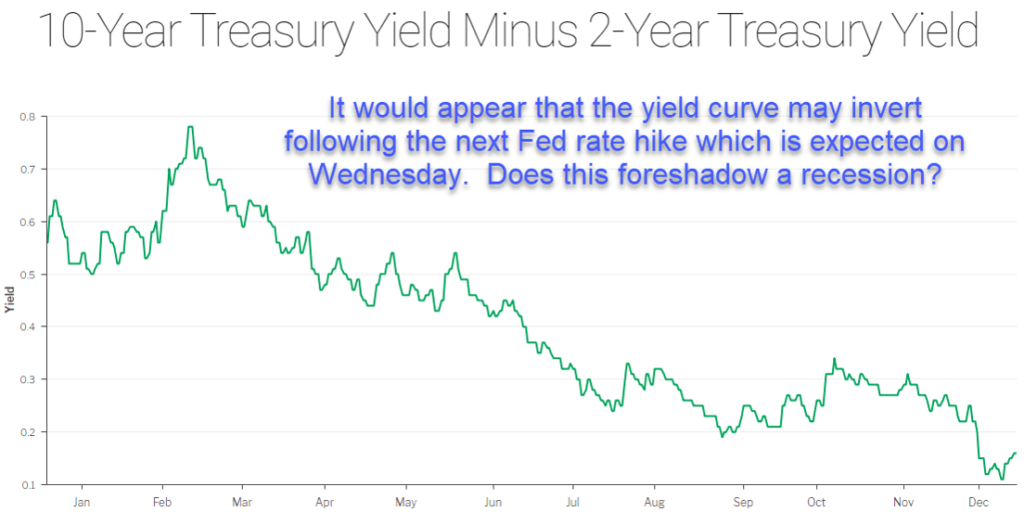
Should the Fed hike the Federal Funds rate tomorrow by .25%, as expected, it will be interesting to see how the yield curve responds.  The 2-year treasury note is currently yielding 2.66% and the 10-year treasury note is yielding 2.83% a difference of only .17%.

If the 2-year yield surpasses the yield on the 10-year treasury note it will be the first time that the yield curve has inverted since 2005-2007.  Every time in recent history the US yield curve has inverted an economic recession has followed.

Outlook

Unfortunately many analysts are growing pessimistic on their economic outlook which is partially why we’ve seen home loan rates improve in the past month.  As long as this viewpoint holds I will recommend floating.

Current Outlook: floating

Credit Myth #3: A high credit score can make up for a low credit score

After spending over 16 years in the mortgage lending industry I have identified seven myths that consumers commonly hold regarding their credit score.  Over the course of the next few weeks I am going to breakdown each myth and help you better understand how your credit scores are determined so that you can achieve a better outcome for your next loan application.

The third myth is that a high credit score in a joint loan application can make up for a low credit score.  The reality is, mortgage underwriters use the lower of the two applicants’ credit scores when evaluating a joint loan application.  It doesn’t matter if the higher credit score applicant has perfect credit or is only marginally higher.  The underwriter will use the lower of the two scores in determining if the application can be approved and in pricing the interest rate.

Sometimes it may be possible for the applicant with a higher credit score to qualify for a loan independent of the applicant with the lower credit score.  In that instance it may make sense to complete the loan application in the higher credit scorer’s name only.

Please contact me today to learn more about how your credit will impact your next home loan process.