A Few Ideas Worth Sharing for May 11, 2017

I just published my monthly newsletter with a few ideas worth sharing.  In this edition I included an article which explains how two major economic forces could collide and cause mortgage rates to increase later on in 2017, how technology is reshaping the way we live in our homes, and how to reduce stress and live life with greater purpose with a two minute daily habit.

You can check it out and subscribe to my newsletter HERE.

Mortgage Rate Update May 8, 2017

Last week we switched to a locking bias and indeed mortgage rates did worsen very modestly.  Rates were pressured higher on Wednesday last week after the Fed labeled weak 1st quarter economic activity as “transitory”.

Friday’s all-important jobs report showed that 194,000 new jobs were created during April and the US unemployment rate fell to a decade low of 4.4%.  Good news for the economy tends to be bad news for mortgage rates.

As you’ve probably heard France elected 38 year old Emmanuel Macron to be their new president yesterday.  He defeated far right candidate Marine Le Pen.  The financial markets are shrugging their shoulders today as it was widely expected.

Congratulations to the people of France who elected the youngest president in their history. The election has not had an impact on mortgage rates thus far.

The Wall Street Journal ran THIS PIECE over the weekend in which they highlight the fact that interest rates are vulnerable to a sharp increase if the Trump administration tax cut plan converges with the Fed’s unwinding of their balance sheet.  Should President Trump get his tax cut plan through congress the federal deficit would likely grow beyond the current forecast of $1 trillion by 2023.  This coupled with the Fed increasing the supply of bonds on the open market would almost surely drive long-term yields higher.  This is a threat we will have to monitor throughout the summer.

In the meantime mortgage rates remain at very attractive levels.  This week’s economic calendar is fairly light.  The highlights come on Thursday & Friday when we get the Producer Price Index and Consumer Price Index.

The technical outlook for interest rates looks favorable so I am going to recommend a floating bias this week.

Current Outlook: locking bias

Mortgage Rate Update May 1, 2017

Happy May Day!  A short history lesson: The earliest accounts of May Day celebrations, meant to celebrate the birth of Spring, dates back the Roman Republic era.  However, in the late 19th century Socialist & Communist groups adopted May 1st to be International Workers’ Day in honor of lives that were lost during an attack on striking workers.

Speaking of working this is the first week of a new month and therefore we have the all-important jobs report due out Friday.  In fact, the economic calendar is packed with significant events this week.

Starting tomorrow the Fed will conduct their regularly scheduled two-day monetary policy meeting.  According to CME group there is only a ~5% chance that the Fed will hike short-term interest rates at this meeting.  However, the markets think there is a 63% chance they will hike at the next meeting scheduled for June 13th-14th.  The Fed does not directly control mortgage rates but their comments and actions can influence them.  On Friday five Fed members are scheduled to speak and we’ll get the results of the aforementioned jobs report.  I expect to see volatility at the end of the week.

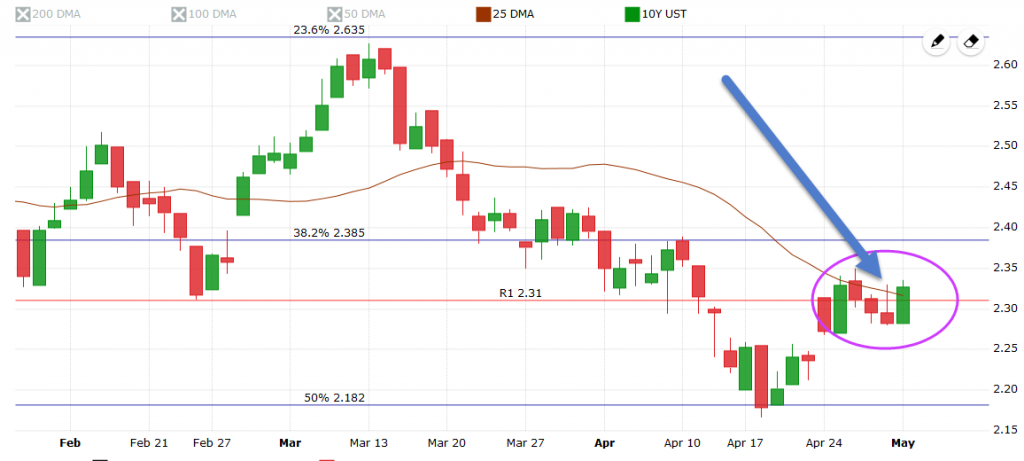
From a technical perspective we are keeping a watchful eye on the yield of the US 10-year treasury note.  This morning it broke above 2.31% which was a solid level of resistance.

Should the yield on the US 10-year treasury note close above 2.31% tonight then I think it is likely it will increase all the way to ~2.39% and mortgage rates will likely increase by .125%.  For this reason I am going to recommend a locking bias.

Current Outlook: locking bias

Mortgage Rate Update April 24, 2017

In case you have not set plans in motion I want to let you know that tomorrow is National Hug a Plumber Day.  You may want to contact one today and set up an appointment.  Don’t be surprised if they are a couple hours late.

Last week mortgage rates lost a little bit of ground but overall the current level of interest rates is better than they’ve been since the election last November.

Speaking of elections, over the weekend France conducted the first round of their presidential vote.  Centrist Emmanuel Macron and far right candidate Marine Le Pen appear to be headed for a run-off which will take place on May 7th.  It is expected that Macron will defeat Le Pen but let us not forget it was also expected that Secretary Clinton would defeat President Trump.  Global stock markets are reacting favorably to France’s election results which is putting pressure on US interest rates.

The yield on the US 10-year treasury note, which mortgage rates tend to follow, hit a multi-month low at 2.20% last week.  However, this morning the yield is back up to 2.27% and trending higher.  Not surprising, mortgage rates are also priced slightly worse to start this week.  From a technical perspective it appears that yields will likely move higher this week (I am guessing to ~2.40%).

The economic calendar is rich with housing data this week.  On Tuesday we’ll get the S&P Case Shiller home price index report and the FHFA house price index.  With housing supply tight across the country it is expected that these releases will show continued appreciation rates that exceed historical averages.  On Thursday we’ll get Pending Home Sales from the National Association of Realtors.

Since momentum is working against us I am going to recommend a locking bias for the first part of this week.

Current Outlook: locking bias

Mortgage Rate Update April 17, 2017

On this day in 1961 the Bay of Pigs invasion began.  As we know the attempt to overthrow Fidel Castro was a complete failure as it ultimately solidified the relationship between Russia and Cuba and enhanced Cold War tensions.

Speaking of tensions US interest rates have benefited from growing geopolitical uncertainty.  Global investors do not like being exposed to “risky” assets during potentially turbulent times and therefore we are experiencing a “flight-to-safety” which drives US interest rates down.

Also helping to drive rates lower has been a shift in expectations regarding the Trump Administration’s fiscal stimulus plans.  No details have been released but the markets think a much more watered down version will have to be presented in order to win congressional approval.  A more aggressive stimulus plan would add inflationary pressure to the economy and hurt interest rates and vice versa.

A less aggressive stimulus plan could also hurt US stocks.  As measured by the Shiller Price-to-Earnings ratio, which is the ratio of the S&P 500’s price divided by its average inflation-adjusted earnings from the previous 10 years, the stock market appears ripe for reversal.  If US stocks do move lower it should help interest rates remain at current levels or maybe even better.

The economic calendar for the week is heavy with fresh housing data.  This morning the home builder index, which measures optimism for US home builders, came in slightly below expectations.  Tomorrow we get housing starts and building permits.  Finally, on Friday the National Association of Realtors will release the latest existing home sales figures.

Momentum is still on our side so I will float.

Current Outlook: floating

Mortgage Rate Update April 10, 2017

In case you weren’t aware today is National Siblings Day.  Now is a great time to call your sibling and let them know how “okay” they are (just kidding Ceri!  You are awesome).

Friday’s all-important jobs report showed that only 98,000 new jobs were created last month.  This was well below expectations and the lowest output since May of 2016.  Bad news for the economy tends to be good news for mortgage rates.

Also helping mortgage rates is the uncertainty regarding Syria and the US military action which took place last week.  Geopolitical tension tends to drive global investors into “safe havens” which benefits interest rates here in the US.

This week’s economic calendar is fairly light.  The highlights come Thursday and Friday when the Producer Price Index & Consumer Price Index are released.  Fed Chairwoman Janet Yellen is scheduled to speak later today and take questions via Twitter.  Might she hint when the Fed will begin to unwind their balance sheet (which would likely put upward pressure on rates)?

From a technical perspective mortgage rates are presently at the low end of their trading range dating back to December.  In other words, rates are currently as good as they have been for the past four months.  Could they get better?  Sure but the last four times they got hear they reversed and moved higher so I am going to maintain a locking bias.

Current Outlook: locking bias

Mortgage Rate Update April 3, 2017

Are looking forward to tonight’s NCAA men’s basketball championship game between Gonzaga and North Carolina?  Did you know the greatest upset of  all-time came on this day in 1978 when the Movie ‘Annie Hall’ beat out ‘Star Wars’ for best picture?  Absurd.

We start the week with mortgage rates at the best levels since late February.  This is partially because of the unfortunate subway blast which took place in St. Petersburg, Russia earlier today.  Geopolitical uncertainty tends to drive investors into safe-havens which helps US interest rates.

This mornings subway blast in Russia is causing investors to seek safety which is driving US home loan rates lower.

The financial markets are seeing some follow through on President Trump’s failed attempt to repeal the Affordable Care Act.  The Trump administration had planned to spend some of the Federal Government’s savings on a fiscal stimulus package which will have to be scaled back now.  Rates had been pressured higher on the expectation of a large fiscal stimulus package and are moving back down now.

The economic calendar heats up on Wednesday this week with the release of the minutes from the Fed’s latest monetary policy meeting.  Analysts are eager to learn more about the committee’s plan to unwind the Fed’s balance sheet which grew during the housing downturn via quantitative easing.  The Fed is a major holder of mortgage-backed securities which ultimately determine mortgage rates.  Should they aggressively sell off these assets it would put upward pressure on mortgage rates.

Finally, the all-important monthly jobs report is due out this Friday.  The market is currently expecting ~175,000 new jobs.  A number north of that would hurt mortgage rates and vice versa.

From a technical perspective momentum is on our side but given that we’re at multi-week lows I like a locking bias.

Current Outlook: locking bias

Are Video Games The Reason Why Mortgage Rates Are So Low?

OK, OK…I realize the headline might be a little far-fetched, but I ran across this article in 1843 Magazine, The Economist’s lifestyle magazine, and was fascinated. The entire article is definitely worth a read.

Of significance to this blog is the thesis @ryanavent contributes to the great mystery as to why the unemployment rate is at a historically low level yet inflationary pressure remains weak. 

Effectively, the article argues that one of the reasons why the Labor Force Participation Rate is so low is because there is a large pool of eligible workers who are posted up in their parents basements addicted to video games. 

Since the unemployment rate only accounts for those who are looking for work and excludes those who are out of the Labor Force (i.e. addicted gamers), the rate of those out of work who want work is artificially low.

Young man usingh soccer ball for a pillow plays video games.
We can thank this chap for historically low mortgage rates.

Since inflation is one of the primary drivers of mortgage rates and because wages have remained relatively stagnant given the low labor force participation rate, one can argue that low mortgage rates have effectively become a beneficiary to the addictive nature of video-gaming. Thanks Nintendo!

Mortgage Rate Update March 20, 2017

Housekeeping: As you may have noticed the past two weeks ‘rate update’ is shifting to once weekly distribution (each Monday).  I am working on a new supplemental Thursday format designed to get you ready for the weekend that I will be rolling out after spring break.

HAPPY 1ST DAY OF SPRING!  It’s almost time to bust out your shorts from the back of your closet.

Last week’s advice to “float” proved to be a good decision as mortgage rates did improve following the Fed’s decision to hike rates on Wednesday.

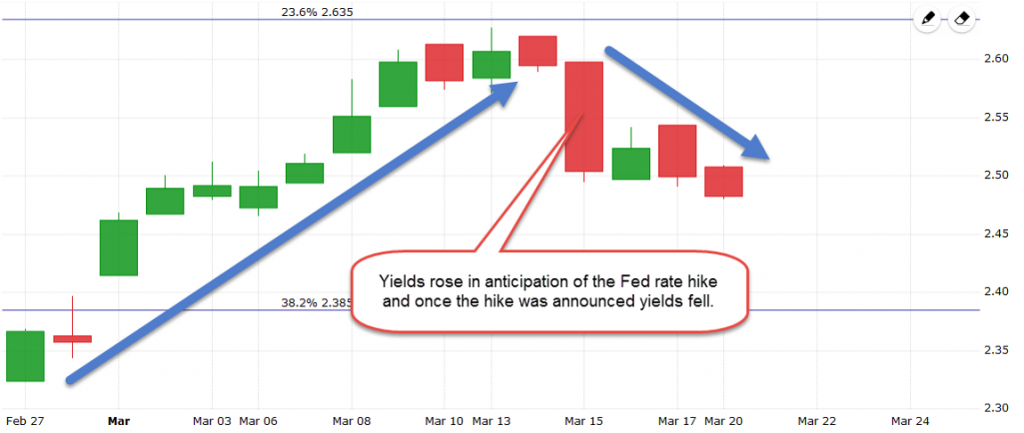
The Fed’s +.25% rate hike announced on Wednesday was not a surprise to the financial markets.  Interest rates behaved just like they did the last two times the Fed hiked rates (Dec. 2015 & Dec. 2016).  Prior to the announcement yields rose then following the announcement yields fell.  The chart below shows the yield on the US 10-year treasury note going from 2.33% up to 2.63% from late February until last Wednesday.  Since then yields have retreated back to ~2.49%.

In her post-meeting comments Fed Chairwoman Janet Yellen reiterated the committee’s confidence in the economy and said they would continue to “gradually” hike short-term interest rates (two more hikes expected in 2017).  Currently the financial markets are pricing in a ~58% probability that the next Fed rate hike will come in June.

This week’s economic calendar is light.  The highlights include the FHFA housing price index (Wed.), existing home sales (Wed.), and new home sales (Thurs.).

I will be keeping a close eye on the stock market and technical trading patterns.  After floating last week and seeing some gains I am leaning towards a locking bias this week.

Current Outlook: locking bias

Mortgage Rate Update March 13, 2017

Mortgage rates had a rough time last week.  They now stand at their worst levels in over two years.

Friday’s all-important jobs report was better than expected.  It showed that 235,000 jobs were created during the month of February and that wages increased by 2.8% year-over-year.  With these results the Fed is almost certain to hike short-term rates by .25% again on Wednesday.

Should we be concerned that mortgage rates will also increase?  After all the Fed does not directly set mortgage rates.  Mortgage rates drifted higher last week in anticipation of a Fed rate hike so in some respects the damage is done.  Furthermore, when the Fed hiked in December mortgage rates declined shortly thereafter.  Maybe we will experience the same reaction this go around.

From a technical perspective interest rates appear ripe for reversal after trending higher last week.  The yield on the US 10-year treasury note touched ~2.63% on Friday and is starting the week moderately lower.
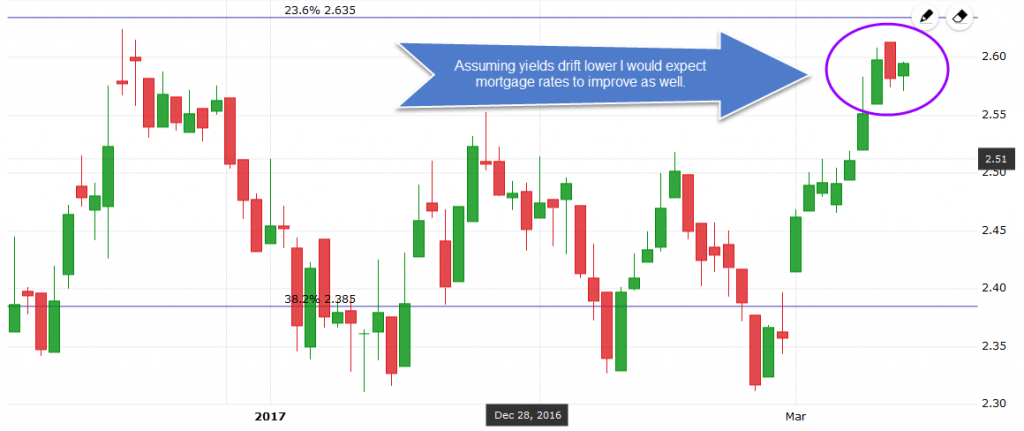
However, we have to be careful because if yields move above the 2.63% threshold mortgage rates will continue higher as well.

This week’s economic calendar is busy.  The highlights include the Producer Price Index (Tuesday), Consumer Price Index (Wednesday), Retail Sales (Wednesday), Housing Starts (Thursday), and of course national Guinness Consumption Day (Friday).

Current Outlook: floating