Mortgage Rate Update October 27, 2016

Across the globe long-term interest rates, including those for US mortgages, have worsened this week.  A peak at the chart below shows that the yield on the US 10-year treasury note, which mortgage rates tend to track, has risen by ~.50% from the beginning of July until today.

portland-mortgage-broker-oct-27-2016

Why the increase?

First, let’s remember that the “Brexit” vote took place at the end of June.  Mortgage rates immediately fell sharply as uncertainty spread across the global financial markets and investors sought safe havens for capital.

That uncertainty has dissolved and there is greater confidence in economic growth.  As a result, many of the investors who re-positioned investments into the US have reversed those trades which has put upward pressure on interest rates.

Second, inflation expectations are rising across the globe.  This is partially related to oil prices increasing.  Since February oil prices have risen by nearly 50%.  Inflation is the primary driver of long-term interest rates, including mortgages, because it reduces the value of a lender’s future return.

From a technical perspective mortgage rates continue to look vulnerable so I will maintain a locking bias.

Current Outlook: locking bias
Mortgage Rate Update October 13, 2016

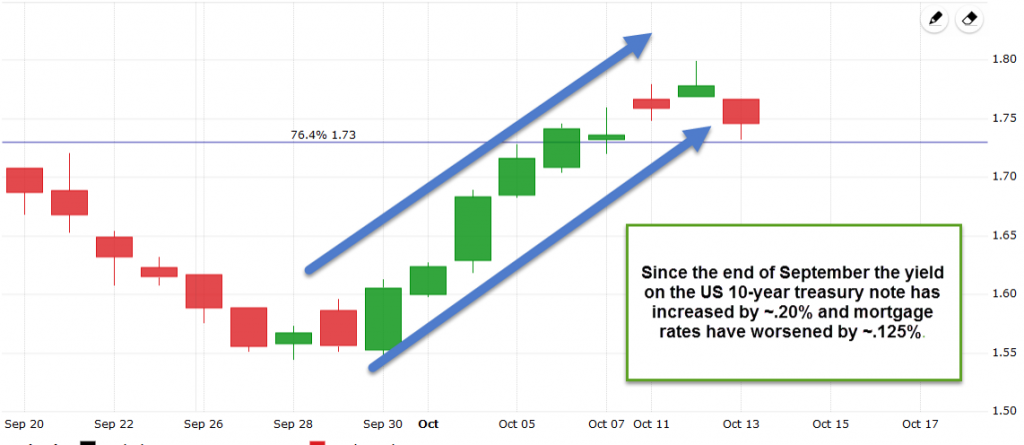
Mortgage rates have worsened modestly this week.  A look at the yield on the US 10-year treasury shows an increase from ~1.55% in late September to ~1.75% today.  During that time mortgage rates have increased by ~.125%.

portland-mortgage-rates-us-10yr-10-13
This morning interest rates have stabilized and are trying to reverse lower as stocks slide.  US stocks are trading lower on news that Chinese exports declined 10% year-over-year.  Mortgage rates tend to benefit when stocks falter.

In September 2015 the Fed was widely expected to raise short-term interest rates but ended up delaying the action after China released weaker than expected economic data.  Might today’s release cause the Fed to delay again?  At this point I think not but we’ll have to see how the markets respond in the coming weeks.

From a technical perspective the pattern shown in the chart above leads me to believe we could see yields continue to decline.  I am going to recommend a floating stance.

Current Outlook: floating

Mortgage Rate Update September 22, 2016

Mortgage rates are better today as compared to Monday. There is a lot to cover today.

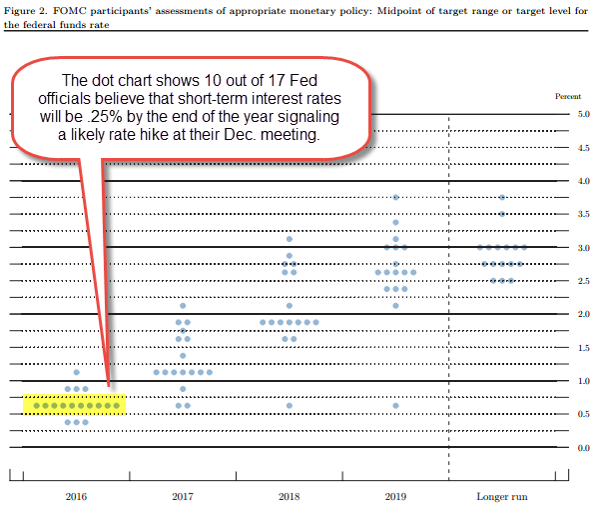
First, the highly anticipated Fed meeting concluded yesterday.  As expected the Fed did not make any changes to short-term interest rates.  However, the Fed did signal to the markets that it is probable that they will hike at their December meeting.  A look at the “dot chart”, which is released following every meeting shows that 10 out of 17 members are anticipating one more .25% rate hike in 2016 (presumably at the December meeting).

portland-mortgage-broker-fed-rate-chart-sept-2016

Given that the Fed is “likely” to hike rates in December do prospective borrowers need to hurry and lock in a rate?  The media and unnamed mortgage companies will use this to stir up fear but the reality is a Fed rate hike will not in and of itself push home loan rates higher.  History may not repeat itself but the last time the Fed hiked rates in December of 2015 mortgage rates fell by .375% in the following 8 weeks.

The National Association of Realtors released monthly numbers for existing home sales.  The number of home sales declined in August sparking concerns in the media.  Let’s not get ahead of ourselves.  Existing home sales in July were exceptionally high so a decline from those levels is not surprising.  Furthermore, as compared to August of 2015 there were .8% more home sales.  Inventory remains tight nationwide which is supportive of pricing.

Lastly, weekly jobless claims fell this week which is a good sign for the labor market.  The numbers released today represent the sample week for the next Bureau of Labor Statistics jobs report due out on Friday, Oct. 7th.

Mortgage rates are trending in a favorable direction so I will recommend floating into the weekend.

Current Outlook: floating

Mortgage Rate Update September 15, 2016

Mortgage rates remain unchanged from Monday.  In case you missed it mortgage rates rose by ~.125% the latter half of last week.

The economic calendar was full of significant releases today.

First off, retail sales softened during the month of August declining by .3%.  This was a larger decline that analysts had expected and is raising concerns about the health of the economy moving forward.  This report also increases the likelihood that the Fed will not hike short-term interest rates next week.  More on that below.

Retail Sales declined by more than anticipated in August. Bad news for the economy tends to be good news for mortgage rates.

The Labor Department released the latest Producer Price Index, which measures inflation at the wholesale level of our economy.  On a year-over-year basis prices only increased by 1.2% when excluding volatile food & energy prices.  This is considered to be tepid inflationary pressure which is good for mortgage rates.  The Consumer Price Index will be released tomorrow.

Lastly, weekly jobless claims ticked up slightly last week.  The number of people filing for unemployment benefits remains at relatively low levels but the increase signals a potential change in trend.

All in all interest rates are not reacting to the onslaught of data released today.  Attention remains focused on next week when the US Federal Reserve and Bank of Japan (central bank of Japan) will deliver monetary policy decisions on Wednesday.  I do not think the Fed will raise rates but if they intend on hiking in December I expect them to deliver a signal to the markets.

Current Outlook: neutral

Mortgage Rate Update September 12, 2016

Mortgage rates have inched higher but still remain incredibly attractive from a historical perspective.

The financial markets have reacted to recent Fed speeches which have led the public to believe that there is a reasonable case for a rate hike at the next monetary policy meeting which is taking place September 20-21st.

Today we heard from three different Fed speakers.  Starting tomorrow Fed officials enter a “blackout” period where no public comments can be made regarding monetary policy until after the policy statement is released next Wednesday.

The financial markets are a little spooked about an upcoming rate hike.

In essence the Fed has reiterated what we already know.  The Labor market is healthy and warrants a rate hike.  However, inflation remains tepid and the Fed would like to see a little more price pressure before continuing their rate hike campaign.

I still believe the Fed will not raise short-term interest rates until their December meeting but speaking of inflation the economic calendar has two important inflation related releases.  The first will come on Thursday with the Producer Price Index and the next is released Friday which is the Consumer Price Index.  Should either of these show stronger than expected price pressure it could spark another small jump in mortgage rates.

I would advise locking as I think borrowers have more to lose than to gain at this point.

Current Outlook: locking

Mortgage Rate Update September 9, 2016

Here we go again!  It’s hard to believe summer is over and a new school year has begun.

Mortgage rates are unchanged from my last ‘rate update’ on August 22nd.  They remain very near all-time low levels.

This week’s economic calendar is very light.  I expect mortgage rates to react to dynamics in the stock market and to “Fed speak”.  As a reminder, the Fed does not directly control mortgage rates but their words and comments can create waves in the financial markets and impact the direction of mortgage rates.

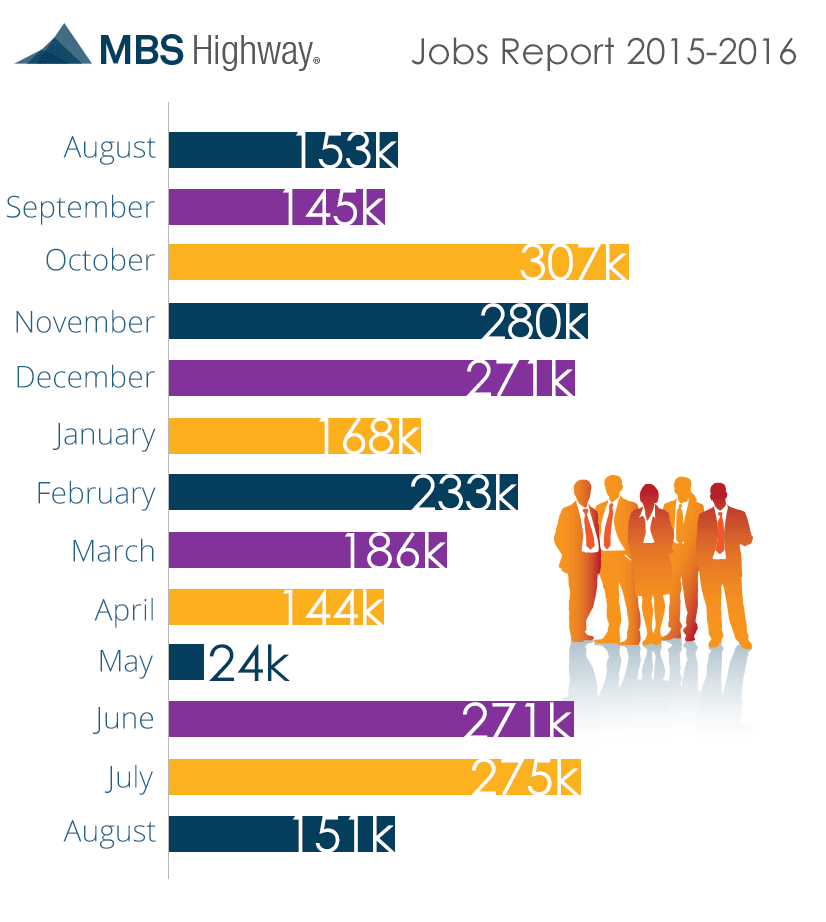
The Fed is scheduled to meet on September 20th-21st.  Currently the markets believe there is a 15% chance that the Fed will hike short-term interest rates at this meeting. Friday’s jobs report showed that ~151,000 new jobs were created in August which is slightly softer than the previous couple months making it more likely the Fed will not hike.

Jobs-Report-9-2-2016

As Barry Habib of MBShighway.com perceptively pointed out earlier today, the Fed is unlikely to hike short-term rates at this upcoming meeting because the London Interbank Offered Rate (AKA “LIBOR”) is scheduled to reset on Sept. 29th.  If the Fed hikes short-term rates on the 21st then the LIBOR would likely reset +.25% higher and there are literally billions of dollars of mortgages tied to LIBOR around the world.  I think the Fed will wait until December to hike.

What I am certain of is that you will hear a lot of analysis on this topic over the next two weeks.

Current Outlook: neutral

Mortgage Rate Update August 22, 2016

Housekeeping:Rate Update’ will be on vacation for the remainder of August.  Look for the next ‘rate update’ to take place after Labor Day.

Mortgage rates are unchanged from last Thursday.

This week’s economic calendar is relatively light which is fitting given that we are in the “dog days of summer”.  What will be closely watched is the Jackson Hole Symposium.

Every year since 1978 the Federal Reserve Bank of Kansas City has hosted an annual economic policy symposium where central bankers from around the world fly in to focus on various economic topics.  Sounds fun, right?

The most anticipated speech will come Friday when Fed Chairwoman Janet Yellen will speak.  As I wrote about on Thursday the Fed is currently at odds as to whether to hike short-term interest rates now or later.

Scenic Jackson Hole, Wyoming will play host to central bankers from around the globe this week.  Fed Chairwoman Janet Yellen is slated to deliver a much anticipated speech this Friday.
Scenic Jackson Hole, Wyoming will play host to central bankers from around the globe this week. Fed Chairwoman Janet Yellen is slated to deliver a much anticipated speech this Friday.

The US economy has shown strong job growth each of the past two months.  Furthermore, inflationary pressure has been picking up especially looking at the Consumer Price Index (CPI) which takes into account housing costs.  One problem with the Fed’s preferred gauge of inflation, called the PCE, is that it does not include housing in its basket of goods.

If Yellen sounds “hawkish” in her comments this Friday it will be interesting to see how the markets react.  Intuitively you might think mortgage rates will suffer if she hints at a rate hike.  However, the Fed does not directly control mortgage rates.  I wouldn’t be surprised to see US stocks falter which could help mortgage rates move modestly lower.

Current Outlook: floating

Mortgage Rate Update August 18, 2016

Mortgage rates are unchanged from Monday.

Yesterday minutes from the last Fed meeting were released.  They indicated that a some on the monetary policy committee believes the timing is ripe for another rate hike.  These “hawks” cite a strong labor market and steady economic growth.

Fed "hawks" are pushing Fed "doves" to hike rates again soon.
Fed “hawks” are pushing Fed “doves” to hike rates again soon.

However, the “doves”, those on the committee who are not ready to hike (including Janet Yellen), would like to see more inflationary pressure before they hike.  Market odds believe there is a 50% chance the Fed will hike at one of the next three meetings (September, October, and December).

The remainder of this week’s economic calendar is quiet.  As I wrote about on Monday (see HERE) the technical picture for mortgage-backed bonds (MBS) remains potentially volatile.  For now MBS prices are trading in our favor but that could change quickly so caution is advised.

I am going to switch to a floating position for now.

Current Outlook: floating

Mortgage Rate Update August 15, 2016

Mortgage rates are mostly unchanged from last Thursday although pricing is a touch worse at the same note rates.

Technical trading patterns are what I am most interested in to start the week.  They are also the most difficult to convey in a written format.  Below is a chart of mortgage-backed bond (MBS) trading.

Portland mortgage broker 8-15-16

MBS’s are currently trading above the 25-day moving average which is a good sign for mortgage rates.  And we need ot be careful because the range of MBS prices are trading in a tighter and tighter range which opens up the possibility of a “breakout”.  A breakout occurs when prices move sharply higher or lower.  Should MBS’s breakout lower it would be a bad signal for mortgage rates.

It’s an interesting week on the economic calendar.  Tomorrow the Labor Department will release its latest reading on the Consumer Price Index (CPI).  With the labor market at or near “full employment” the Fed is almost solely waiting on convincing inflationary numbers before they re-engage in rate hikes.  If the CPI is +2.0% or more on a year-over-year basis then it would make it more likely that the Fed will hike in December.

Speaking of the Fed, the minutes from their last monetary policy meeting will be released on Wednesday and their comments can always move the markets.

Current Outlook: locking bias

Mortgage Rate Update August 11, 2016

Mortgage rates are slightly improved from Monday.

Interest rates here in the US remain near historic lows at the same time as our stock markets hover at all-time highs.  I wrote about this unique relationship HERE.  Normally when stocks rally it is at the expense of interest rates but given the challenges overseas the US remains a safe-haven.

Consider this, an investor who wishes to have the “safety” of buying bonds (in effect lending the US government money) the current yield on the 10-year treasury note is ~1.54%.  Or, they could invest in the 30 stocks in the Dow Jones Industrial Average and earn annual dividends of ~2.78%.  Historically bond yields tend to be higher than dividend yields because the equity investor also gets the prospect of stock price appreciation whereas the bond investor is “guaranteed” a return of principal in the future.

Dividends Word Meaning Stock Market And Incomes

The fact that stock dividends are presently higher than bond yields suggests that investors don’t foresee much stock price appreciation in the near-term and/ or believe interest rates will potentially go lower in the future (in which case they could sell their bonds yield 1.54% at a premium).

From a technical perspective US interest rates are treading gingerly at a significant level of support.  Should today’s $15 billion US treasury 30-year bond auction be met with weak foreign demand I anticipate mortgage rates could worsen slightly.  I recommend locking to play it safe.

Current Outlook: locking bias