Mortgage Rate Update November 23, 2015

Mortgage rates are unchanged from last week.

Let’s start off the week with some housing news.  The National Association of Realtors released its existing home sales for October.  The headline number of existing home sales fell from September but remains ~4% above October 2014.  Within the report there are some interesting details.

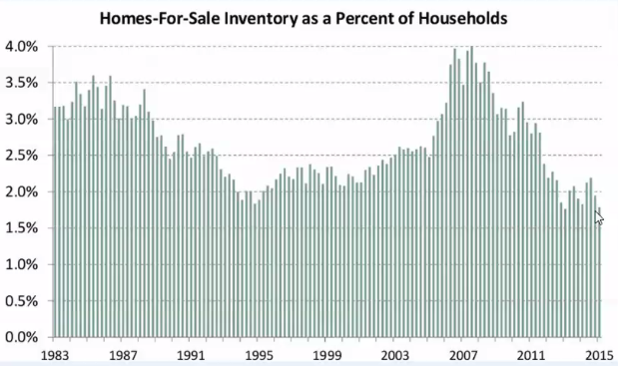
The inventory level for homes remains tight.  As a percentage of US households only 1.75% of the housing stock is currently available for sale.  This is well below the historic average of ~2.6%.  A tight supply is one main reason why prices continue to rise.  Speaking of prices rising, the median home price in the Western Region increased by 8% from a year ago.
Source: mbshighway.com

First time homebuyers accounted for 31% of all purchases, up from 29% in September.  Conversely, the number of distressed sales (foreclosure or short sale) declined and currently are 9% below October 2014.

The remainder of this compact work week is jammed with significant economic data.  Tomorrow we’ll get the second estimate for third quarter GDP and the latest S&P Case Shiller Home Price Index report.  On Wednesday we’ll get personal income, personal consumption expenditure price index, the FHFA home price index, durable goods, and new home sales.  Needless to say we could see volatility for the remainder of the week especially since many trading desks will likely be vacant on Wednesday.

From a technical perspective mortgage rates are trading near important technical levels.  We will want to keep an eye on the US 10-year treasury yield this week.  It is currently trading at 2.27%.  Should it pierce above 2.33% I will shift to a locking position.

Current Outlook: floating as long as the US 10-year treasury is at or below 2.33%.

Mortgage Rate Update September 28, 2015

Mortgage rates are essentially unchanged at 2015 lows.

US interest rates continue to benefit from investors who are concerned about the global economy.  China’s economy is weakening and conditions in Europe are struggling to improve.  As a result commodity prices are at multi-year lows and currencies for emerging markets have softened.  When global uncertainty is on the rise it creates demand for US-denominated “safe” assets and reduces yields.  In fact, according to Lipper, a fund tracking company, US based mutual funds focused on treasury securities are on track to draw the most inflow of capital this year since 2009.

Global Uncertainty is driving yields lower in the US.

The economic calendar is very busy this week.  Earlier today we got a reading on inflation and pending home sales.  The Core Personal Consumption Expenditure price index increased by only .1% last month and is up only 1.3% from last year.  The Fed’s target is 2% for this index and therefore price pressure remains well below the levels they’d like to see.

According to the National Association of Realtors pending home sales fell by 1.4% last month on a year over year basis.  Higher prices and tighter inventory continue to weigh on the number of transactions.

On Tuesday we’ll get the latest Case-Shiller home price index report and on Friday we get the all-important jobs report.  I will focus on that report in Thursday’s update.

From a technical perspective mortgage-backed bond prices are trading at recent highs.  I think borrowers have more to lose than to gain so will maintain a locking bias.

Current Outlook: locking bias

Mortgage Rate Update July 13, 2015

Mortgage rates are slightly higher across the board this morning on news that Greece and its creditors have reached a bailout agreement.

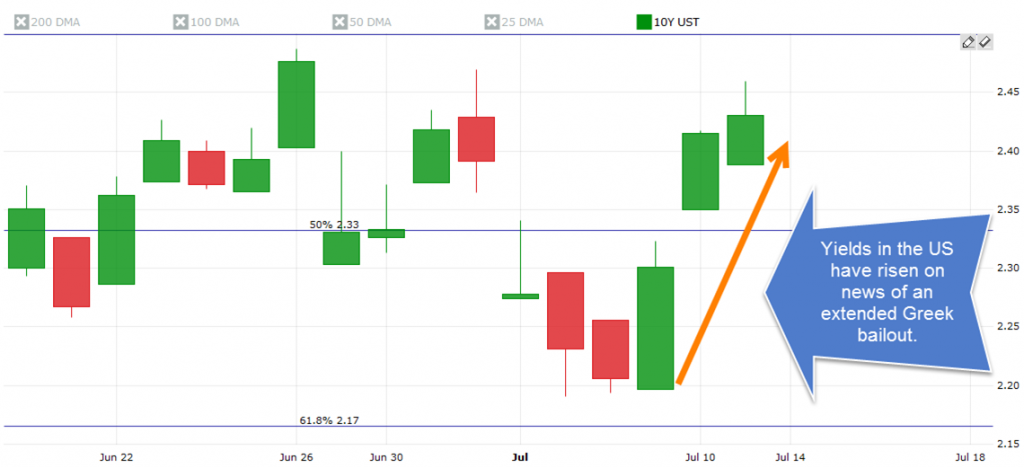
Earlier today it was announced that Greece has agreed to terms for an €86 billion bailout.  Greece will have to implement a series of austerity measures which will be tricky given that last Sunday Greek citizens voted down a referendum with similar terms.  For now, interest rates in the US have risen on the news given that there is less fear and uncertainty surrounding the situation.

The yield on the US 10-year treasury note has risen to ~2.45%, up from only ~2.2% at the beginning of last week.  Mortgage rates tend to change along with the US 10-year treasury note.

07-13-15US 10yr

The economic calendar is very busy this week.  The highlights include Retail Sales (Tuesday), Producer Price Index (Wednesday), Consumer Price Index (Friday), and congressional testimony from Fed Chairwoman Janet Yellen.

From a technical perspective interest rates are presently at the higher end of the trading range they’ve been bound in for the past month or so.  Assuming these technical levels hold we would recommend floating.  However, with a Greek bailout deal in place we run the risk of rates moving higher.

Current Outlook: cautiously floating