Mortgage Rate Update October 29, 2015

Mortgage rates have worsened modestly following the release of the Fed’s monetary policy statement.

As was expected the Fed left short-term rates unchanged but their comments were unfriendly to mortgage rates.  Given the recent turmoil stemming from the Chinese economy many analysts had predicted that the Fed would wait until Q1 2016 to begin their rate hikes.  In fact, prior to the Fed’s announcement the markets had a assigned a ~33% chance for a rate hike in December.  Now the probability is ~50%.

10-29 -US 10yr

It will be interesting to see what happens from now until the next Fed meeting which is scheduled for mid-December.  By the time the Fed meets we will have received two more monthly jobs reports.  Assuming the November and December job reports are healthy it will become increasingly likely that the Fed will move to hike in December.  If not, then they will be forced to wait.

Speaking of jobs, this week’s jobless claims numbers were relatively strong.  This marks four straight weeks of healthy claims figures which you would think will translate into strong jobs reports.

For now, I will shift to a locking bias as the technical trading patterns do not look favorable for mortgage rates in the near-term.

Current Outlook: locking

Mortgage Rate Update October 26, 2015

Mortgage rates remain unchanged.

Despite a rally in the stock market during the month of October mortgage rates have essentially remained flat.  The S&P 500 index hit a recent low of ~1,880 back on September 28th.  Since then the index has increased by 10%.  Normally we would expect mortgage rates to worsen when stocks strengthen but that has not been the case.

10-26-15 SP500

From a technical perspective US stocks look overbought which means we may see them reverse and move lower in the near-term.  That said, since mortgage rates didn’t worsen while stocks accelerated I don’t necessarily think they will improve if stocks do decline.

There’s a lot going on this week in the financial markets.  The Fed is scheduled to meet Tuesday-Wednesday.  It is not expected that the Fed will raise rates at this meeting but as always the wording in their monetary policy statement can always create volatility.

After a blockbuster report in August new home sales softened in September.  In other housing news the Case-Shiller Home Price Index is scheduled to be released on Tuesday and pending home sales on Thursday.

Lastly, we’ll get a look at personal income and the Personal Consumption Expenditure price index on Thursday.  We expect inflationary pressure to remain tame which is good for mortgage rates.

Current Outlook: floating

Mortgage Rate Update October 22, 2015

Mortgage rates are unchanged for the week.

Although there are a lot of story-lines buzzing around nothing seems to be making a meaningful impact in the interest rate markets.

Earlier today European Central Bank (ECB) President Mario Draghi made comments which are leading the markets to believe that the ECB may engage in further monetary stimulus.  The news is helping lift stock markets both here and across the Atlantic.

Existing Home Sales were strong across the US in September.

According to the National Association of Realtors existing home sales rose in September by a sharper than anticipated clip.  The report showed that on an annualized basis the US saw 5.55 million homes sale in September.  Tight supply continues to support prices across the country.  Median home prices in the western region of the report increased by 8.0% on a year-over-year basis.

From a technical perspective interest rates maintain at the best levels of the year.  I will maintain a locking bias.

Current Outlook: locking

Mortgage Rate Update October 19, 2015

Mortgage rates are unchanged from last week.

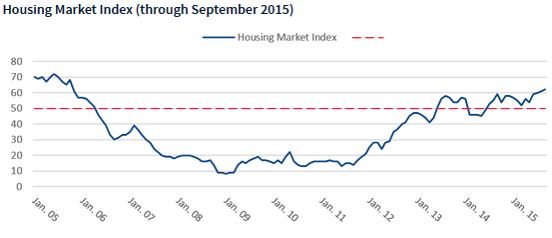
The economic calendar is full of housing related news this week.  Earlier today the National Association of Home Builders reported that their housing market index hit a 10-year high for October.

Source: National Association of Home Builders

Depending on who you ask this can be good news or bad news.  At least for the immediate term this is a positive sign.  That said, home builders tend to be the “last ones to the party” so this could be a signal that the run in housing will run out of steam.

Tomorrow we’ll see the latest numbers for building permits and housing starts.  Lastly, on Thursday we’ll see the Federal Housing Finance Agency Housing Price Index and existing home sales.

From a technical perspective mortgage rates look vulnerable to worsening (modestly) over the next couple days.  However, longer-term the rate environment looks promising.

Current Outlook: locking

Mortgage Rate Update October 15, 2015

Mortgage rates continue to trade sideways.

We know that the Fed is waiting for signs of inflation before they proceed with raising short-term interest rates.  So will inflation begin to rear it’s head anytime soon?

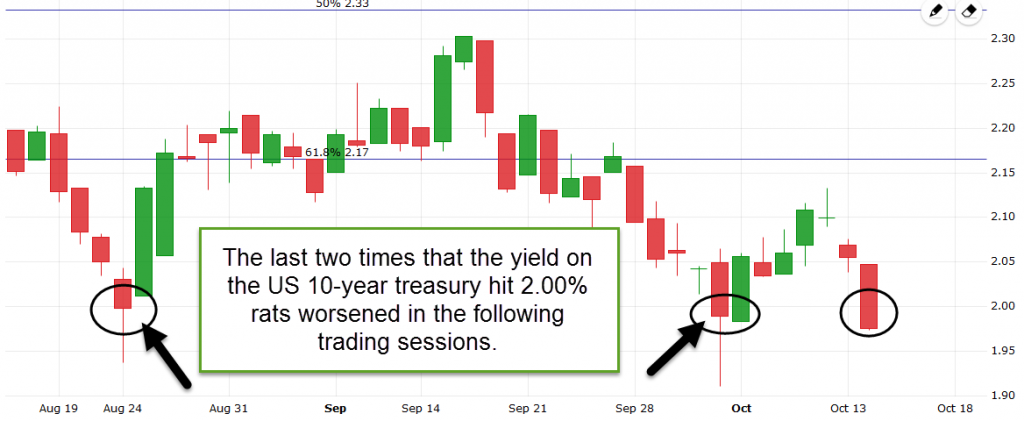
Yesterday, the Producer Price Index (PPI), which reports on price pressure in the wholesale/ manufacturing level of our economy, was tepid.  When you strip out volatile food & energy prices the core PPI increased by only .8% year-over-year.  Following the release of the report the yield on the US 10-year treasury note fell to 1.98%.

10-15-15 10yr

Today, the Consumer Price Index (CPI), which reports on price pressure at the retail level of the economy, was a little livelier but still below the Fed’s target of 2.00%.  The headline CPI figure fell by .2% from last month.  When you strip out volatile food and energy prices year-over-year prices increased by 1.9%.  On a side note, based on the results in this report social security recipients will not be receiving a cost of living adjustment for 2016 (this is only the third time in the past 40 years this has happened).

From a technical perspective rates now look vulnerable to a modest increase.  The last two times that the yield on the US 10-year touched 2.00% o below they moved higher in the following trading sessions.

Current Outlook: locking

Mortgage Rate Update October 13, 2015

Mortgage rates are unchanged to start the week.  The bond market was closed yesterday in recognition of Columbus Day.  Stocks did trade on Monday but were mostly flat.

Global influences continue to support a low interest rate environment here in the US.  A report out of China today showed that both imports and exports decreased in the world’s 2nd largest economy.  In Germany a survey of sentiment dropped substantially potentially signalling continued weakness in the Eurozone.  Bad news for the global economy tends to drive rates lower here at home.

Global weakness continues to support low rates in the US.

The economic calendar here in the US is fairly busy this week.  On Wednesday we’ll get the Producer Price Index and Retail Sales, on Thursday we’ll get the latest reading on the Consumer Price Index, and on Friday consumer sentiment and industrial production.  As we know inflation is a hot topic because it’s the missing ingredient for the Fed to begin raising short-term rates.

From a technical perspective interest rates look like they could improve modestly although we can’t lose sight of the fact that we’re presently at 2015 low levels.  I will switch to a floating bias.

Current Outlook: floating bias

Mortgage Rate Update October 8, 2015

Mortgage rates have been basically flat all week.

It’s been a fairly quiet week on Wall Street.  That may end today as the markets are eagerly awaiting minutes from the most recent Fed meeting.  We already know that the Fed elected not to raise short-term interest rates but their comments during the meeting may provide clues as to when they intend to.  Currently the markets assign a 64% chance that the Fed will raise short-term interest rates at the Dec. 15-16th meeting.

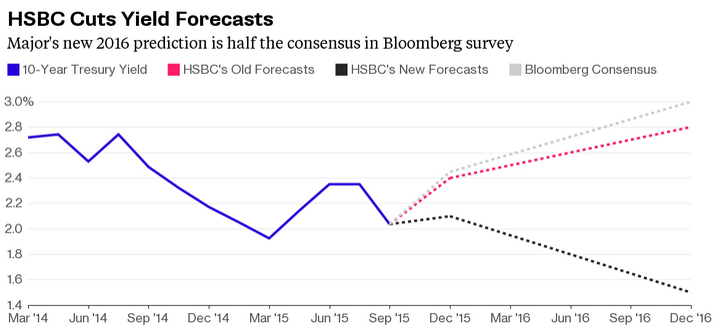
Meanwhile analysts at HSBC bank have cut their yield projections for 2016.  Previously they had forecast that the yield on the US 10-year treasury would increase to 2.8% by December 2016.  They adjusted their outlook lower to 1.5%.  The yield on the US 10-year treasury is currently 2.08%.  Mortgage rates tend to track changes in the yield of the US 10-year treasury note.

Source: Bloomberg.com

We may see some volatility following the release of the minutes from the last Fed meeting.  Recent releases have not been kind to interest rates so I will maintain a locking bias.

Current Outlook: locking bias

Mortgage Rate Update October 5, 2015

In last Thursday’s ‘rate update’ I recommended floating into Friday’s jobs report and that proved to be the right call.  Mortgage rates improved by ~.125% following a weaker than expected employment report.

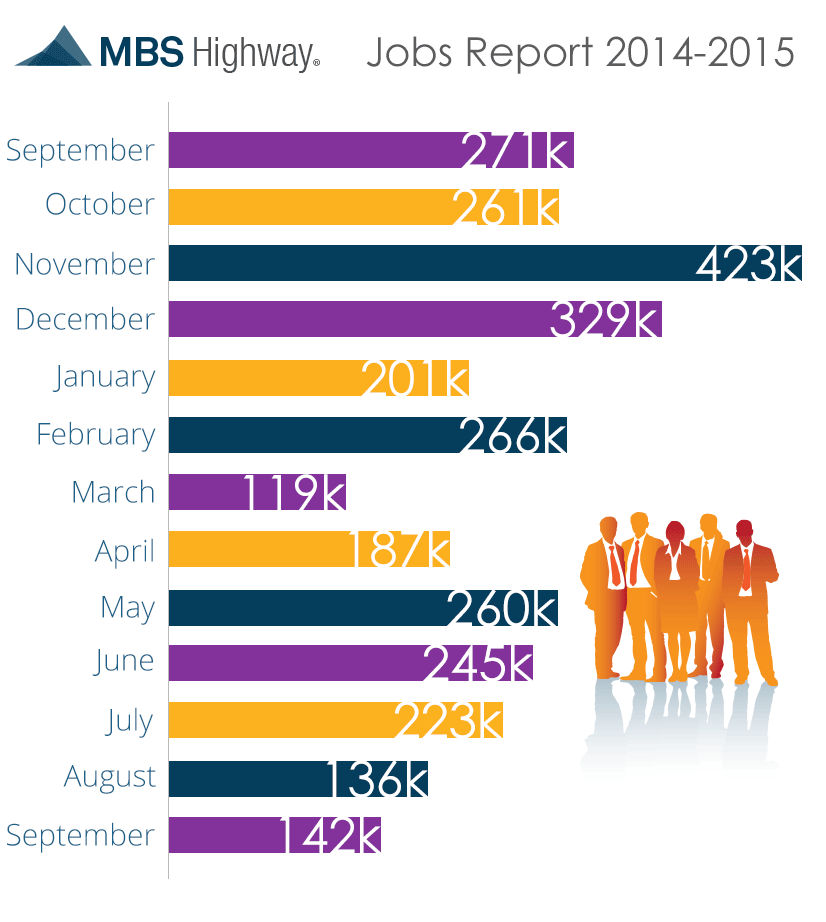
In case you missed it the Labor Department reported that only 142,000 new jobs were created in September.  Four of the past months have shown job growth below 200,000 and for the past two months below 150,000.  Bad news for the economy is often good news for mortgage rates.

jobs-report-10-2-15

The average hourly earnings declined modestly and was 2.2% higher than a year earlier.  As I wrote about last Thursday the Fed is looking for wages to grow as a signal to begin raising short-term interest rates.

Looking ahead this week the economic calendar is relatively light.  The biggest highlight comes on Thursday when minutes from the last Fed meeting are released.  It will be interesting to see what the Fed is thinking with regard to a timeline for hiking rates.  That said, their previous meeting was prior to Friday’s disappointing jobs report so it’s likely their viewpoint has shifted since.

From a technical perspective mortgage-backed bonds are trading up against technical resistance which means mortgage rates may be as good as they will be in the near-term.  Indeed rates are back at 2015 lows.  I will recommend locking.

Current Outlook: locking bias

Mortgage Rate Update October 1, 2015

Mortgage note rates are unchanged today but the accompanying closing costs are slightly less so in fact the overall rate environment has improved modestly this week.

Attention in the financial markets is squarely focused on tomorrow’s all-important jobs report.  If you’ll remember back to last month new job creation came in at 173,000 which was below expectations.  Normally the interest rate markets are mainly concerned with the number of new jobs created yet there is another factor in the report that could prove more influential this time around.

I expect that mortgage rates could react to the average hourly earnings section in the jobs report.  As I’ve repeatedly written over the past couple months the Fed is searching for any sign of inflation which could give them president to raise short-term rates.  Market expectations are for average hourly earnings to increase by +.2%.  A result north of .2% would likely pressure mortgage rates higher and vice versa.

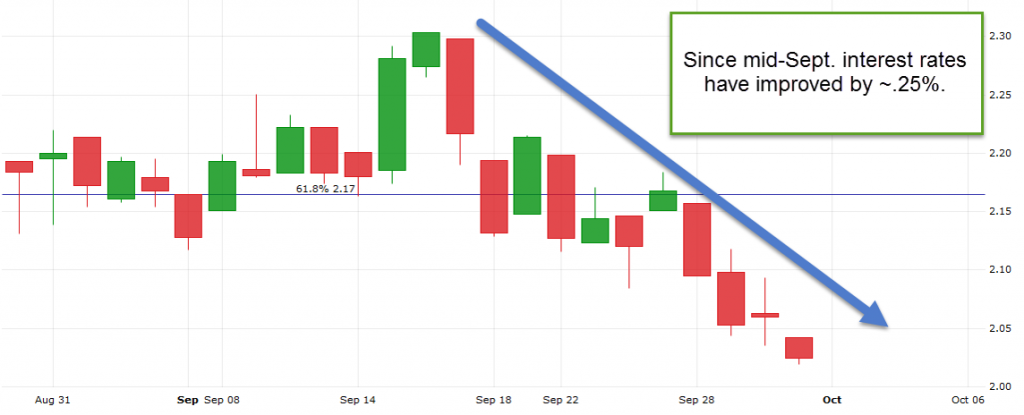
10-01-10yr

From a technical perspective interest rates have momentum on their side.  Since mid-September the yield on the US 10-year treasury note, which mortgage rates loosely follow, have fallen from ~2.30% to ~2.03%.  Over that time mortgage rates have improved by .125%-.25%.

The jobs report is always very difficult to handicap therefore I am going to recommend a floating bias based on the technical signals in the market.

Current Outlook: floating bias

Mortgage Rate Update September 28, 2015

Mortgage rates are essentially unchanged at 2015 lows.

US interest rates continue to benefit from investors who are concerned about the global economy.  China’s economy is weakening and conditions in Europe are struggling to improve.  As a result commodity prices are at multi-year lows and currencies for emerging markets have softened.  When global uncertainty is on the rise it creates demand for US-denominated “safe” assets and reduces yields.  In fact, according to Lipper, a fund tracking company, US based mutual funds focused on treasury securities are on track to draw the most inflow of capital this year since 2009.

Global Uncertainty is driving yields lower in the US.

The economic calendar is very busy this week.  Earlier today we got a reading on inflation and pending home sales.  The Core Personal Consumption Expenditure price index increased by only .1% last month and is up only 1.3% from last year.  The Fed’s target is 2% for this index and therefore price pressure remains well below the levels they’d like to see.

According to the National Association of Realtors pending home sales fell by 1.4% last month on a year over year basis.  Higher prices and tighter inventory continue to weigh on the number of transactions.

On Tuesday we’ll get the latest Case-Shiller home price index report and on Friday we get the all-important jobs report.  I will focus on that report in Thursday’s update.

From a technical perspective mortgage-backed bond prices are trading at recent highs.  I think borrowers have more to lose than to gain so will maintain a locking bias.

Current Outlook: locking bias