Italy is best with friends!

Rizioni

A week has passed already and as they say… time flies when you are having fun. We have been fortunate to see Italy though an intimate lens thanks to our dear Italian friends Edoardo and Odile.

The week began, just outside of Venice in Odile’s home town of Mogilano. We were fortunate to meet Odile’s family who shared their home with us for most of our time in Italy. We spent a half day in Venice roaming the streets amongst the mass of “touristas”, with Odile as our guide. We lunched with a friend of Edoardo’s, a resident of Venice in his home (built in the 1500’s) near the grand canal. By night we did the “Bacari” tour which involves hopping from one bar to the next and having a bite and a glass at each stop. That evening Jet-lag-ed and wined we slept like babies.

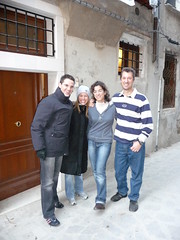
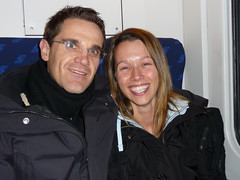
Edorado, Odile, Letta and Ivan

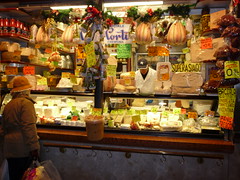
The following day we visited Padova, the university town where Edoardo and Odile met. Edoardo shared stories of shenanigans he and his friends pulled and Edoardo and Odile reminisced upon their first date and favorite college memories. We roamed the streets and saw some of the most amazing food markets I have ever seen. In experiencing the markets you can understand why food is such a part of the culture in Italy. Little did we know our culinary tour had only just begun.
Formaggi

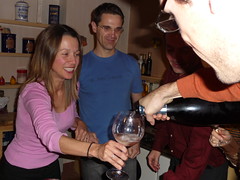
We spent New Year’s eve with some friends of Edoardo’s from his university days in a quintessential Italian villa in the hills near Tiene. The evening was complete with course after course of homemade Italian dishes, kids, fireworks, “disco inferno”, dancing, several inches of snow and of course prosecco, prosecco and more prosecco.

P1000241

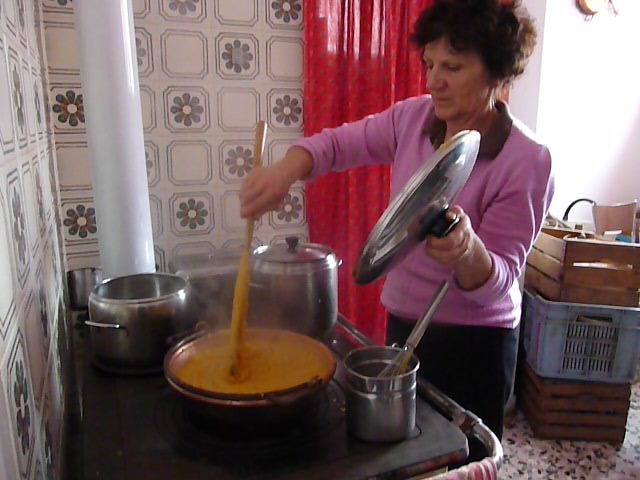
Cavizzanna was our next stop, a tiny village nestled in the Val di Sol “Sun Valley” on the edge of the Dolomites (fitting for this Idaho girl). The village of Cavizzanna was where Edoardo grew up and where Edoardo and Odile were married. We spent two days with the Rizzi family and feasted on food that Edoardo’s mother prepared. The food was amazing most of which was harvested from the land nearby including the apple orchards that Edoardo worked as a young boy. The highlight for Tina was the making of homemade Polenta on a wood burning stove.

P1000274

We have said good-bye to our Italian friends for now and will head to Spain tomorrow. It has been a wonderful adventure so far and has been so because we have been among friends. We have them to thank for the experiences and memories that we have gained thus far. Ciao Italy!

See more photos here and here.

Arrived in Italy….the adventure begins!

After a long couple days and of traveling which took us from PDX to LAX to London-Heathrow to Rome to Treviso, Italy we have finally met up with our friends Odile and Edoardo.  We will spend the next few days with them before heading onto Barcelona.  We are currently in Odile’s hometown of Mogliano which is just outside of Venice (Venezia).

We wil be staying with Odile’s sister (Sara) and her family.  We have also met Odile’s parents who are very welcoming.

This afternoon we are heading into Venice to enjoy lunch with one of their friends as well as partake in bacari which is where we travel from bar to bar drinking wine and eating small plates.  It should be a blast.

We’re still trying to figure out internet access so the updates may be few and far between for now.

Evan’s 6-month sabbatical!

For those who haven’t heard the story before, it’s worth retelling:

After graduating from Linfield College, I set out to travel the world for a few months. I started in Seoul, South Korea, and gradually made my way to China. From China, I rode the Trans-Mongolian railway from Beijing to Moscow via Mongolia and Siberia. From Moscow, I traveled west through Eastern Europe into Poland, Austria, Italy, and into Southern France.

It was in a small town called La Ciotat that I went to stay with a college friend who was living there teaching English. It was that weekend that changed my life forever.

It just so happened that my friend’s college roommate was staying with her on the weekend that I arrived. Over $5 bottles of Bordeaux wine and fresh seafood, I had met my future wife. And the rest is history….

So what is the point of this story? The point is to illustrate that embedded in my wife and me is a desire to travel and experience new places.

On that note, I’ve announced that my wife and I are taking a six-month sabbatical beginning on December 28, 2008, returning June 24, 2009. Over the course of the next six months, my wife and I will spend time in Italy, Spain, Portugal, Sweden, but the bulk of our time will be in New Zealand.

Our plan to take an extended trip has been in the works for a couple of years, and we are very excited to finally realize the experience.

That said, I have taken steps in the office to ensure that in my absence the professionalism, expertise, and proactive service that you’ve come to expect from the Swanson & Johnston Lending Team will persist.

Aaron and I have worked closely over the past four years so that he would be ready to assume the responsibility of my desk during this time. I am very confident that he will do a great job. In fact, he and I have joked that, upon my return, I may find that the loyalties of my valued past clients and professional partners have shifted to him because of the extraordinary care he will have displayed while I am abroad.

So don’t be surprised to hear from Aaron over the course of the next few months. If you have questions about your mortgage, potentially refinancing, or buying a new home, do not hesitate to contact him. Furthermore, I would encourage you to refer your colleagues, friends, and family directly to Aaron while I’m away. His contact information is shown here:

Aaron Johnston

Office: 503.282.5626 xt. 413

email: aaron@mortgage-trust.com

Thank you for your support!

Heilbroner’s “The Worldly Philosophers”

My passion for economics was ignited in college thanks to my favorite professor Randy Grant (no disrespect to Jeff Summers because he was also a major influence).  For some reason economics was the one subject that made sense to me, almost as if it were intuitive.

Of all the great economics classes that Linfield had to offer two stood out as my favorites.  My favorite was environmental economics because of the interesting problems the subject posed (i.e externalities, individual vs. social cost-benefit analysis, free loading, etc.).

However, my second favorite economics class was, “This Evolution of Economic Thought”.  It was taught by Randy who later re-wrote the text with his doctoral professor Stanley Brue (if this is any indication as to what a dork I am I actually bought this text for myself for my 28th birthday).  It may also have been that this was my favorite class because it had the least intimidating final (trivial pursuit with economics questions).

That said, when Robert L. Heilbroner’s, “The Worldly Philosophers: The Lives, Times, and Ideas of the Great Economic Thinkers” was given to me as a gift for Christmas in 2007 I was excited to read it.  However, even given my excitement I didn’t manage to pick it up until Thanksgiving 2008.  But, once I picked it up I couldn’t put it down.

Economics is such an interesting science.  It is arguably one of the youngest sciences on the planet and therefore the history is very recent.  What I found most intriguing about Heilbroner’s account about the history of economic thought is how he associated the environmental impacts of his subject’s contributions to economic thought.

For example, in describing the contributions of Karl Marx he created the context under which Marx developed his philosophy (i.e. industrial revolution, exploitation of labor, etc.).

Second, Heilbroner dedicates a relatively large proportion of his book to lesser known “underground” economists who made important but somehow less noteworthy contributions to the subject of economics.

If you enjoy economics this is a great read.  If not, don’t bother.

Here are my notes:

*When times are tough people come together:

“…when the specter of starvation can look a community in the face…the pure need to secure its own existence pushes society to the cooperative completion of its daily labors.”

*During medieval times economics as a science could very well have been established.  However, as Heilbroner explains,

“…it had not yet conceived the abstract elements of production itself.  Lacking land, labor, and capital, the Middle Ages lacked the market…”

*During the middle ages the process of “enclosure” (privatizing of land for the purpose of raising sheep) caused land to be regarded as a valuable which is an important step in the concept of scarcity and the marketplace.

*Adam Smith wrote with a lot of humor in compiling the index of his The Wealth of Nations.

*Adam Smith’s most notable contribution from The Wealth of Nations:

“What he sought was, ‘the invisible hand,’ as he called it, whereby, ‘the private interests and passions of men’ are led in the direction ‘which is most agreeable to the interest of the whole society.”

*Great economists see society as an evolving process:

“To Smith and the great economists who followed him, society is not conceived as a static achievement of mankind which will go on reproducing itself, unchanged and unchanging, from one generation to the next.  On the contrary, society is seen as an organism that has its own life history.”

*Adam Smith believed that wealth accumulation was good because of the positive impact on society.

*Although many people believe that Adam Smith’s laissez-faire doctrine means that he was universally opposed to government intervention this is not necessarily the case.  Here is a quote from Smith:

“the understandings of the greater part of men are necessarily formed in their employments.  The man whose whole life is spent performing a few simple operations…generally becomes as stupid and ignorant as it is possible for a human creature to become unless the government takes some pains to prevent it.”

*However, Heilbroner goes on to write that Smith thought:

“The market must be left free to find its own natural levels of prices and wages and profits and production; whatever interferes with the market does so only at the expense of the true wealth of the nation.”

*Heilbroner writing about Thomas Malthus:

“For what the essay on population said was that there was a tendency in nature for population to outstrip all possible means of subsistence.”

*David Ricardo also had a negative outlook on natural developments in a market economy.  He felt that the interests of landlords ,”always opposed …the interest of every other class in the community…”

*David Ricardo was a gifted businessman.  Much like a modern day value investor:

“Sir John Bowring later declared that Ricardo’s success was based upon his observation that people in general exaggerated the importance of events.”

*According to Heilbroner, Ricardo’s biggest contribution to economic thought was the tool of abstraction.  By thinking of land, labor, and capital as abstract items economists were later able to build economic models.

*Utopian Robert Owen recognized the impact that a person’s environment can have on their behavior:

“…Owen was convinced that mankind was no better than its environment and that if that environment was changed, a real paradise on earth might be achieved.”

*In John Stuart Mill‘s text Principles of Political Economy he points out that the true province of economic law is production and not distribution.  He goes to associate laws of production as natural laws.

*In Karl Marx‘s Manifesto he differed from previous economic thinkers in that he saw communism as a logical conclusion to the developments in the economy rather than being a matter brought upon society as a choice.

*While writing about Marx and theories of economic fluctuations Heilbroner delivers this brilliant paragraph:

“A crisis does not mean the end of the game.  Quite the contrary….each crisis serves to renew the capacity of the system to expand.  Crisis-or a business slump or recession, in modern terminology-is therefore the way the system works, not they way it fails.”

*Critics of Marx later discovered that he made a major mathematical mistake in equating labor value & price.  As a result, he concluded that communism was eminent in his model.  In retrospect this is easy to dismiss as inaccurate.

*Following Marx economists began to focus their studies on more detailed aspects of the economics (i.e supply and demand, marginal utility) instead of the broad-based macro-view that previous economists had taken.

*Francis Edgeworth described humans as pleasure machines.  For him economics was defined to be,

“…the study of human pleasure-mechanisms competing for shares of society’s stock of pleasure…”

*Coincidentally, Heilbroner wrote this paragraph about Henry George‘s view on property speculation that sounds dangerously similar to today’s economic reality in the US (interesting to note that Henry George lived in California which is one of the hardest hit by the recent housing downturn):

“George was convinced that rent led inevitably to wild speculation in land values and just as inevitably to an eventual collapse which would bring the rest of the structure of prices tumbling down beside it.”

*Many critics of the Iraqi War have speculated that the source of US aggression was more about economic interests than threats to our freedom.  John Hobson probably would have agreed.  Here is Heilbroner on Hobson:

“Imperialism thus paves the way to war-not by swashbuckling adventures or high tragedy, but through a sordid process in which capitalist nations compete for outlets for their unemployed wealth.”

*Alfred Marshall‘s famous description of supply and demand (arguably his greatest contribution) per Heilbroner:

“Neither cost nor utility…could ever be quite divorced from the determination of price; demand and supply…were like ‘the blades of a pair of scissors,’ and it was as fruitless to ask whether the upper or lower blade of the scissors did all the cutting.”

*Two additional contributions from Marshall-  First, he believed an economy ultimately rested on the decisions of the individual.  This was a major shift in perspective.  Second, he did not focus on political influences.  He saw economics being independent of political influence.

*Heilbroner writing about the stock market crash of 1929- does his description bear any resemblance to the housing market today?:

“In retrospect it was inevitable.  The stock market had been built on a honeycomb of loans that could bear just so much strain and no more.  And more than that, there were shaky timbers and rotten wood in the foundation which propped up the magnificent show of prosperity.”

“And then there was the fact that the average American had used his prosperity in a suicidal way; he had mortgaged himself up to his neck, had extended his resources dangerously under the temptation of installment buying, and then had ensured his fate by eagerly buying fantastic quantities of stock- some 300 million shares…on margin.”

*During World War I John Maynard Keynes worked for the British Treasury in the area of foreign finances.  As a testament to his brilliance it was said:

“…men of ripe judgment have declared that Keynes contributed more to winning the war than any other person in civil life.”

*One of Keynes’s major contribution was his recipe for government spending during times of depression to help stimulate the economy.

*Joseph Schumpeter coined the term “entrepreneur” and saw their innovating activity as the source of profit in the capitalist system.

*Interestingly, Schumpeter agreed with Marx in that they shared the view that capitalist economies are bound to eventually fail.  However, they disagree on the path under which this occurs.  For Marx the process took place because of the collective uprising of the working class.  For Schumpeter it occurs because as the economy grows large corporations are erected.  Over time, the values of entrepreneurship and innovation (which create economic growth) are replaced with bureaucratic management.

*Heilbroner writing about Schumpeter’s view that economic analysis is subjective (hence, a person’s environment impacts their economic views):

“There is a ‘preanalytic’ process that proceeds our logical scenarios, a process from which we cannot escape, and which is inescapably colored with our innermost values and preferences.”

Thomas Friedman’s “Hot, Flat, and Crowded”

I was introduced to Thomas Friedman as a senior at Linfield College.  My finance professor invited a guest speaker in for a lecture.  I don’t remember who the speaker was or what the topic of the lecture either but I do remember he was raving about a book he had recently read entitled, The Lexus and the Olive Tree.  He recommended that we all read it so I picked it up.

With that book I came to appreciate Friedman’s ability to evaluate complex conditions from a “10,000 foot view”.  This is probably most evident in his book The World is Flat.  Each of these two books ends with somewhat of pessimistic conclusion that sounds much like a doctor telling a patient about their fatal illness that has little or no chance of healing.

This pessimism is absent in his newest release entitled Hot, Flat, and Crowded-Why We Need a Green Revolution and How it Can Renew America.  Instead, Friedman not only accesses the ills that face our environment but also recognizes the opportunity that the US has to lead the world in innovation and a more sustainable way of life.

Here are my notes:

*Friedman argues that the US has effectively become fat and lazy:

“In some ways, the subprime mortgage mess and housing crisis are metaphors for what has come over America in recent years: A certain connection between hard work, achievement, and accountability has been broken.  We’ve become a subprime nation that thinks it can just borrow its way to prosperity……”

*Friedman argues that as a nation we seem to think less about the collective national interest.  Furthermore, we fail to think long-term in a lot of areas.

*In the wake of ’73-’74 oil embargo we didn’t invest long-term in fuel alternatives to derive energy.  In contrast, Japan invested heavily in conservation while France invested heavily in nuclear power from which they get 78% of their energy today.

*In recent years the government has not asked for public involvement in fixing our problems.

*Friedman states:

the “….post 9/11 performance was one of the greatest squandered opportunities for American nation-building in our history.”

This is because the population was motivated to get involved but the government failed to ask.

*Royal Dutch Shell predicts that from 2008-2050 all forms of energy consumption will double.  However, I would guess it would double even faster than that.  At 5% growth consumption would double every 15 years (using the rule of 72).

*Projections of global warming:

“Since we can’t stop C02 emissions cold, if they continue to grow at just the mid-range projections, “the cumulative warming by 2100 will be between 3 and 5 degrees Celsius over pre-industrial conditions,” says the Sigma Xi report, which could trigger sea level rises, droughts, and floods of biblical scale…”

*Quoting an essay in the New York Times about consumption:

“A real problem for the world is that each of us 300 million Americans consumes as much as 32 Kenyans.  With 10 times the population, the US consumes 320 times more resources than Kenya does…”

*Friedman discusses the concept of a “cradle to cradle” economy in which everything is recycled.  Instead of buying things people would lease them.  For example, instead of buying an appliance, a person would lease it from the manufacturer.  Once it had ended it’s useful life it would be returned to the manufacturer who would then reuse the material.  This would shut down on resource consumption.

*More on “over-consumption”:

“…the average American consumes enough energy to meet the biological needs of 100 people…..By comparison, China and India currently consume approximately 9-30 times less energy per person…”

*Peter Schwartz sums up America’s energy policy for oil:

“Maximize demand, minimize supply, and make up the difference by buying as much as we can from the people who hate us the most.”

*Friedman argues that 9/11 was a missed opportunity for the US to “end our addiction to oil” because we could have asked the population to participate in the sacrifices in the name of patriotism.

*Friedman points out that the style of Islam that benefits from the oil infrastructure of the middle east is one which is much more “puritanical” than the “softer-edged” Islam which is more prevalent in areas such as Egypt.  It got me thinking, I wonder if there exists a positive correlation between the incidence of terrorism & the price of oil (the argument being that when the price of oil increases>money flows into more fundamental Islamic messages which translates into more terrorist attacks).

*On the next page (pg. 94) Friedman draws a negative correlation between the price of oil and political freedom in the middle east.

*Friedman on the benefits of renewable energy:

“…the world will be a better place politically if we can invent plentiful renewable energy sources that eventually reduce global demand for oil to the point where even oil-rich states will have to diversify their economies…”

*Friedman on “going green”:

“That is why going green is no longer simply a hobby for high-minded environmentalists…It is now a national security imperative.  Any American strategy for promoting democracy in an oil-rich region that does not include a plan for developing renewable energy alternatives that can eventually bring down the price of oil is doomed to fail.”

*Ray Kurzweil suggests that people have difficulty grasping exponential change.  This got me thinking that this is why people have difficulty saving money for retirement (which earns exponential returns in the form of compound interest).

*Friedman on pricing in externalities:

“Because in a world that is hot, flat, and crowded-where energy, water, land, natural resources, and energy resources are all being stressed- everybody, in time, is going to be forced to pay the true cost of energy they are using, the true cost fo climate change they are causing, the true cost of biodiversity loss they are triggering, the true cost of the petrodictatorship they are funding, and the true cost of the energy poverty they are sustaining.”

*Friedman is not suggesting that small incremental changes in how we conduct our lives will make a difference.  Instead, he believes a systematic overhaul is needed:

Jonathan F.P. Rode: “Optimizing individual components can only lead to incremental change; optimizing the system can lead to a transformational ecology.”

*Friedman believes that a “green movement” DOES NOT have to work against the economy.

*Under a regulated marketplace, “Utilities made their money by building stuff- more power plants and more power lines that enabled them to sell more and more electrons to more and more customers- because they were rewarded by their regulators with increased rates on the basis of those capital expenditures.  (Instead of being rewarded for increasing efficiency)

*Friedman on creating incentives in place of regulations:

“We are not going to regulate our way out of the problems of the Energy-Climate Era.  We can only innovate our way out…”

*When oil prices fall, it places a dis-incentive on energy innovation.  Friedman suggests a variable tax which would place a floor price on a barrel of oil at $100.  When the free market price for oil drops below $100 a tax would be imposed to bring it up to $100.  This would create a permanent incentive for innovation to replace oil.

*Bubbles create rapid innovation in the industry that is experiencing the bubble.

*Machiavelli on the courage of leading:

“It ought to be remembered that there is nothing more difficult to take in hand, more perilous to conduct, or more uncertain in its success, than to take the lead in the introducing a new order of things…”

*Friedman makes the argument that a gasoline/ carbon tax would increase the cost and encourage green innovation.  The problem is that taxes are unpopular.  Friedman’s suggests that if framed properly the American public may support such a tax.  He suggests that we are currently being taxed but that we’re being taxed by Saudi Arabia, Iran, Russia, Venezuala, “and if we continue on this track…Mother Nature”.

*I read the book Natural Capitalsim by Armory Lovins & Paul Hawken a while back.  One of the major themes of that book is that green innovation often comes with unintended benefits.  Friedman also highlights this theme by writing about the GE diesel locomotive.  GE designed this new locomotive in response to stricter EPA emission standards.  The GE design not only reduced emissions but also improved fuel efficiency which has improved their competitive position in that industry.

*Pollution= Waste:

“…pollution is simply waste:wasted resources, wasted energy, wasted materials.  Companies that eliminate such waste will be using their capital, technology, and raw materials more productively to generate maximum value and, therefore, will become more competitive.”

*Texas Instruments plant.  Friedman uses a new wafer plant that Texas Instruments built a few years ago as an example of how energy efficient buildings can not only be cheaper to operate but cheaper to build.

*Friedman also discusses how LEED certified buildings are shown to have higher occupancy rates, rental rates, and values.  However, per his previous point, they may not be any more expensive to build.  Therefore, as soon as real estate developers understand this more LEED buildings should be constructed.

*On the topic of utilities Friedman points out that the current incentive system DOES NOT promote efficiency.  He believes that,

“The ideal situation is that the utility makes more money by pushing you to save more electricity- so the utilities profits go up and the customer’s total bills actually goes down…”

*Breakdown of US’s current sources of energy production:

“….right now about half of America’s electricity comes from burning coal, 20% from nuclear power, 15% from burning natural gas, 3% from burning oil, 7% from hydropower, and 2% from burning wood and geothermal, solar, and wind sources.”

*Friedman points out that he believes that conservation and a healthy economy can exist.  In fact, political leaders must establish policy with ecological and “people” considerations in mind.

*Here’s an interesting point that I thought was interesting (parents take note):

“Biological, health, and economic data indicate that children who connect with nature perform better in school, have higher SAT scores, exhibit fewer behavioral challenges, and experience fewer attention deficit disorders.”

*Friedman arguing for the long-term value of wind and solar energy production:

“Solar and wind power may be more expensive to install today, but the price of fuel- sun and wind- are fixed.  They will be free forever.  Fossil fuel systems may be cheaper to install today, but the prices of these fuels- coal, oil, and natural gas- are constantly fluctuating, and with carbon taxes of one kind or another part of the future and demand for these fuels steadily rising, in America and elsewhere, they are clearly headed upward in price.”

*When people measure their consumption it becomes behavior-changing.  For example, those who track their spending habits make decisions to spend less money.  Thos who track their consumption of energy make decisions to consume less.

*Friedman believes that the government should fund research to create breakthroughs.  The free market can take it from there:

“Government’s job is to seed the research that will produce the sorts of fundamental breakthroughs in chemistry, materials science, biology, physics, and nanotechnology that open the way for whole new approaches to solving energy problems….  Venture capitalists can then pick off the most promising ideas and try to commercialize them.”

*Friedman describes the problems in the bureaucracy of utility of improvements.  Specifically he tells the story of a project in California that started in 2002.  The construction timeline is only 2 years.  However, they don’t expect to be done until 2013 because of the permitting process.

*Michael Mandelbaum, a Johns Hopkins professor, makes an interesting point on why long-term environmental interests are not represented in the political process.  Climate change pits:

“…the present versus the future-today’s generation versus its kids and unborn grandchildren.  The problem is, the future can’t organize.  Workers organize to get workers rights.  Old people organize to get health care.  But how can the future get organized?…”

*Friedman responds to Mandelbaum’s point by answering:

“An unusual situation like this calls for that ethic of stewardship…”

*The current system for energy regulation needs to be streamlined into a common oversight entity.  Here’s a snapshot of the current framework:

“Local and regional utilities…are regulated by states…  The Environmental Protection Agency oversees air quality, water quality, and fuel quality standards.  The Department of Transportation…is responsible for setting auto and truck mileage standards.  The Department of Energy’s Office of Science is the biggest source of funds in the country for energy research.  And the DOE has responsibility for setting efficiency standards for appliances and the national model building code.  The Department of Agriculture has a big say in ethanol production.  The US Army Corps of Engineers oversees the building and maintenance of many of our hydroelectric damns, while the Fedral Energy Regulatory Commission oversees interstate electricty transmission lines and the Nuclear Regulatory Commission regulates the building and operation of nuclear power plants.  It’s the president’s Council of Economic Advisers that rules on the economic viability of any energy initiative.”  (it actually goes on-see page 408 of hardback edition)
US in a recession

I think the National Bureau of Economic Research should be renamed to “National Bureau of the Blatantly Obvious”- The US is in a recession.

Studs Terkel’s “Hard Times”

Although I had heard of Studs Terkel prior to his death in October I was not familiar with his work. Upon his passing in October 2008 I read and watched a couple tributes to him by various journalists. When I learned that he specialized in “oral history” I was intrigued.

Given the economic downturn we find ourselves in today I thought it might be interesting to pick up his book Hard Times which is an oral history of the Great Depression.  Written in 1970 the book is a series of interviews with hundreds of people recalling their experiences in the Great Depression.

The diversity of experiences is striking.  Most of the people that Terkel interviews recall stories of economic hardship.  Many of the men left their families to “hobo” around the country looking for work.  However, on page 79 William Benton recalls his experiences during the 1930s which included making $2 million per year.

Here are some notes from the book:

*Jim Sheridan recalls there being greater camaraderie during the Great Depression than there was at the time of his interview.  This is also something that my grandmother talks about.  As I talk to people today about the economy and the new political direction our country is taking many of them are hopeful that society will “come together” to make things better.  When times are tough it seems like people take greater care of each other.

*E.Y. Harburg recalls that during the depression she lost all her possessions which forced her to use her creativity.  This represents another byproduct of difficult times.

*A man named Roy speculated that a depression today would hurt society more than it did in the 1930s.  His rational is that because we take so many things for granted we wouldn’t know what to do with ourselves.  I’m not so certain.  I think we would make it through.

*It was interesting to read many of the people’s thoughts regarding the depression because in a lot of ways there are similarities to what people are thinking today.  Here are a couple quotes that you could just as easily read in today’s newspaper:

“…the American way that seemed so successful.  All of a sudden, things broke downand didn’t work.  It’s a difficult thing to understand today.  To imagine this system, all of a sudden- for reasons having to do with paper, money, abstract things-breaking down.”

“the market went down again…The public got scared and sold….Over speculation was the cause, a reckless disregard of economics.”

* The depression made people appreciate security:

“…there’s a conditioning here by the Depression.  I’m what I call a security cat.  I don’t like the job I have, but I don’t dare switch….I won’t hang around with failures.  When you hang around with successful people, it rubs off on ya.

*Another positive byproduct of the difficult times as explained by Country Joe McDonald:

“I travel around and talk to some of the Mexican migrant workers.  In a way, they seem closer to each other than most well-off middle-class people.  Their impoverished condition somehow made them very real people.  It’s hard to be phony when you haven’t got anything.  I mean when you’re really down and out.  I think the Depression had some kind of human qualities with it that we lack now.

*William Benton was probably the most interesting interview in the book for me.  This man thrived during the Great Depression selling his advertising business in 1935 for multi-million dollars.  He described his time during the Depression as “Progress through catastrophe”.  It was a great reminder that even in difficult times it is possible to do well.

*Martin DeVries recalled that had people been more fiscally responsible in the late 1920s the Depression may not have happened.  Likewise, had people made better decisions about lending money, borrowing money, and speculating on real estate the same could be true about the turmoil we find ourselves in today.  Here is Martin’s quote:

“…But many of them hadn’t lived properly when they were making it.  They hadn’t saved anything.  Many of them wouldn’t have been in the shape they were in, if they had been living in a reasonable way.  Way back in the ’29s, people were wearing $20 silk shirts and throwing their money around like crazy.  If they had been buying $2 shirts and putting the other $18 in the bank, when the trouble came, they wouldn’t have been in the condition they were in.”

*During the Depression soe households would open up their basements for people to stay who were down and out.  Since they couldn’t get jobs to pay rent they would “work around the house”.

*A women named Dorothe recalls that, “The faith people had in each other was different” during the Depression.

*Lary Van Dusen recalls:

“The Depression left a legacy of fear, but also desire for acquisition- propery, security.  I now have twenty times more shirts than I need, because all during that time, shirts were something I never had.”

*During the presidential campaign many people compared Obama to Kennedy.  However, listen to this quote and think about any similarities to the conditions underwhich FDR was elected:

“It was the hopeful voice of FDR that got things out of the swamps.  He didn’t have much to offer, but it was enough.  He was a guy flexible enough to understand the need for experiments, for not being rigid and for making people feel there was somebody who gave a damn about them.”

*One miscelaneous point that I found interesting was that bike racing was appaerntly a fairly popular sport prior to the Depression.  During that time it lost its popularity and was never able to come back.

*Dr. Nathan Ackerman speculates:

“I think a depression today would have a paradoxical effect, at least temporarily.  Political upheaval, on one hand- and bringing people closer together, on the other.  Greater consideration for one another.”

Twitter in the WSJ

I have been a user of twiiter.com for almost a year now.  I think it’s a great way to stay in touch with family in friends.

However, this morning’s story in the WSJ.com about the professional applications of twiiter.com got me thinking of ways that I could apply twitter.com to business.

Any ideas would be appreciated.  You may email them to me @ evan@mortgage-trust.com or comment below.

Also, in case you use twitter please feel free to follow me.  My “twitname” is ‘evanswanson’.

The Oracle and the Derivatives market

The NY times wrote an excellent article this morning about the legacy of Alan Greenspan and the derivatives market.

Derivatives are insurance contracts which one party can sell to one another party (aka “counter-party) which protects against significant losses for a specific financial security.

The article points out that the simplest form of a derivative is home insurance.  A homeowner purchases home insurance to protect against significant losses on the value of their home.  Similarly, during the credit boom investors could purchase derivative contracts to protect against losses in the mortgage-backed bond investments they were making.

In the early part of this decade many (including Warren Buffett) called into question the concentration of risk around such derivative contracts.  At issue was the fact that so many of these derivative contracts were being issued by the same financial institutions (i.e. AIG, Bear Sterns, etc.).  If a catastrophic event were to occur they did not have the capital to back all of their commitments.

Unlike home insurance the derivatives market is unregulated so the buyer of the contract is left to do their own due diligence regarding the financial strength of the derivative issuer.  In 2003 Greenspan and other “free market” proponents advised congress to pass a law to keep these securities unregulated arguing that the market would be able to properly price risk.

However, as we now know this is not the case.  It is true that derivative contracts play a crucial role in the management of risk.  However, we may want to re-think whether or not these contracts should come under the oversight of a government regulator.

Borrow Smart Retire Rich

Todd Ballenger is now a professional author and speaker but his career began in the financial services industry.  In fact, during his career he has held licenses to act as a Realtor, life insurance agent, financial planner, and mortgage loan officer.

His unique perspectives from each of his endeavors has led him to create what he calls his, “7-step process for managing the wealth in your house” which he outlines in his book Borrow Smart Retire Rich.

Here are my notes & lessons from the book:

* In 2005 real estate equity accounted for 61.2% of the average US household’s net worth (over the time period 1952-2005 the average was 19.9%.

*Waiting to buy a home can prove a costly mistake.  I blogged about this concept at this link.

*Financial advisers typically seek to balance their clients’ assets based on their desire for safety, liquidity, and return.  You can also apply these criteria when making decisions regarding the best mortgage structure on a house.

*Net worth: Most people understand that a household’s net worth is equal to: Assets – Liabilities.  However, most people don’t realize that the specific location of their assets and liabilities is an extremely important concept on the path towards wealth creation.  Here is a link to a blog posting about this concept.

*Playing defense in a depreciating market: “The key to avoiding loss of wealth in a depreciating market is having the flexibility to wait for the market to recover.” For me this means having liquidity.

*Home equity is not a very “liquid” asset.  The only way to access your homes equity is to sell it or take a loan out against it.

*Life events which can impact a person’s ability to access their home’s equity through a loan:

a) Job loss/ Career Change

b) Lawsuit against homeowner

c) Forced early retirement

d) Income changes

e) Disability

f) Death

g) Home value change

h) Tax lien

i) Marriage/ divorce

j) Identity theft

k) Collection

l) Judgement

*Making principal payments: See this blog posting.

*House equity has no return on investment: “If you invest $40,000 and the investment is still worth $40,000 after 30 years, your investment has earned a 0% return.  It has had no growth.  Thus, the ability of your house to influence your net worth boils down to whether or not the house’s value appreciates or depreciates over time.

* Net after tax borrowing cost: “When you borrow money against the value of your house at 7%, the lender will earn a 7% return.  If you are in a 32% federal and state tax bracket, and your interest is tax-deductible, then….your actual cost of borrowing is 4.76%.

*On paying off the mortgage versus saving the money: “…many of us with a mortgage believe that the mortgage should be paid off before we start getting serious about saving.  However, that approach has some hidden costs.  For one thing, it means losing time to allow investment earnings to compound.

*Calculating the cost of prepaying the mortgage versus saving-click this link for more

*The idea of shifting wealth away from the home and into savings/ investments which earn a higher EPR comes with “discipline risk”.  This is the risk that the homeowner will not use the savings productively and will instead use it to consume non-appreciating goods.

* Buying a house 100% with cash employs no leverage.  If one uses a mortgage to buy a home then leverage is employed enhancing return on investment.

* Factors that go into determining how much leverage to use in buying a home:

a) Risk Tolerance

b) Time Horizon

c) Net after tax cost of borrowing

d) Need for liquidity

e) Goals for real estate

* Ballenger equates equity in one’s home to bond holdings in evaluating a household’s investment mix.  This is because equity represents money invested in the house which saves on interest expense at a rate similar to long bonds.

*Click this link for a great metaphor about learning to manage wealth.

* Using a strategy to reposition equity away from the house and into assets out of the home (that carry a higher return than the net cost of borrowing) can create substantial wealth over time.  However, a more traditional amortizing loan may prove to be a better option for a household that does not display discipline with their spending habits.

* Option payment ARMs represent the most effective tool for building wealth so long as the rate of return on equity invested outside of the home exceeds the net cost of borrowing AND discipline is exercised.

*Click this link to learn about financial arbitrage and how it applies to borrowing out of necessity and borrowing out of opportunity.

*Click this link to learn about why every home purchase is made with 100% financing.

*Top reasons for a new mortgage (and hense an annual mortgage review)

a) Deciding to sell your house sooner than expected OR deciding to stay in a home longer.

b) Deciding to remodel

c) Change in marital status

d) Birth of a new baby

e) Change in income

f) Change in tax status

g) Inheritance

h) New investment or business opportunity

i) Change of employment or job location

j) Major illness

k) Change in value of home

l) Change in interest rates