Oregon Office of Economic Analysis: Is 2015 Peak Renter?

Josh Lehner, an economist that works for the Oregon Office of Economic Analysis, continues to do excellent work.  Earlier this month he released a blog post (SEE HERE) in which he predicts that 2015 could be a peak renter year for Portland.  How did he arrive at this conclusion?

Josh looked at demographic data from the census bureau which shows that the bulk of millennials, a large population cohort for Portland, are currently right around 25 years old.  They are at the beginning of what he refers to as “root-setting” years (ages 25-45).  During these years people tend to get married and have children and as a result create new household formations.  For example, presently 80% of 25 year old’s in Portland rent their home (implies 20% own).  Comparatively, approximately 30% of 45 year old’s rent (meaning 70% own their homes).

rent or buy mortgage for bank loan for home ownership renting or buying and owning house a flat building or property road sign arrow

In 10 years 35 year old’s will be the single largest age cohort according to population projections.  If we assume that 50% of them will own and 50% will rent (current breakdown for 35 year old’s) then we’d assume demand for home ownership to rise in the next 10 years.

Josh predicts that demand for multi-family housing (think apartments, 2-4 unit plexes, and condo’s) could weaken and demand for detached single family homes in good school districts will grow.  A word of caution, he acknowledges that tastes and preferences can change over time and given that rents and home prices continue to rise in Portland it’s difficult to know how the future will play out.

That said, it is a very interesting post and worth a read.

Portland Business Journal: ‘Portland a terrific value’

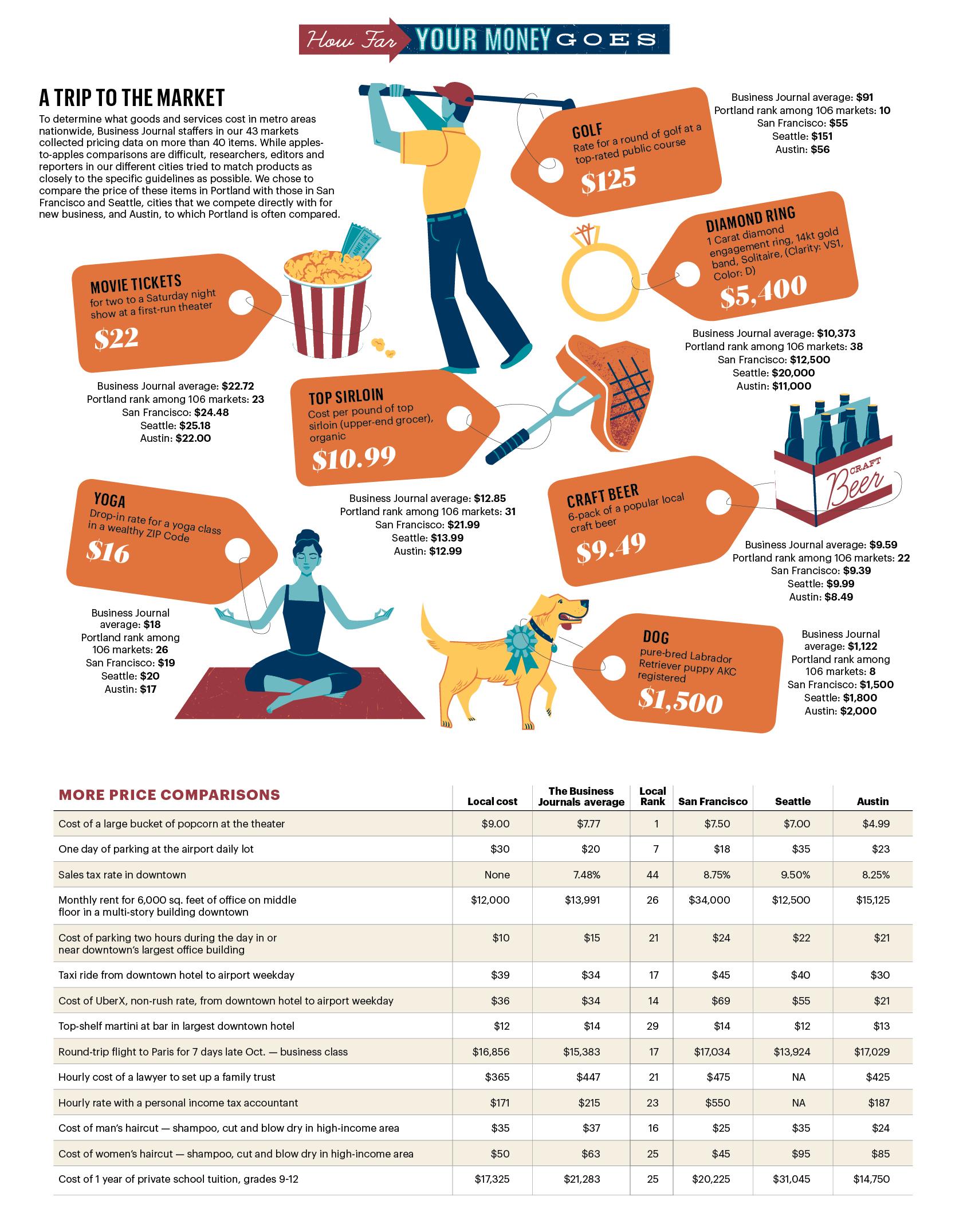
The Portland Business Journal did an interesting analysis over the past few months.  In conjunction with its sister papers across the country it measured the affordability of different metropolitan areas by collecting cost data for a variety of consumption categories (see FULL STORY HERE).  Everything from a large bucket of popcorn at the movie theater to housing was analyzed (see the cool info-graphic HERE).  So how did Portland fare?

Do you consider Portland to be affordable?  Feel free to leave your comments below.
Do you consider Portland to be affordable? Feel free to leave your comments below.

According to the results of the study Portland ranked no. 78 out of 106 markets but that number is misleading because many of the metropolitan areas that were compared are much smaller than Portland.  As you might expect Portland was measured to be much more affordable than other west coast cities such as Seattle, San Francisco, San Jose, and Los Angeles.

What might this mean for the housing market?  It’s tough to know for certain but theoretically the state should be able to continue to recruit tech companies out of those higher cost areas and bring more jobs to Portland.  More jobs is always a good thing for the local housing market.

Mortgage Rate Update October 19, 2015

Mortgage rates are unchanged from last week.

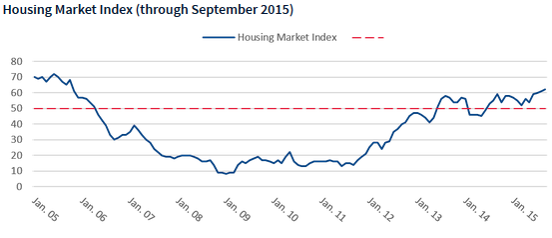
The economic calendar is full of housing related news this week.  Earlier today the National Association of Home Builders reported that their housing market index hit a 10-year high for October.

Source: National Association of Home Builders

Depending on who you ask this can be good news or bad news.  At least for the immediate term this is a positive sign.  That said, home builders tend to be the “last ones to the party” so this could be a signal that the run in housing will run out of steam.

Tomorrow we’ll see the latest numbers for building permits and housing starts.  Lastly, on Thursday we’ll see the Federal Housing Finance Agency Housing Price Index and existing home sales.

From a technical perspective mortgage rates look vulnerable to worsening (modestly) over the next couple days.  However, longer-term the rate environment looks promising.

Current Outlook: locking

Mortgage Rate Update October 15, 2015

Mortgage rates continue to trade sideways.

We know that the Fed is waiting for signs of inflation before they proceed with raising short-term interest rates.  So will inflation begin to rear it’s head anytime soon?

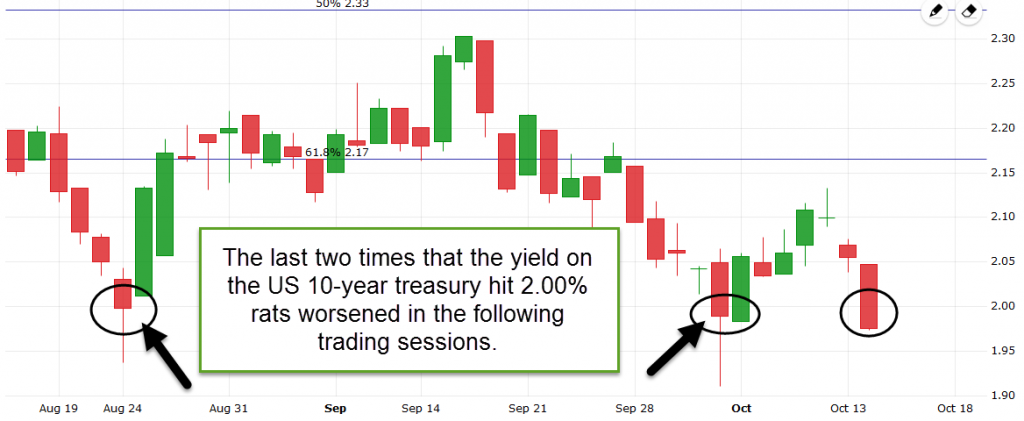
Yesterday, the Producer Price Index (PPI), which reports on price pressure in the wholesale/ manufacturing level of our economy, was tepid.  When you strip out volatile food & energy prices the core PPI increased by only .8% year-over-year.  Following the release of the report the yield on the US 10-year treasury note fell to 1.98%.

10-15-15 10yr

Today, the Consumer Price Index (CPI), which reports on price pressure at the retail level of the economy, was a little livelier but still below the Fed’s target of 2.00%.  The headline CPI figure fell by .2% from last month.  When you strip out volatile food and energy prices year-over-year prices increased by 1.9%.  On a side note, based on the results in this report social security recipients will not be receiving a cost of living adjustment for 2016 (this is only the third time in the past 40 years this has happened).

From a technical perspective rates now look vulnerable to a modest increase.  The last two times that the yield on the US 10-year touched 2.00% o below they moved higher in the following trading sessions.

Current Outlook: locking

Mortgage Rate Update October 13, 2015

Mortgage rates are unchanged to start the week.  The bond market was closed yesterday in recognition of Columbus Day.  Stocks did trade on Monday but were mostly flat.

Global influences continue to support a low interest rate environment here in the US.  A report out of China today showed that both imports and exports decreased in the world’s 2nd largest economy.  In Germany a survey of sentiment dropped substantially potentially signalling continued weakness in the Eurozone.  Bad news for the global economy tends to drive rates lower here at home.

Global weakness continues to support low rates in the US.

The economic calendar here in the US is fairly busy this week.  On Wednesday we’ll get the Producer Price Index and Retail Sales, on Thursday we’ll get the latest reading on the Consumer Price Index, and on Friday consumer sentiment and industrial production.  As we know inflation is a hot topic because it’s the missing ingredient for the Fed to begin raising short-term rates.

From a technical perspective interest rates look like they could improve modestly although we can’t lose sight of the fact that we’re presently at 2015 low levels.  I will switch to a floating bias.

Current Outlook: floating bias

Mortgage Rate Update October 8, 2015

Mortgage rates have been basically flat all week.

It’s been a fairly quiet week on Wall Street.  That may end today as the markets are eagerly awaiting minutes from the most recent Fed meeting.  We already know that the Fed elected not to raise short-term interest rates but their comments during the meeting may provide clues as to when they intend to.  Currently the markets assign a 64% chance that the Fed will raise short-term interest rates at the Dec. 15-16th meeting.

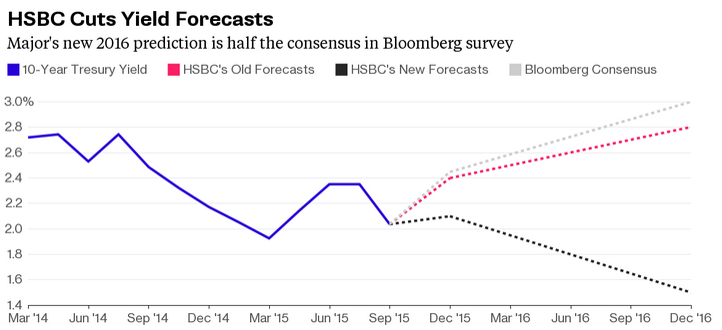
Meanwhile analysts at HSBC bank have cut their yield projections for 2016.  Previously they had forecast that the yield on the US 10-year treasury would increase to 2.8% by December 2016.  They adjusted their outlook lower to 1.5%.  The yield on the US 10-year treasury is currently 2.08%.  Mortgage rates tend to track changes in the yield of the US 10-year treasury note.

Source: Bloomberg.com

We may see some volatility following the release of the minutes from the last Fed meeting.  Recent releases have not been kind to interest rates so I will maintain a locking bias.

Current Outlook: locking bias

Mortgage Rate Update October 5, 2015

In last Thursday’s ‘rate update’ I recommended floating into Friday’s jobs report and that proved to be the right call.  Mortgage rates improved by ~.125% following a weaker than expected employment report.

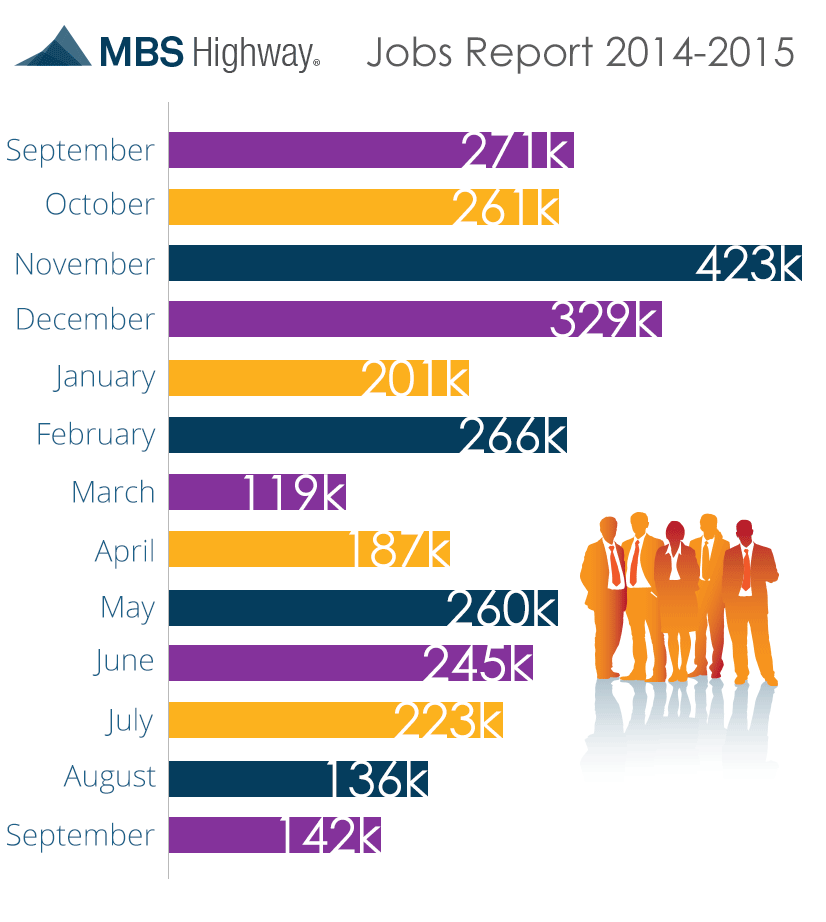
In case you missed it the Labor Department reported that only 142,000 new jobs were created in September.  Four of the past months have shown job growth below 200,000 and for the past two months below 150,000.  Bad news for the economy is often good news for mortgage rates.

jobs-report-10-2-15

The average hourly earnings declined modestly and was 2.2% higher than a year earlier.  As I wrote about last Thursday the Fed is looking for wages to grow as a signal to begin raising short-term interest rates.

Looking ahead this week the economic calendar is relatively light.  The biggest highlight comes on Thursday when minutes from the last Fed meeting are released.  It will be interesting to see what the Fed is thinking with regard to a timeline for hiking rates.  That said, their previous meeting was prior to Friday’s disappointing jobs report so it’s likely their viewpoint has shifted since.

From a technical perspective mortgage-backed bonds are trading up against technical resistance which means mortgage rates may be as good as they will be in the near-term.  Indeed rates are back at 2015 lows.  I will recommend locking.

Current Outlook: locking bias

Mortgage Rate Update October 1, 2015

Mortgage note rates are unchanged today but the accompanying closing costs are slightly less so in fact the overall rate environment has improved modestly this week.

Attention in the financial markets is squarely focused on tomorrow’s all-important jobs report.  If you’ll remember back to last month new job creation came in at 173,000 which was below expectations.  Normally the interest rate markets are mainly concerned with the number of new jobs created yet there is another factor in the report that could prove more influential this time around.

I expect that mortgage rates could react to the average hourly earnings section in the jobs report.  As I’ve repeatedly written over the past couple months the Fed is searching for any sign of inflation which could give them president to raise short-term rates.  Market expectations are for average hourly earnings to increase by +.2%.  A result north of .2% would likely pressure mortgage rates higher and vice versa.

10-01-10yr

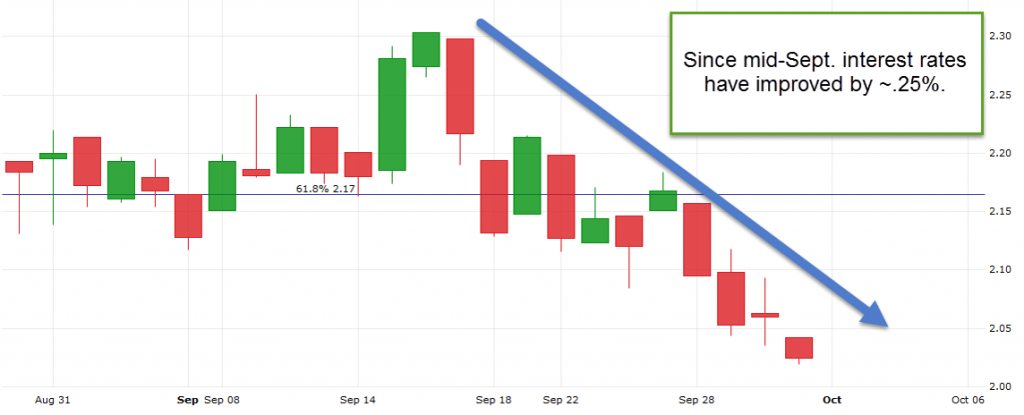
From a technical perspective interest rates have momentum on their side.  Since mid-September the yield on the US 10-year treasury note, which mortgage rates loosely follow, have fallen from ~2.30% to ~2.03%.  Over that time mortgage rates have improved by .125%-.25%.

The jobs report is always very difficult to handicap therefore I am going to recommend a floating bias based on the technical signals in the market.

Current Outlook: floating bias

Mortgage Rate Update September 28, 2015

Mortgage rates are essentially unchanged at 2015 lows.

US interest rates continue to benefit from investors who are concerned about the global economy.  China’s economy is weakening and conditions in Europe are struggling to improve.  As a result commodity prices are at multi-year lows and currencies for emerging markets have softened.  When global uncertainty is on the rise it creates demand for US-denominated “safe” assets and reduces yields.  In fact, according to Lipper, a fund tracking company, US based mutual funds focused on treasury securities are on track to draw the most inflow of capital this year since 2009.

Global Uncertainty is driving yields lower in the US.

The economic calendar is very busy this week.  Earlier today we got a reading on inflation and pending home sales.  The Core Personal Consumption Expenditure price index increased by only .1% last month and is up only 1.3% from last year.  The Fed’s target is 2% for this index and therefore price pressure remains well below the levels they’d like to see.

According to the National Association of Realtors pending home sales fell by 1.4% last month on a year over year basis.  Higher prices and tighter inventory continue to weigh on the number of transactions.

On Tuesday we’ll get the latest Case-Shiller home price index report and on Friday we get the all-important jobs report.  I will focus on that report in Thursday’s update.

From a technical perspective mortgage-backed bond prices are trading at recent highs.  I think borrowers have more to lose than to gain so will maintain a locking bias.

Current Outlook: locking bias

Mortgage Rate Update September 24, 2015

Mortgage rates are essentially unchanged at year-to-date lows.

Concern over global economic growth continues to suppress interest rates here in the US.  Yesterday, the US treasury sold 1-month bills with a 0% yield.  The auction was overbid with over $9 of offers coming in for every $1 of debt available for purchase.  The strong demand is a signal of a global flight to safety which helps keep interest rates in the US low.  The US treasury is scheduled to auction $29 billion in 7-year notes later today.

It’s a fairly busy day in terms of new economic releases.  Initial jobless claims came in at 267,000 which is a fairly strong number.  Durable good orders for the past month were reported down by 2% last month which was actually better than analysts were expecting.

09-24-DJIA

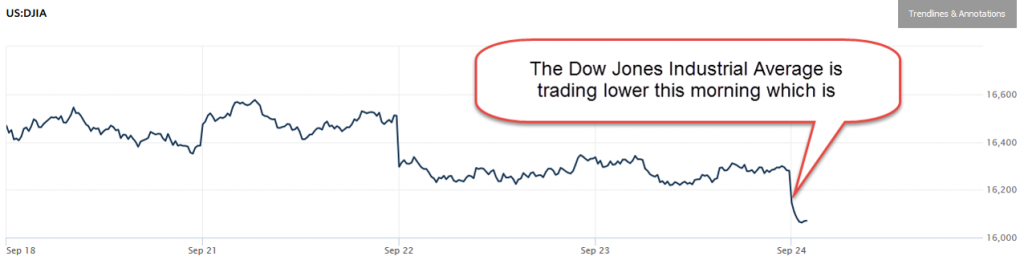
As I’ve reported repeatedly over the past few weeks it is global influences that are clouding the economic outlook.  The stock market is opening up sharply lower today following the direction of European markets.  Weakness in stocks is generally a positive sign for mortgage rates.

From a technical perspective interest rates continue to trade near their best levels of the year.  It certainly seems like borrowers have more to lose than to gain by not locking.

Current Outlook: locking bias