Mortgage Rate Update April 17, 2017

On this day in 1961 the Bay of Pigs invasion began.  As we know the attempt to overthrow Fidel Castro was a complete failure as it ultimately solidified the relationship between Russia and Cuba and enhanced Cold War tensions.

Speaking of tensions US interest rates have benefited from growing geopolitical uncertainty.  Global investors do not like being exposed to “risky” assets during potentially turbulent times and therefore we are experiencing a “flight-to-safety” which drives US interest rates down.

Also helping to drive rates lower has been a shift in expectations regarding the Trump Administration’s fiscal stimulus plans.  No details have been released but the markets think a much more watered down version will have to be presented in order to win congressional approval.  A more aggressive stimulus plan would add inflationary pressure to the economy and hurt interest rates and vice versa.

A less aggressive stimulus plan could also hurt US stocks.  As measured by the Shiller Price-to-Earnings ratio, which is the ratio of the S&P 500’s price divided by its average inflation-adjusted earnings from the previous 10 years, the stock market appears ripe for reversal.  If US stocks do move lower it should help interest rates remain at current levels or maybe even better.

The economic calendar for the week is heavy with fresh housing data.  This morning the home builder index, which measures optimism for US home builders, came in slightly below expectations.  Tomorrow we get housing starts and building permits.  Finally, on Friday the National Association of Realtors will release the latest existing home sales figures.

Momentum is still on our side so I will float.

Current Outlook: floating

Mortgage Rate Update April 10, 2017

In case you weren’t aware today is National Siblings Day.  Now is a great time to call your sibling and let them know how “okay” they are (just kidding Ceri!  You are awesome).

Friday’s all-important jobs report showed that only 98,000 new jobs were created last month.  This was well below expectations and the lowest output since May of 2016.  Bad news for the economy tends to be good news for mortgage rates.

Also helping mortgage rates is the uncertainty regarding Syria and the US military action which took place last week.  Geopolitical tension tends to drive global investors into “safe havens” which benefits interest rates here in the US.

This week’s economic calendar is fairly light.  The highlights come Thursday and Friday when the Producer Price Index & Consumer Price Index are released.  Fed Chairwoman Janet Yellen is scheduled to speak later today and take questions via Twitter.  Might she hint when the Fed will begin to unwind their balance sheet (which would likely put upward pressure on rates)?

From a technical perspective mortgage rates are presently at the low end of their trading range dating back to December.  In other words, rates are currently as good as they have been for the past four months.  Could they get better?  Sure but the last four times they got hear they reversed and moved higher so I am going to maintain a locking bias.

Current Outlook: locking bias

Mortgage Rate Update April 3, 2017

Are looking forward to tonight’s NCAA men’s basketball championship game between Gonzaga and North Carolina?  Did you know the greatest upset of  all-time came on this day in 1978 when the Movie ‘Annie Hall’ beat out ‘Star Wars’ for best picture?  Absurd.

We start the week with mortgage rates at the best levels since late February.  This is partially because of the unfortunate subway blast which took place in St. Petersburg, Russia earlier today.  Geopolitical uncertainty tends to drive investors into safe-havens which helps US interest rates.

This mornings subway blast in Russia is causing investors to seek safety which is driving US home loan rates lower.

The financial markets are seeing some follow through on President Trump’s failed attempt to repeal the Affordable Care Act.  The Trump administration had planned to spend some of the Federal Government’s savings on a fiscal stimulus package which will have to be scaled back now.  Rates had been pressured higher on the expectation of a large fiscal stimulus package and are moving back down now.

The economic calendar heats up on Wednesday this week with the release of the minutes from the Fed’s latest monetary policy meeting.  Analysts are eager to learn more about the committee’s plan to unwind the Fed’s balance sheet which grew during the housing downturn via quantitative easing.  The Fed is a major holder of mortgage-backed securities which ultimately determine mortgage rates.  Should they aggressively sell off these assets it would put upward pressure on mortgage rates.

Finally, the all-important monthly jobs report is due out this Friday.  The market is currently expecting ~175,000 new jobs.  A number north of that would hurt mortgage rates and vice versa.

From a technical perspective momentum is on our side but given that we’re at multi-week lows I like a locking bias.

Current Outlook: locking bias

Mortgage Rate Update March 13, 2017

Mortgage rates had a rough time last week.  They now stand at their worst levels in over two years.

Friday’s all-important jobs report was better than expected.  It showed that 235,000 jobs were created during the month of February and that wages increased by 2.8% year-over-year.  With these results the Fed is almost certain to hike short-term rates by .25% again on Wednesday.

Should we be concerned that mortgage rates will also increase?  After all the Fed does not directly set mortgage rates.  Mortgage rates drifted higher last week in anticipation of a Fed rate hike so in some respects the damage is done.  Furthermore, when the Fed hiked in December mortgage rates declined shortly thereafter.  Maybe we will experience the same reaction this go around.

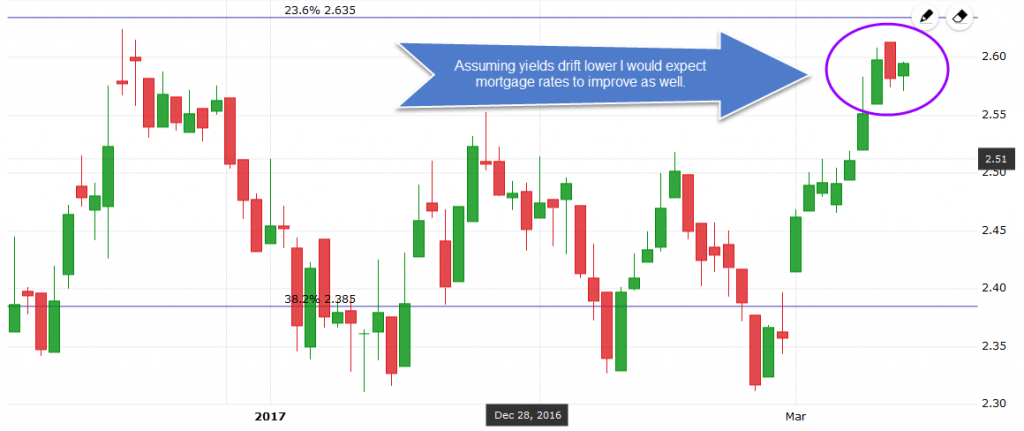
From a technical perspective interest rates appear ripe for reversal after trending higher last week.  The yield on the US 10-year treasury note touched ~2.63% on Friday and is starting the week moderately lower.

However, we have to be careful because if yields move above the 2.63% threshold mortgage rates will continue higher as well.

This week’s economic calendar is busy.  The highlights include the Producer Price Index (Tuesday), Consumer Price Index (Wednesday), Retail Sales (Wednesday), Housing Starts (Thursday), and of course national Guinness Consumption Day (Friday).

Current Outlook: floating

Mortgage Rate Update February 21, 2017

The bond market was closed yesterday in recognition of Presidents Day.  Speaking of the nation’s top office, I read over the weekend that during the President’s daily briefing he was told that three Brazilian soldiers were killed overnight.  In reaction the president was stunned and showed an uncommon display of grief and emotion.  After collecting himself the president asked, “how many is a brazillion?”  (may or may not be true).

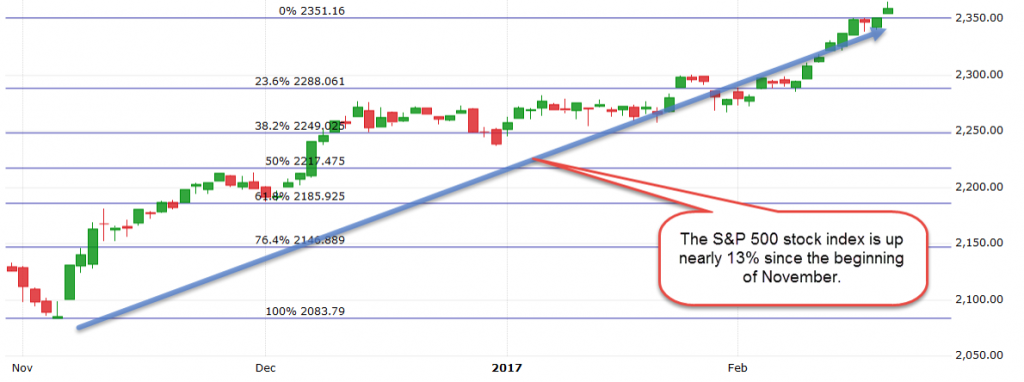
The ‘Trump Bump’ continues to roll on which is not favorable for mortgage rates (CLICK HERE to learn why).  Since early November the S&P 500 has gained nearly 13%.  During that time mortgage rates have increased by ~.50%.

Why have stocks been rallying?  First, investors anticipate legislation which will cut taxes and boost federal spending.  Second, higher anticipated inflation levels make holding bonds less attractive therefore some investors have cut fixed income holdings in favor of stocks.  Neither of these outcomes are certain.

Has the stock market become overheated?  According to data from FactSet the 12-month forward price-to-earnings ratio for the S&P 500 is at its highest level since 2004.  Furthermore, there is growing concern that France’s upcoming presidential election could rattle the global financial markets.  We’ll be keeping an eye on polls there.

The technical picture in the interest rate markets are a little muddled to start the week.  I am going to maintain a floating bias but have grown cautious.

Current Outlook: cautiously floating

Mortgage Rate Update February 16, 2017

Given that today is National “Do a Grouch a Favor Day” (seriously see HERE) I find it appropriate that mortgage rates are improving modestly this morning.  Mortgage rates are essentially unchanged from Monday which is a win given that pricing worsened Monday-Wednesday.

In case you missed it Fed Chairwoman Janet Yellen told congressional lawmakers that the Fed would likely hike short-term interest rates again at one of their upcoming meetings (prepare yourself for annoying mortgage radio commercials in the next few weeks which falsely claim that this will certainly lead to higher mortgage rates).

According to CME Group there is currently a 22% chance the Fed hikes at their March meeting and a 74% chance they hike by their June meeting.  The Fed does not directly control mortgage rates but their comments can influence them.

Why does the Fed hike rates?  The Fed has a dual mandate to “foster economic conditions that achieve both stable prices and maximum sustainable employment.”  Inflation data released yesterday showed that retail prices in the US jumped at the highest annual pace in nearly five years.  Fed rate hikes curb inflationary pressure.

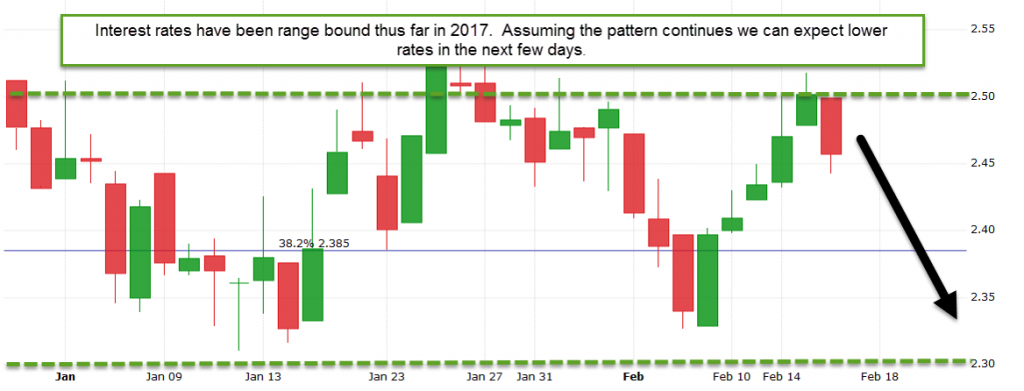
Mortgage rates have been range bound so far in 2017.  The chart below shows that the yield on the US 10-year treasury note, which mortgage rates tend to track, has ranged from 2.30% to 2.50%.

During this time conventional 30-year rate home loans have been offered at 4.125%-4.375%.  Assuming mortgage rates remain range bound the technical outlook looks good headed into next week.  I recommend floating to see if this pattern continues.

Current Outlook: floating

Mortgage Rate Update February 13, 2017

Mortgage rates worsened during the latter half of last week.

Mortgage rates will be looking for love tomorrow from Fed Chairwoman Janet Yellen.  She is scheduled to provide testimony to congressional lawmakers tomorrow and Wednesday.  Much like the origins of St. Valentine’s Day are not well understood neither is the relationship between the Fed and mortgage rates.

Mortgage rates are looking for some love from the Fed this week.

I am particularly interested to hear if Yellen will comment on when they might discontinue the practice of reinvesting principal repayments back into the mortgage-backed bond (MBS) market.

You might remember the term “quantitative easing” (“QE”) which was thrown around exhaustively from 2009-2012.  During this time the Federal Reserve essentially printed money and purchased, amongst other things, mortgage-backed bonds with the intent of driving interest rates lower.  Although the Fed is no longer actively engaging in “QE” they are using the principal repayments from refinances and home sales to repurchase/ replace MBS holdings which in effect helps to keep rates down.  If and when they discontinue this practice we could expect mortgage rates to worsen.

Looking at the rest of the economic calendar for the week we’ll get some fresh inflation data Tuesday and Wednesday, retail sales on Wednesday, and new housing starts on Thursday.

Unfortunately momentum is working against us so I will maintain a locking bias.

Current Outlook: locking

Mortgage Rate Update February 9, 2017

Mortgage rates continued to improve modestly this week and are currently at multi-week lows.  That said pricing is modestly worse this morning so momentum may be shifting.

With heavy snow covering much of the northeastern seaboard we have to be prepared for some volatility in the financial markets.  Its likely that fewer traders are able to make it into their offices and therefore we can assume there are fewer buyers and sellers which can lead to wider swings.

As I stated on Monday the economic calendar has been light this week.  In the absence of significant data mortgage rates tend to react to technical trading patterns and the stock market.

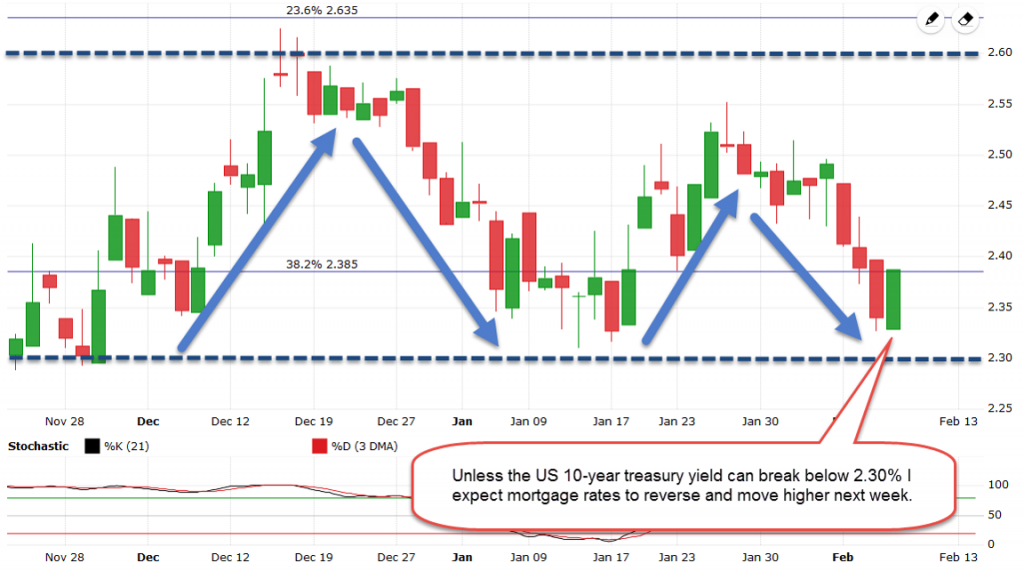
The technical outlook is not favorable.  The yield on the US 10-year treasury, which mortgage rates tend to track, has traded between 2.30%-2.60% since the end of November.  It got down to 2.34% yesterday and has bounced to 2.38% this morning.  Unless the yield can dip below 2.30% it looks as if rates may reverse trend higher.

Stocks are also rallying this morning on news that the Trump administration intends on accelerating tax cuts.  When stocks rally it tends to hurt mortgage rates.

I will maintain a locking recommendation.

Current Outlook: locking

Mortgage Rate Update February 6, 2017

Mortgage rates are unchanged from last week but accompanying closing costs are modestly lower.

In case you missed it Friday’s all-important jobs report showed stronger than expected hiring (+227,000 jobs) which would normally be a bad signal for mortgage rates.  However, average hourly earnings increased by less than expected which tempered inflationary fears.  Therefore, mortgage rates had a muted response.

This week’s economic calendar is relatively light.  The highlights will come on Friday with import/ export prices and consumer sentiment.

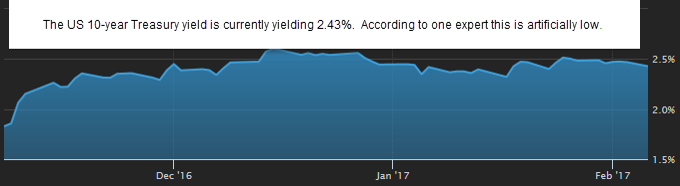
The US 10-year treasury note, which mortgage rates tend to follow,  is currently yielding ~2.43%.  According to a prominent bond money manager this is artificially low and the markets should expect higher yields in the future.  Since the Bank of Japan and European Central Bank are still enacting quantitative easing measures it is placing artificial barriers that are preventing higher rates.  Once those programs stall rates will rise.  When will that happen?  That is up for debate.

Source: Wall Street Journal

Last week President Trump signed an executive order which requires that the Treasury Department take a detailed look at the Dodd-Frank financial regulation law and make recommendations for revisions.  It is generally assumed that the president will push to roll back regulations that affect the mortgage industry.  It is not clear which rules he is targeting and the Senate will have to approve the changes with a 60 vote super majority (Republicans only hold 52 seats).  This is a topic I will be keeping an eye on.

Current Outlook: locking bias

Mortgage Rate Update January 26, 2017

Mortgage rates are not having a great week.

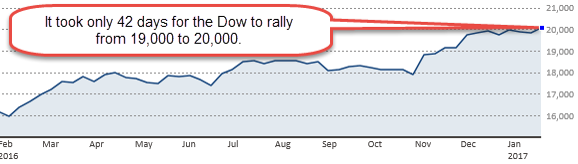
As I’m sure you’ve heard the Dow Jones Industrial Average topped 20,000 yesterday and managed to close above this psychological level.  The Dow is extending those gains today.  When stocks rally it attracts new capital which is often sourced from the bond market.  Weakness in the bond market is what pressures interest rates higher.

Source: CNBC.com

It took only 42 days from the Dow to reach 20,000 from 19,000.  This was the second fastest 1,000 rally in Dow history.

Unfortunately the technical trading patterns have eroded and the outlook for mortgage rates is not extremely optimistic.  Rates have risen this week and they may get worse in the near future.

Current Outlook: locking