Mortgage Rate Update April 20, 2015

Mortgage rates continue on a sideways path with no meaningful movement up or down.  Might we see some volatility this week?  The economic calendar is very light.  The only meaningful data scheduled for release this week is existing home sales (Wednesday), new home sale (Thursday), and durable goods (Friday).

In the absence of significant readings on the economy mortgage rates are likely to react to technical trading patterns and the stock market.

From a technical perspective mortgage-backed bonds (MBS’s) have traded within a fairly narrow range since April 1st.  Anytime we see prolonged periods of time where MBS’s trade within a tight trading range it increases the risk for “breakout” where interest rates react quickly for better or worse.

A look at the yield on the US 10-year treasury note may offer clues.  In the past 5 weeks the yield on the US 10-year treasury note has made three attempts at moving below 1.85%.  Thus far none of these have proved successful.  It looks like they are gearing up for another attempt.  Should yields break below this level we would expect them to touch 1.78% which may squeeze an additional .125% improvement for mortgage rates.

4-20-15 10yr


For now, we’ll float to see if rates can move a bit lower.  Should he yield on the US 10-year treasury note reverse higher I will shift to a locking position.

Current Outlook: floating
Mortgage Rate Update April 16, 2015

It’s a lot more of the same this morning as mortgage rates have effectively been unchanged for over two weeks now.

US interest rates look as if they want to move higher following comments from Federal Reserve Vice Chairman Stanley Fischer.  Earlier he stated that he sees signs of wage pressure building in the economy.  The Fed is not going to raise short-term interest rates until they see inflation move higher to ~2%.  If wages due rise in our economy it would likely pressure inflation higher which is a bad sign for mortgage rates.

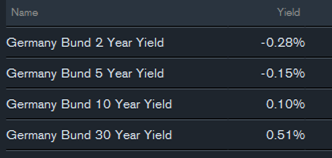
10 german

Meanwhile, interest rates in Germany remain ultra-low.  Currently yields on German government 2-year and 5-year notes are negative.  This means investors are actually paying money in order to lend the German government money.  The 10-year German bund is yielding only .10% (US 10-year note is at ~1.9%).  As long as rates remain low in Germany it should keep somewhat of a ceiling on US interest rates.

From a technical perspective mortgage-backed bond prices are trading within a fairly tight range and have been for nearly three weeks.  Anytime we see prolonged periods of sideways movement it increases the risk of a “breakout” where bond prices move sharply up or down.  These are very difficult to predict.

At this point I believe borrowers have more to lose than to gain so I will take a locking bias.

Current Outlook: locking bias

Mortgage Rate Update April 13, 2015

Mortgage rates have effectively been unchanged for two weeks now.

What may throw interest rates off the sideways path?  The economic calendar is busy this week.  Tomorrow we’ll get the latest reading on Retail Sales which has been surprisingly week the past two releases given that gasoline prices are so low.

The highlights this week will be delivered Tuesday and Friday when we get the Producer Price Index (PPI) and the Consumer Price Index (CPI).  If you’ll remember back to the Fed’s last monetary policy statement one of the factors they made clear was they would not raise interest rates until inflation moved back towards the 2.00% level.

Inflation has always been one of the primary drivers of interest rates (CLICK HERE to learn why).  Inflation has been at historically low levels for a few years.  Until inflation shows signs of ticking higher mortgage rates should remain relatively low.  If we see an uptick in annualized inflation this week it would hurt rates.

Is inflation headed higher towards the Fed's 2% target?  We'll learn more this week.
Is inflation headed higher towards the Fed’s 2% target? We’ll learn more this week.

Also on the calendar this week is the home builders’ housing market index (Wednesday), housing starts (Thursday), building permits (Thursday), and consumer sentiment (Friday).

After two weeks of relative calm the markets may get choppy this week.

Current Outlook: neutral

Mortgage Rate Update April 9, 2015

Mortgage rates are unchanged for the week.

Minutes from the last Federal Reserve monetary policy meeting were released yesterday and the markets had little response.  If you’ll remember this past meeting was much anticipated because investors were waiting to hear if they’d drop “patient” from the post-meeting statement.  The minutes showed that there was consensus around this detail but there is still disagreement about how soon to begin raising short-term rates.

On a completely unrelated note, don't forget to enjoy the Masters this weekend!
On a completely unrelated note, don’t forget to enjoy the Masters this weekend!

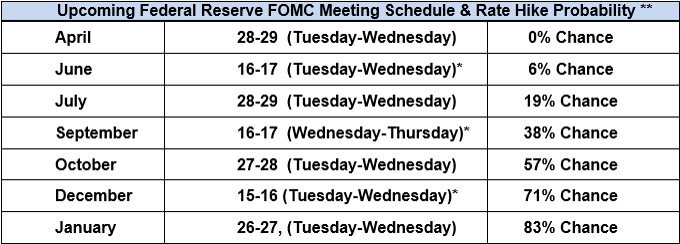
The markets now believe there is a 6% chance the Fed will begin raising short-term rates in June, a 16% chance in July, a 35% chance in September, and 53% chance in October.  As we know the Fed does not directly control mortgage rates.

Mortgage rates have been more or less unchanged for the past 7 trading days.  From a technical perspective there is no clear indication on which direction the markets are headed.

This afternoon’s US Treasury auction of 30-year bonds could set the tone headed into next week (Click HERE to learn how government bond auctions can impact mortgage rates).  Yesterday’s 10-year note auction was met with solid demand from investors.  IF that pattern continues today it would bode well for mortgage rates.  If not, watch out.

Current Outlook: neutral

Mortgage Rate Update April 6, 2015

Mortgage rates are more or less unchanged from last week.

In case you missed it Friday’s all-important jobs report was much weaker than expected.  The US economy added only 126,000 new jobs whereas analysts had been expecting ~245,000.  On the release mortgage rates improved.

However, mortgage rates are having a tough Monday as US stocks rally.  The Dow Jones Industrial Average is currently up approximately 150 points.  When stocks rally mortgage rates often suffer.

US stocks are rallying this morning which is pressuring mortgage rates higher.

The economic calendar is very light this week.  The highlight comes on Wednesday when the Fed will release minutes from the last monetary policy meeting.  This event always has the potential to move the markets yet their last statement was pretty clear so it’s hard to imagine they’ll be any surprises.

From a technical perspective mortgage rates appear vulnerable.  I will recommend a locking bias.

Current Outlook: locking bias

Mortgage Rate Update April 2, 2015

Mortgage rates priced better today than they were at the start of the week.

All eyes are focused on tomorrow’s all-important jobs report.  As you may recall last month the US economy added 295,000 new jobs which was higher than market expectations.  Mortgage rates initially rose on the headline number but then reversed course a couple days later.  To complicate things tomorrow is also Good Friday so the stock market is closed and the bond market will close at noon eastern time.

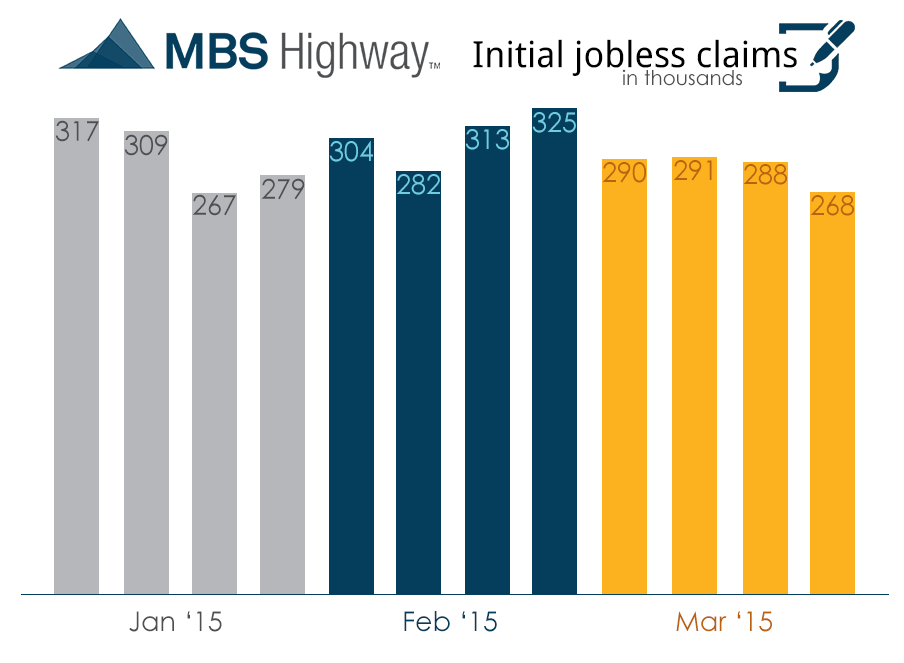
Currently, the markets are expecting ~235,000 new jobs and the US unemployment rate to remain at 5.5%.  Earlier today the Labor Department released figured for weekly jobless claims.  The report showed that only 268,000 new filings came in last week which is the lowest number in 15 years.

claims-4-2-15

This morning’s jobless figures will not influence tomorrow’s jobs report but given the recent strength in labor market I believe borrowers are wise to lock in their rates.

Current Outlook: locking bias

Mortgage Rate Update March 30, 2015

Mortgage rates are more or less unchanged from Thursday’s levels.

Earlier today the Commerce Department released its latest reading on the Personal Consumption Expenditure price index.  Also known as “PCE” it is the Fed’s favorite gauge of inflation because unlike the Consumer Price Index it allows for substitutions in the consumption basket (for example, if the price of beef rises consumers are more likely to purchase chicken).

The report showed that after stripping out volatile food and energy prices annual inflation stands at 1.4% which is well below the Fed’s target of 2.0%.  US stocks love this news because it makes it more likely that the Fed will keep short-term rates for a longer period of time.  Speaking of which, here is the latest forecast on when the Fed may begin to raise short-term rates:

FedFedFed

In housing news the National Association of Realtors reported higher than expected pending home sales for February.  One reason for stronger than expected results?  Rents continue to increase across the country and people are finding it more affordable to purchase a home.

The economic calendar is busy this week.  We get the monthly trio of jobs report starting on Wednesday and concluding on Friday.  Friday is also Good Friday with the markets only open for a couple hours so I would not be surprised to see some volatility.

Current Outlook: locking bias

Mortgage Rate Update March 26, 2015

Mortgage rates are slightly worse than they were on Monday.

As I warned in Monday’s ‘rate update’ the US Treasury’s fresh supply of $90 billion in new debt has put upward pressure on rates this week (CLICK HERE to understand why).  Yesterday’s $35 billion auction of 5-year notes was met with soft demand and as a result yields moved higher.

The economic data of late has been a mixed bag.  Yesterday’s durable goods orders disappointed investors while this morning’s jobless claims figures was slightly better than expected.  The choppy results fuels volatility which is already present due to uncertainty surrounding when the Fed will begin to raise short-term interest rates.

Geopolitical tension has arisen in Yemen where Saudi Arabia has launched airstrikes against militant groups.  The conflict has caused oil prices to spike higher.  Should the situation escalate there we could see mortgage rates benefit via a “flight-to-safety” in the financial markets.

At this point the safer play is to lock in.

Current Outlook: locking

Mortgage Rate Update March 23, 2015

Mortgage rates are mostly unchanged from late last week.

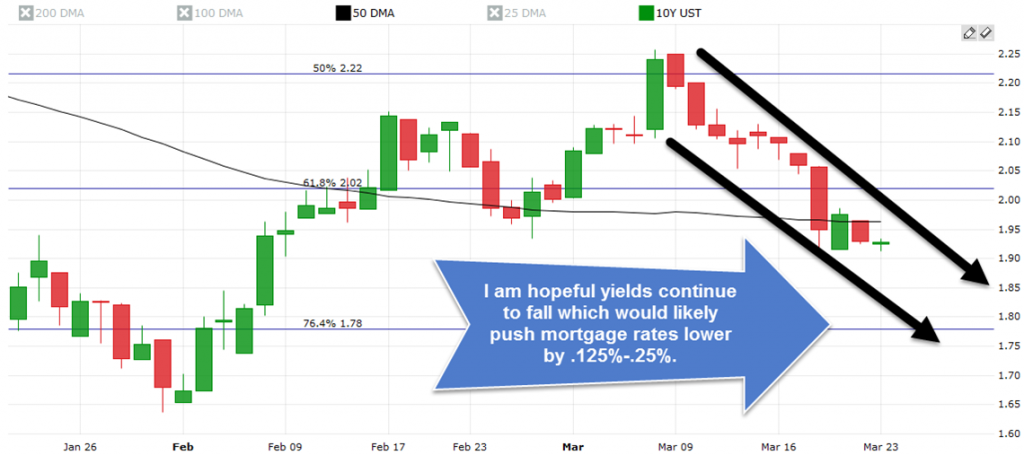
I am encouraged by the technical outlook for interest rates.  A look at the chart showing the yield on the US 10-year treasury note, which mortgage rates correlate with, reveals that downward momentum is in play and there is plenty of room for rates to move lower.

03-2310yr yield

So long as the yield on the US 10-year treasury note can close at 1.91% or lower today I believe mortgage rates have a great chance of improving by another .125%-.25%.

The National Association of Realtors released a report showing existing home sales for the month of February.  Nationwide the number of closed transactions increased by 1.2% from a year ago.  In the West existing home sales rose by 5.7% and the median home price increased by 4.2%.

The US Government will auction $90 billion in fresh debt this week.  The additional supply may make it difficult for mortgage rates to improve (CLICK HERE to understand why).

The economic calendar for the week is not long but it is meaty.  On Tuesday we’ll get the latest reading for the Consumer Price Index & new home sales.  On Friday we’ll get a revised estimate on 4th quarter GDP.

I would recommend floating to see if rates improve as a result of the aforementioned technical outlook.

Current Outlook: floating

Mortgage Rate Update March 19, 2015

Mortgage rates improved yesterday following the Fed’s monetary policy statement.

As was expected the Fed did remove the word “patient” from their statement which gives them the flexibility to begin raising short-term interest rates as soon as June.  It’s important to remember that the Fed does not directly control mortgage rates.

One would think that if the Fed moves closer to a rate hike that mortgage rates would suffer.  However, in addition to dropping “patient” from their statement the Fed also became more cautious about the economic outlook.

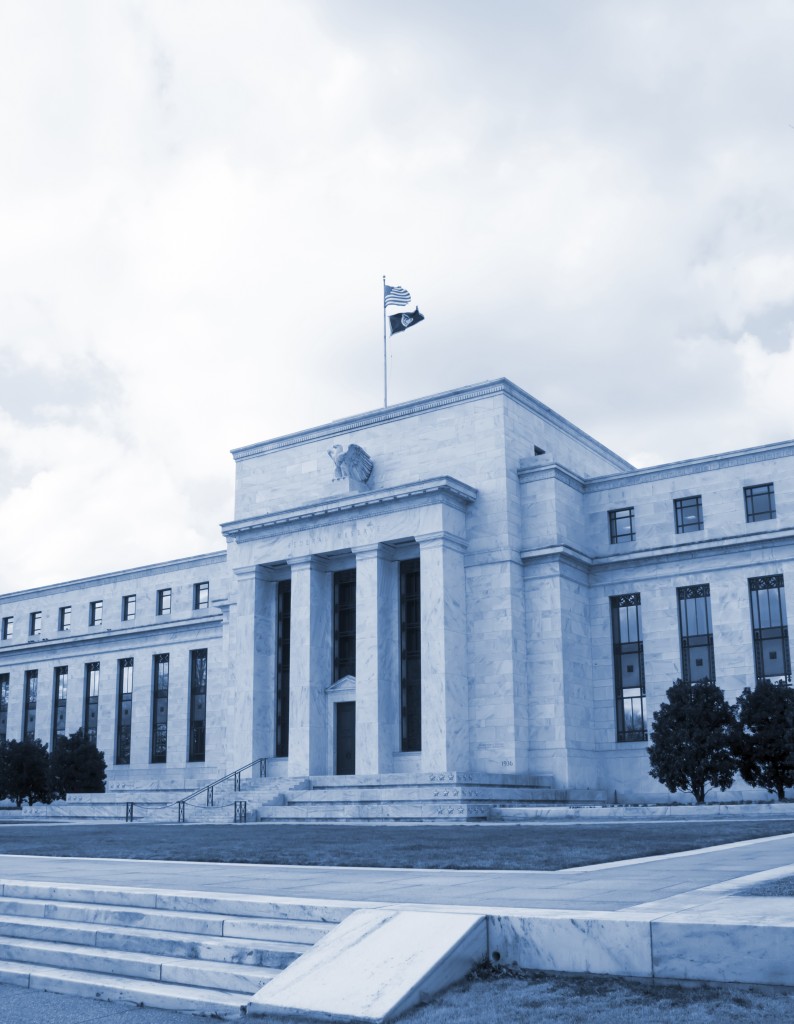
Federal Reserve Building in Washington DC, United States
Mortgage rates reacted favorably to the latest Fed statement, let’s see if they hold.


Fed Chairwoman Janet Yellen effectively stated that they were prepared to raise rates but would not do so until they had more confidence in the labor market and began to see inflation move higher towards 2.00% (currently at ~1.3%).  Despite the US unemployment rate being at 5.50%, which is the Fed’s target for “full employment”, wage growth remains low for most workers and the labor force participation rate is historically low.  When the Fed expresses caution about the economy mortgage rates tend to benefit.

From a technical perspective mortgage-backed bonds (MBS) are trying to hold the line at the 50-day moving average.  Should MBS prices fall below this level it would be a bad signal for mortgage rates.  Given that fixed rate are better than they were 24 hours ago I am leaning towards locking.

Current Outlook: locking